Printable Spiritual Practice Journal
Nurture your inner life with daily practice and reflection
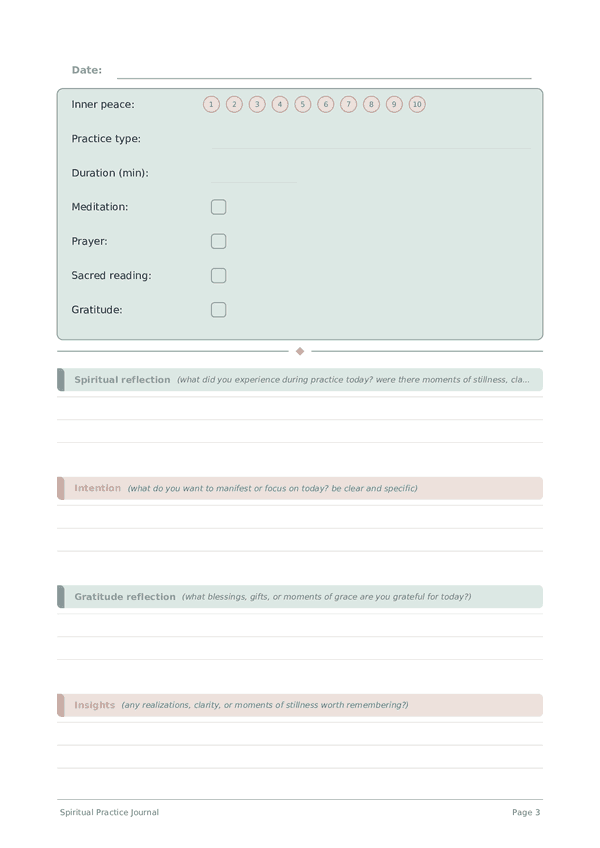
A comprehensive daily journal for tracking and deepening your spiritual practice. The top section lets you rate your inner peace, log practice type and duration, and check off key disciplines — meditation, prayer, sacred reading, and gratitude. The bottom section provides guided prompts for spiritual reflection, setting intentions, expressing gratitude, capturing insights, and recording spiritual lessons. Whether you follow a specific tradition or walk your own path, this journal helps you build consistency and awareness in your spiritual life.
Customize fields
Toggle fields on or off. Click the pencil to rename, or add your own fields.
Benefits
How to Use
What is this journal?
A spiritual practice journal is a daily companion for tracking and deepening your spiritual journey, regardless of tradition. By logging practices like meditation, prayer, and sacred reading alongside reflective writing about insights and lessons, you create a consistent rhythm of spiritual engagement.
This journal welcomes practitioners of any spiritual path — meditation, prayer, yoga, mindfulness, contemplative traditions, or eclectic personal practice. It is designed for those who believe that spirituality, like any skill, deepens through consistent practice and honest self-reflection.
Across spiritual traditions, the practice of daily reflection and recording has been recognized as transformative — from the Christian Examen to the Buddhist practice of mindful review. Modern contemplative science confirms that tracking inner states alongside spiritual practice increases both consistency of practice and depth of spiritual experience over time.
Filled example
Here's what a typical entry looks like when filled in:
How to fill in each field
The top of each page has quick-fill fields (ratings, checkboxes, numbers). Below that is a lined section for writing. Here's what each field means:
Inner peace
How calm and centered do you feel inside today? Rate from 1 to 10
Practice type
Meditation, prayer, yoga, breathwork, scripture reading, silence...
Duration (min)
Record how long you exercised or practiced in minutes. Tracking duration helps you see your commitment grow and find your optimal session length.
Meditation
How long did you sit? What technique? How did it feel to settle in?
Prayer
Speak openly — gratitude, requests, confession, praise
Sacred reading
What passage or text did you read? One word or line that stayed with you
Gratitude
What are you grateful for today? Name one specific person, moment, or thing
Spiritual reflection
What is God teaching you today? How did you sense His presence?
Intention
What do you want to manifest or focus on today? Be clear and specific
Gratitude reflection
What blessings, gifts, or moments of grace are you grateful for today?
Insights
Any realizations, clarity, or moments of stillness worth remembering?
Spiritual lesson
What truth, teaching, or insight resonated with you today?
Tips for success
When and how often to write
Write immediately after each practice session while the experience is fresh — even three sentences about what you noticed internally. If you practice daily, journal daily. If your practice is 3–4 times per week, match that rhythm. Monthly, do a longer contemplative review of your entries, looking for patterns in your inner landscape. Seasonal reviews (equinoxes, solstices, or meaningful dates in your tradition) provide powerful checkpoints for long-term spiritual development.
Frequently Asked Questions
What is this Spiritual Practice Journal designed for?
It's a daily hybrid template that combines a tracker (inner peace rating, practice type, duration up to 180 minutes, and checkboxes for meditation, prayer, sacred reading, gratitude) with eight lines of reflection covering intention, gratitude, insights, and spiritual lessons. The structure supports any tradition or personal path and draws on research showing that consistent contemplative practice strengthens self-regulation (Goleman and Davidson, 2017, Altered Traits, Avery).
How do I rate the inner peace field meaningfully?
Use the 1-10 rating as a subjective check-in, not a performance score. Lazar and colleagues (2005, NeuroReport, 16(17)) showed that even brief meditation correlates with measurable cortical changes, but daily fluctuation is normal. Note context such as sleep, stress, and conflicts so weekly review reveals patterns. Two consecutive low ratings can signal a need for rest rather than more practice.
Is short practice really worth logging in the duration field?
Yes. The MBSR program developed by Jon Kabat-Zinn (1990, Full Catastrophe Living, Bantam) emphasizes consistency over length, and Hölzel and colleagues (2011, Psychiatry Research: Neuroimaging, 191(1)) found measurable brain changes after eight weeks of relatively short daily sessions. Even five minutes counts. The duration field accepts up to 180 minutes so beginners and experienced practitioners can both log accurately.
How is this different from a generic gratitude or mood app?
Apps usually track a single dimension. This journal links four disciplines (meditation, prayer, sacred reading, gratitude) to a peace rating and free reflection on the same page, so you can see which practice yields the most calm over weeks. Paper journaling also reduces screen exposure before bed, which matters for practitioners using evening sessions.
Does daily spiritual practice actually produce measurable benefits?
Peer-reviewed evidence supports stress reduction, attention, and emotional regulation from sustained contemplative practice (Hölzel et al., 2011, Psychiatry Research: Neuroimaging, 191(1); Goleman and Davidson, 2017, Altered Traits, Avery). Harold Koenig at Duke University has also documented associations between religious practice and well-being. Effects build over months, not days, which is why the journal is structured for weekly review.
Is this suitable if I do not follow any specific religion?
Yes. The four checkboxes are optional: a secular practitioner might mark only meditation and gratitude, while a Christian user may mark prayer and sacred reading. The reflection prompts (intention, insights, spiritual lesson) are tradition-neutral. William James (1902, The Varieties of Religious Experience) showed that personal spiritual experience takes many forms, and the template respects that range.
What is the most common mistake people make with this template?
Treating the checkboxes as a goal rather than a record. Marking all four boxes daily without genuine engagement produces shallow data. Kabat-Zinn (1990, Full Catastrophe Living, Bantam) calls this autopilot mode. Better: check only what you actually did with attention, even if it is one item, and use the reflection lines to note quality, not quantity.
How often should I review my entries to see patterns?
Weekly is the practical minimum for spotting which practices correlate with higher peace ratings. The eight reflection lines gather enough material across seven days for meaningful comparison. Monthly review surfaces longer cycles. This template is a supportive contemplative practice and is not a substitute for psychotherapy or clinical care for anxiety or depression; consult a clinician for those concerns.
You Might Also Like
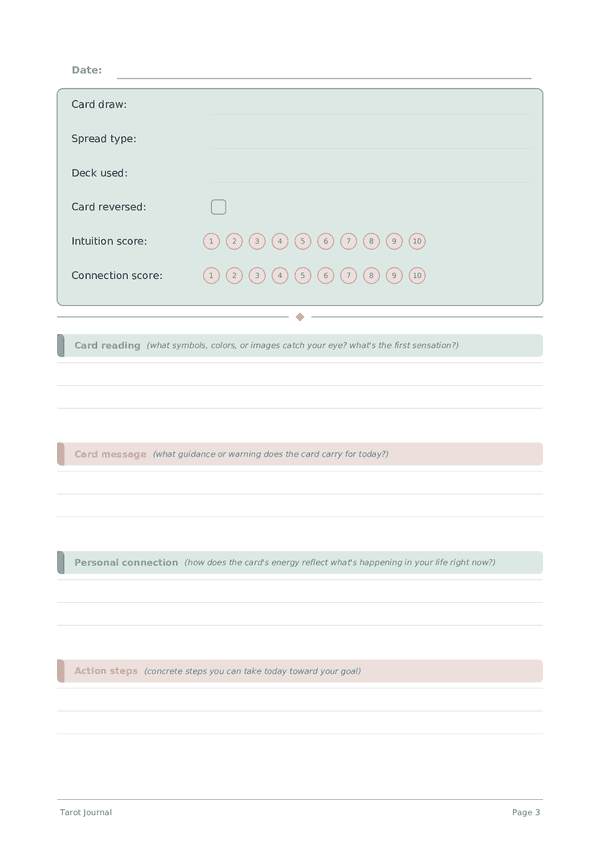
Tarot Journal
Track daily card draws, spreads, and intuitive insights
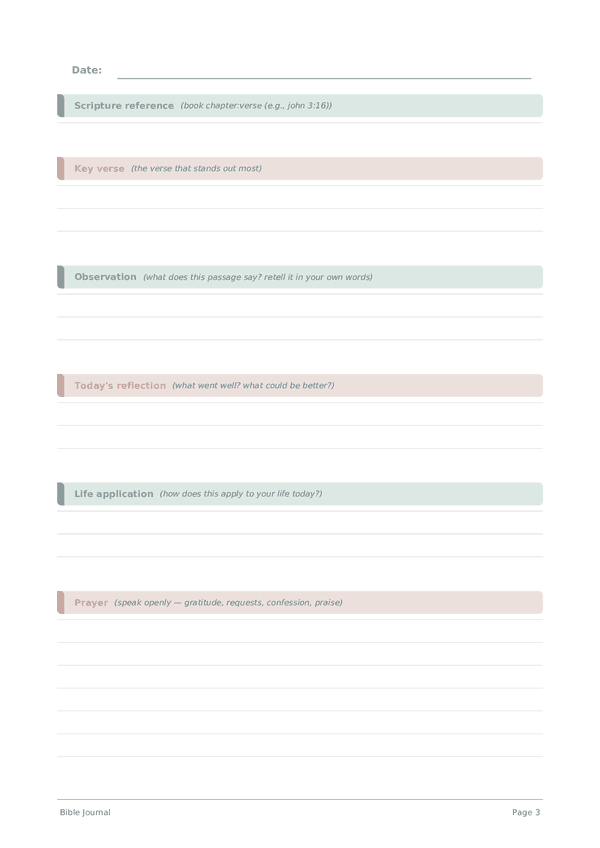
Bible Journal
Scripture, Observation, Application, Prayer — the SOAP method
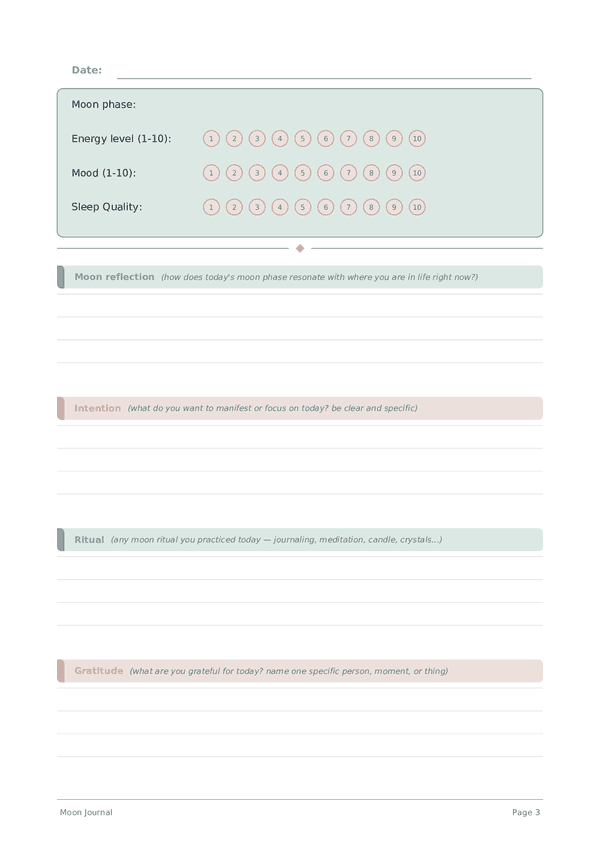
Moon Journal
Align with the lunar cycle — track, reflect, and release
Astrology Journal
Decode the stars, track transits, and align your daily life with cosmic rhythms
Scroll to zoom, drag to move