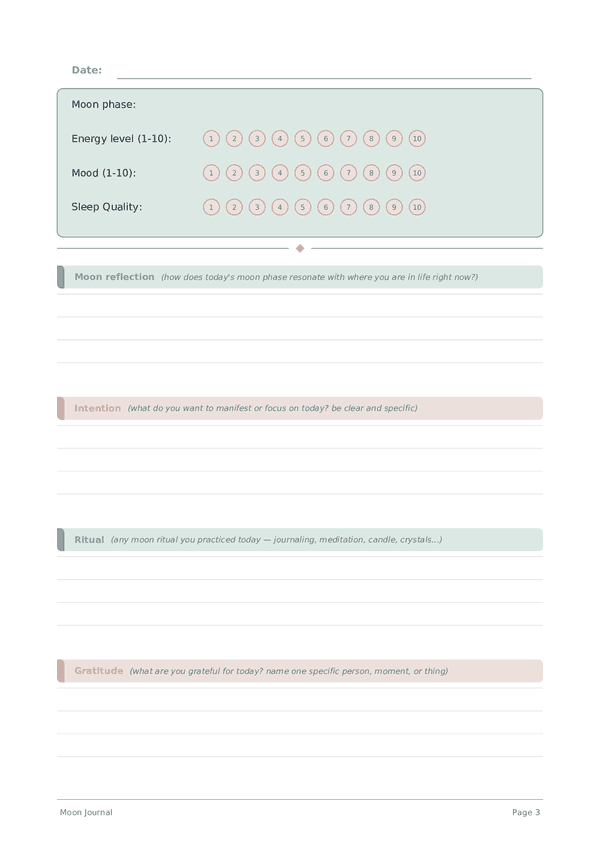
Printable Moon Journal
Align with the lunar cycle — track, reflect, and release
A daily moon journal to track lunar phases alongside your energy, mood, and sleep quality. Set intentions, record rituals, express gratitude, and release what no longer serves you — all in harmony with the moon.
Customize fields
Toggle fields on or off. Click the pencil to rename, or add your own fields.
Benefits
How to Use
What is this journal?
A moon journal is a cyclical practice of tracking your inner world alongside the lunar phases. By noting the moon phase each day and writing about intentions, rituals, and release, you attune to a natural rhythm that has guided human reflection for millennia.
This journal is for anyone drawn to lunar wisdom — whether you follow a full moon/new moon ritual practice, integrate moon phases into your spiritual life, or simply want to explore whether your energy and emotions follow patterns connected to the lunar cycle.
While modern science does not confirm direct lunar effects on human behavior, the practice of cyclical reflection itself is profoundly valuable. Tracking your mood, energy, and sleep against the predictable 29.5-day lunar cycle provides a natural framework for noticing patterns that linear daily tracking misses. Many practitioners report that working with moon phases adds meaningful ritual and rhythm to their reflective practice.
Filled example
Here's what a typical entry looks like when filled in:
How to fill in each field
The top of each page has quick-fill fields (ratings, checkboxes, numbers). Below that is a lined section for writing. Here's what each field means:
Moon phase
New Moon, Waxing Crescent, First Quarter, Waxing Gibbous, Full Moon, Waning Gibbous, Last Quarter, Waning Crescent
Energy level (1-10)
Rate your physical and mental energy level. 1 means exhausted and drained, 10 means fully energized and alert. This helps you identify what activities boost or drain your energy.
Mood (1-10)
Rate your overall emotional state for the day. 1 means very low or depressed, 10 means exceptionally happy and positive. Don't overthink — go with your gut feeling.
Sleep Quality
Rate how restful your sleep was. 1 means terrible and restless, 5 means deep and refreshing. Quality matters as much as quantity.
Moon reflection
How does today's moon phase resonate with where you are in life right now?
Intention
What do you want to manifest or focus on today? Be clear and specific
Ritual
Any moon ritual you practiced today — journaling, meditation, candle, crystals...
Gratitude
What are you grateful for today? Name one specific person, moment, or thing
What to release
What are you ready to let go of with this moon cycle?
Tips for success
When and how often to write
At minimum, write on the 8 major lunar phases each month: New Moon, Waxing Crescent, First Quarter, Waxing Gibbous, Full Moon, Waning Gibbous, Last Quarter, and Waning Crescent. Ideally, make brief daily notes about your mood and energy to build a complete dataset. New Moon and Full Moon entries should be your longest and most reflective. After tracking for a full year (13 lunar cycles), review your entries to discover your personal lunar blueprint — the patterns that are uniquely yours.
Frequently Asked Questions
What is the Moon Journal designed to track?
It is a daily hybrid journal pairing four tracker fields, moon phase, energy (1-10), mood (1-10), and sleep quality (1-10), with six lines of reflection on intention, ritual, gratitude, and release. The structure lets you correlate self-reported well-being with lunar phase across a full 29.5-day cycle, useful for personal pattern observation rather than astronomical prediction.
Is there scientific evidence that the moon affects sleep or mood?
Evidence is mixed and modest. A 2013 study in Current Biology (Cajochen et al.) reported small reductions in sleep duration around full moon under controlled conditions; later replications produced inconsistent results. Meta-analyses generally find no robust effect on mood or behavior. Use the energy, mood, and sleep quality ratings as personal observation, not as confirmation of universal lunar influence.
How do I use the intention and release prompts?
In many contemporary moon-centered practices, the new moon is used for intention-setting and the full moon for release, a convention drawn from neo-pagan and modern witchcraft traditions, not from any single ancient source. Use intention to name one focus for the cycle and release to write what you are letting go. Treat these as journaling prompts, not metaphysical guarantees.
How is this different from a habit or mood tracker?
Standard mood trackers run on weekly cycles tied to your calendar. This journal anchors observation to the lunar cycle, which spans 29.5 days and shifts relative to weekdays. That misalignment is the point: it can reveal patterns invisible to a weekday-based tracker, such as fatigue clustering at the same phase across months. Otherwise the rating fields function as standard self-report scales.
What should I write in the ritual field if I do not practice rituals?
Ritual here means any deliberate, repeatable action that marks the day: lighting a candle, a five-minute walk, a specific tea, an evening pause. James Pennebaker's expressive writing research and Julia Cameron's morning pages (1992, The Artist's Way, Tarcher) both show that small consistent practices anchor reflection. Leave the field blank on days without a ritual; do not fabricate one.
Can I use this journal if I am skeptical about lunar influence?
Yes. The tracker fields work as a standard daily self-report regardless of your stance on lunar effects. The benefit is structural: daily check-ins with rating scales and a short reflection are supported by self-monitoring research as effective for habit and mood awareness. Treat moon phase as a date marker; any correlations you observe across months are personal data, not proof.
What is a common mistake people make with this template?
Forcing high energy or mood entries on full moon and low ones on new moon because tradition suggests they should be there. This corrupts your data. Rate what you actually feel before checking the phase if possible. Across one or two cycles, honest ratings either reveal a personal pattern or show none, and both outcomes are useful information.
How long until I see meaningful patterns?
A full lunar cycle is 29.5 days, so two complete cycles, roughly two months, produce enough paired data points across all four phases for tentative observation. Three cycles is better. This is reflective journaling, not clinical assessment; persistent low mood or sleep problems warrant evaluation by a healthcare professional rather than waiting for the next moon phase.
You Might Also Like
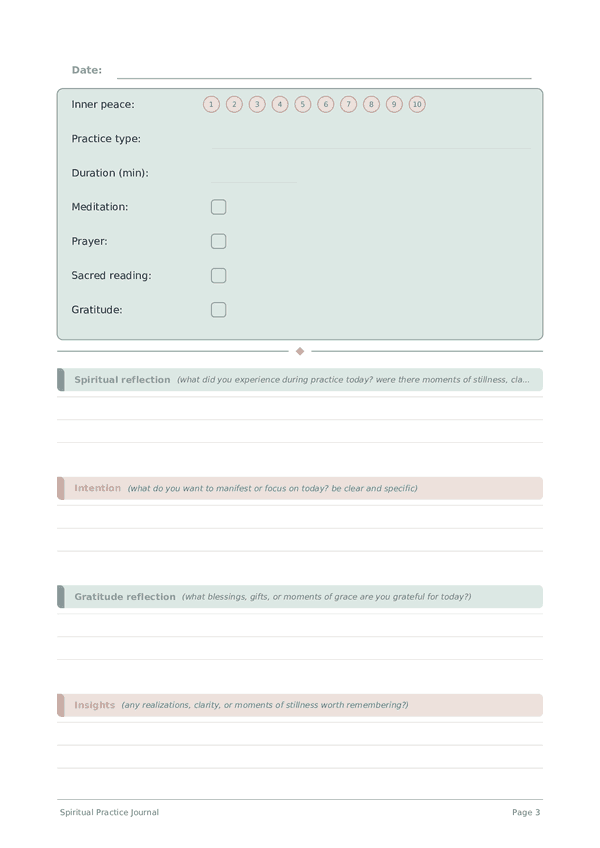
Spiritual Practice Journal
Nurture your inner life with daily practice and reflection
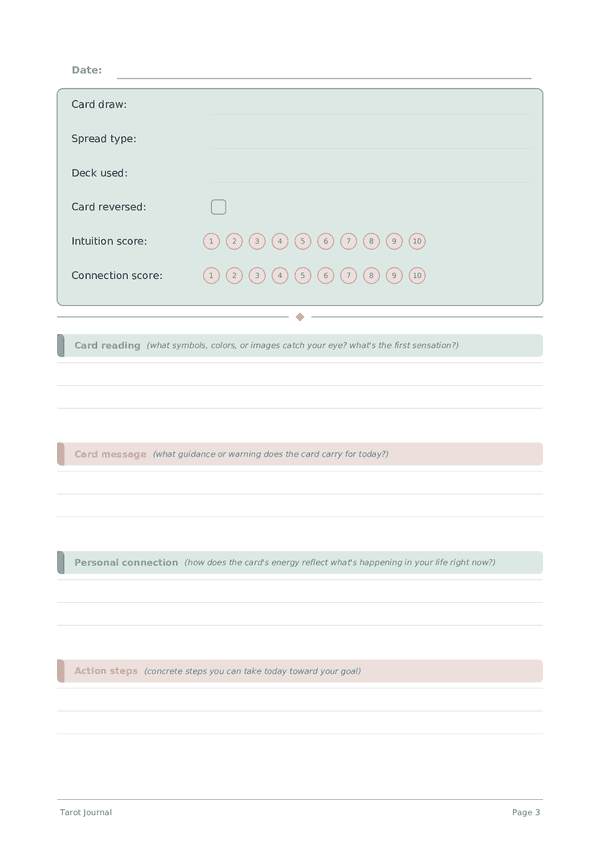
Tarot Journal
Track daily card draws, spreads, and intuitive insights
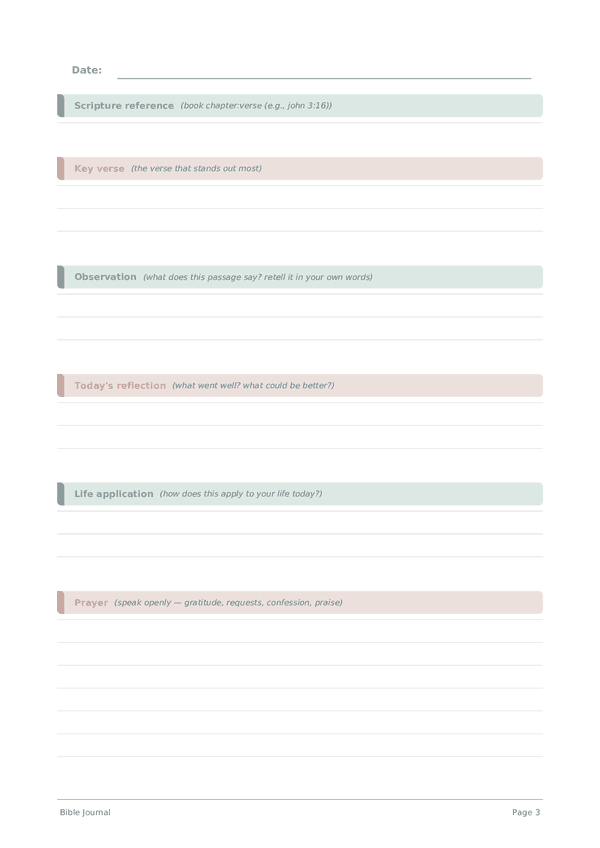
Bible Journal
Scripture, Observation, Application, Prayer — the SOAP method
Astrology Journal
Decode the stars, track transits, and align your daily life with cosmic rhythms
Scroll to zoom, drag to move