Printable Tarot Journal
Track daily card draws, spreads, and intuitive insights
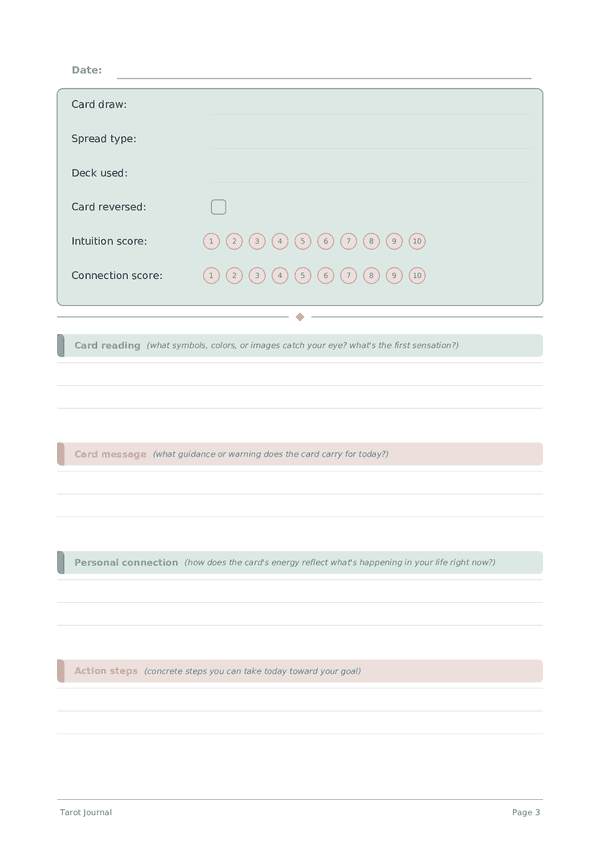
A structured daily practice for tarot readers of all levels. Each entry guides you to record your card draw and spread details, capture your first impressions and symbolic observations, explore the card's personal message, and reflect on how the reading connects to your life. Over time, you build a rich record of recurring cards, evolving interpretations, and patterns that deepen your intuitive reading practice.
Customize fields
Toggle fields on or off. Click the pencil to rename, or add your own fields.
Benefits
How to Use
What is this journal?
A tarot journal is a daily practice for recording and reflecting on your card readings, deepening your relationship with the tarot and your own intuition. By logging the cards drawn, spread type, and deck used alongside reflective writing about messages and personal connections, you build a rich archive of symbolic dialogue with your inner wisdom.
This journal is for tarot enthusiasts at any level — from beginners learning card meanings to experienced readers refining their interpretive skills. It serves as both a study tool and a spiritual diary, tracking how your understanding of each card evolves through personal experience rather than just memorized definitions.
Whether you view tarot as a spiritual tool, a psychological mirror, or a creative thinking framework, consistent journaling dramatically accelerates learning. Tracking patterns in which cards appear frequently, which spreads resonate most, and how readings connect to actual life events builds intuitive pattern recognition that cannot be gained from studying books alone.
Filled example
Here's what a typical entry looks like when filled in:
How to fill in each field
The top of each page has quick-fill fields (ratings, checkboxes, numbers). Below that is a lined section for writing. Here's what each field means:
Card draw
Which card did you draw today? Write the name and number of the card
Spread type
Three-card, Celtic Cross, single draw...
Deck used
Which tarot deck did you use?
Card reversed
Was the card upright or reversed? Note the orientation and how it felt
Intuition score
How strong was your intuitive connection during the reading? Rate from 1 to 10
Connection score
How deeply did the card's message resonate with you? Rate from 1 to 10
Card reading
What symbols, colors, or images catch your eye? What's the first sensation?
Card message
What guidance or warning does the card carry for today?
Personal connection
How does the card's energy reflect what's happening in your life right now?
Action steps
Break your goal into concrete next actions. What exactly will you do, when, and how? The more specific, the better.
Lesson learned today
Capture one insight from today's experience. Over time, these lessons become a personal wisdom library.
Tips for success
When and how often to write
Pull and journal about a daily single-card draw each morning to build interpretive fluency and track evolving themes. Do fuller spreads (3-card or Celtic Cross) weekly or when facing a specific decision or transition. After major life events, a detailed reading and entry can provide valuable perspective. Monthly, review your card frequency log and past readings to assess accuracy and growth. Avoid pulling repeatedly on the same question — if you feel the urge, journal about why the first answer was unsatisfying instead.
Frequently Asked Questions
What is the purpose of the Tarot Journal?
It is a structured daily tracker for card draws, spread types, deck used, reversed status, and two ratings — intuition score and connection score — paired with eight lines of reflection on the card's message, personal connection, action steps, and lessons. The journal does not claim divinatory accuracy; it is a self-reflection tool, similar to expressive writing practices studied by James Pennebaker for emotional processing.
How do I use the intuition score and connection score fields?
Rate intuition score in the morning to capture how clearly the card spoke to you on a 1-10 scale. Rate connection score in the evening to capture how the card mirrored your day. Comparing the two over weeks shows when first impressions align with lived experience. Treat it as reflective practice, not prediction validation — there is no peer-reviewed evidence supporting tarot as a forecasting tool.
Why does the journal ask whether the card is reversed?
Reversed orientation is a long-standing reading convention introduced in modern Western tarot tradition (Rider-Waite system, 1909). The checkbox lets you record orientation precisely so your card message and personal connection notes stay consistent across readings of the same card. Without that marker, returning to old entries to compare interpretations becomes unreliable, since a reversed card and its upright form typically carry different symbolic weight in most reading systems.
How is journaling tarot different from using a tarot app?
Apps deliver pre-written interpretations on tap; this template captures your own first impressions, deck used, spread type, and lived outcomes. Over months you build a personal library of meanings rooted in real experience rather than another author's guidebook. James Pennebaker's expressive writing research shows that handwriting about personally meaningful material has measurable well-being effects, independent of any divinatory framework around the practice.
Is there scientific evidence that tarot reveals truth?
No peer-reviewed evidence supports tarot as a means of accessing hidden information. The benefits documented in psychology are projective — the card becomes a prompt for self-reflection, similar to clinical projective techniques. Use the journal accordingly: treat card message and personal connection as your interpretations, not as objective forecasts. For mental health concerns, consult a licensed clinician rather than relying on card readings.
Can a beginner with no tarot training use this journal?
Yes. Begin with single-card draws and record the deck used and spread type as Daily Draw. Skip the reversed checkbox until you adopt that convention. The bottom prompts (card message, personal connection, action steps, lesson learned today) work without memorized meanings — you respond to the imagery itself. As you read more, your interpretations grow richer, and that growth is what the connection score tracks.
What is the most common mistake new tarot journalers make?
Copying generic guidebook meanings into card message instead of writing what the imagery evoked. Pre-loaded interpretations block the personal connection field from doing its work — tying the card to your specific situation. Write your raw impression first, consult the book second if you wish, and note the difference. Over time your intuition score reflects your own readings, not someone else's.
How often should I draw and journal to see patterns?
Daily single-card draws for a month produce enough data to spot recurring cards and themes. The five tracker fields plus eight reflection lines accumulate quickly. Weekly review is when patterns become visible — the same card appearing on stressful days, certain suits clustering in specific weeks. Treat this as personal symbolic practice; it complements, but does not replace, therapy or medical care.
You Might Also Like
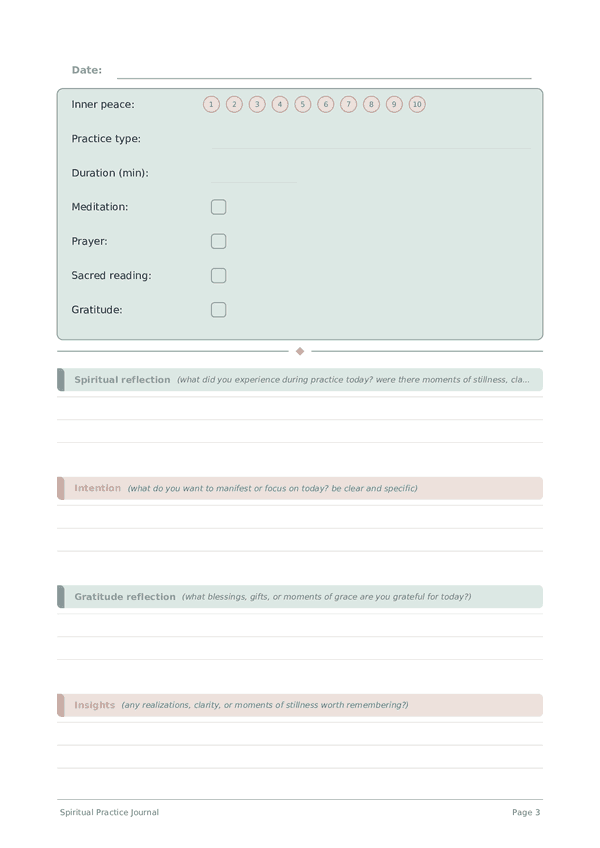
Spiritual Practice Journal
Nurture your inner life with daily practice and reflection
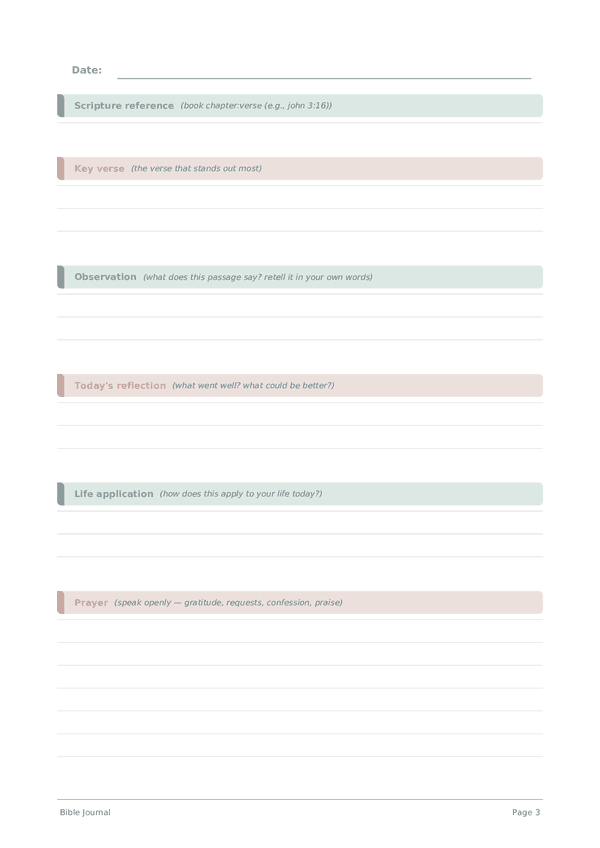
Bible Journal
Scripture, Observation, Application, Prayer — the SOAP method
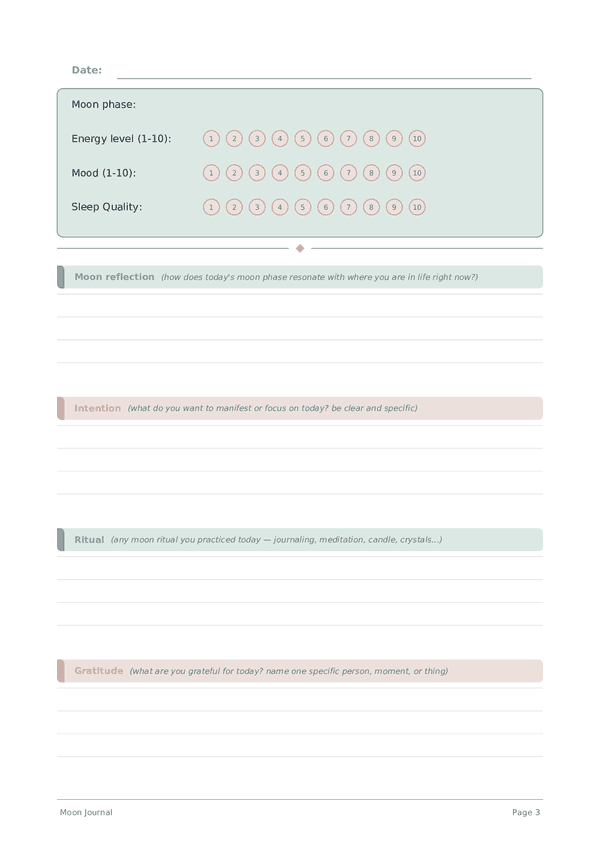
Moon Journal
Align with the lunar cycle — track, reflect, and release
Astrology Journal
Decode the stars, track transits, and align your daily life with cosmic rhythms
Scroll to zoom, drag to move