Printable Baby Journal
Daily care tracking and milestone memories
A complete daily log for new parents. Track feedings, sleep, naps, diapers, mood, and temperature at the top of each page, then write about milestones, firsts, and special moments below. Designed for the busy rhythm of life with a newborn — quick daily tracking paired with space to capture the memories that matter most.
Customize fields
Toggle fields on or off. Click the pencil to rename, or add your own fields.
Benefits
How to Use
What is this journal?
A baby journal is a daily log for tracking your baby's feeding, sleep, health, and developmental milestones. By recording practical data alongside notes about first moments and sweet memories, you create both a useful health reference and a priceless keepsake of your baby's earliest days.
This journal is for new parents navigating the intense, beautiful blur of baby's first months and years. Pediatricians often ask about feeding patterns, sleep schedules, and diaper counts — this journal keeps that information organized. But more importantly, it captures the tiny, magical details that slip from exhausted parents' memories far too quickly.
Developmental pediatrics research emphasizes the value of tracking patterns in infant care. Parents who log feeding and sleep data are better able to identify emerging schedules, notice potential health concerns early, and communicate effectively with healthcare providers. The reflective writing component adds emotional processing to practical tracking — a powerful combination during one of life's most transformative experiences.
Filled example
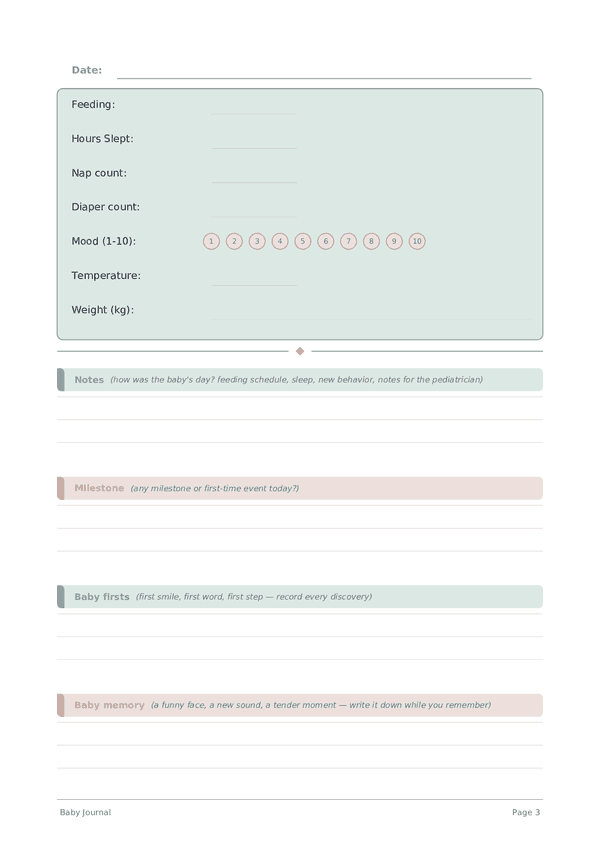
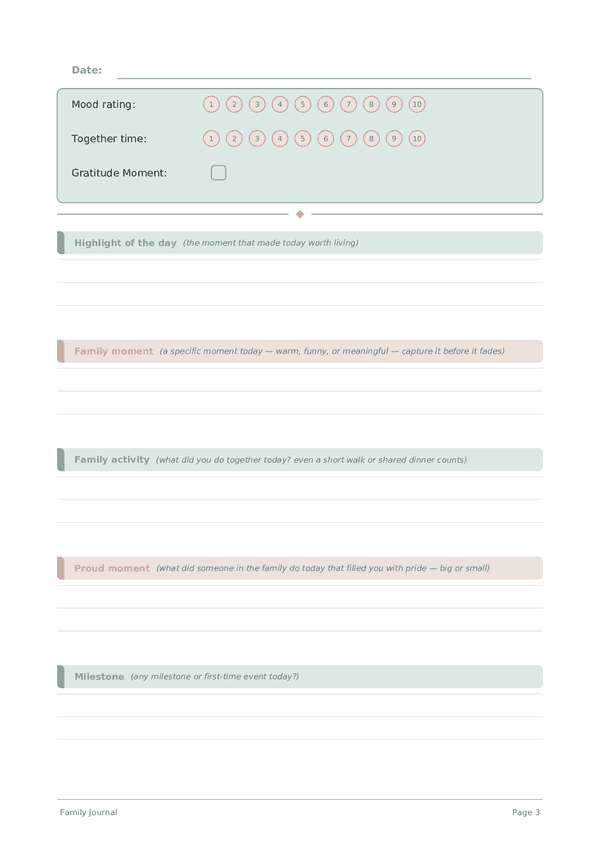
Here's what a typical entry looks like when filled in:
How to fill in each field
The top of each page has quick-fill fields (ratings, checkboxes, numbers). Below that is a lined section for writing. Here's what each field means:
Feeding
Breast or formula? Note the time, duration, or amount for each feeding
Hours Slept
Write how many hours you actually slept (not just time in bed). Tracking this alongside mood and energy often reveals powerful connections.
Nap count
How many naps today, and how long was each one?
Diaper count
Total diaper changes today — wet, dirty, or both
Mood (1-10)
Rate your overall emotional state for the day. 1 means very low or depressed, 10 means exceptionally happy and positive. Don't overthink — go with your gut feeling.
Temperature
Record your basal body temperature. Temperature shifts help track ovulation and overall cycle health.
Weight (kg)
Record your weight if you're tracking it. Weigh yourself at the same time each day for consistent data. Focus on weekly trends, not daily fluctuations.
Notes
Add any additional context or thoughts. This catch-all column is for anything that doesn't fit elsewhere but might be useful later.
Milestone
Any milestone or first-time event today?
Baby firsts
First smile, first word, first step — record every discovery
Baby memory
A funny face, a new sound, a tender moment — write it down while you remember
Proud moment
What did someone in the family do today that filled you with pride — big or small
Tips for success
When and how often to write
During the newborn phase (0–3 months), log feeds and sleep in real time or at each wake window — brief bullet points are enough. From 3–12 months, a daily evening summary works better as routines stabilize. Write a longer reflective entry once a week about your baby’s development and your adjustment to parenthood. These first-year entries are among the most revisited journal pages parents ever write, so consistency matters more than length.
Frequently Asked Questions
Why does the Baby Journal track feeding, sleep, naps, diapers, and temperature together?
Together they form the standard care log pediatricians ask about. AAP's well-child visit guidance and breastfeeding recommendations rely on feeding frequency, sleep duration, and output data to assess infant health. With feedings, hours slept, nap count, diaper count, mood, temperature, and weight on one page, the answer to almost any 'is this normal?' question is already in front of you at the visit.
How many feedings and diapers per day are typical for a newborn?
AAP guidance for healthy term newborns describes roughly 8-12 feedings in 24 hours for breastfed infants in the early weeks, with about six or more wet diapers daily once feeding is established. Your tracker's feeding (max 20) and diaper count (max 20) fields cover this range. Any baby's specific normal varies; discuss persistent deviations with your pediatrician rather than online forums.
When should I check temperature, and what number warrants a call to the doctor?
AAP guidance: any rectal temperature of 38.0 C (100.4 F) or higher in an infant under three months is a medical emergency. Call the pediatrician or seek care immediately. The temperature field (max 42) supports recording in Celsius. For older infants, persistent fever above 38 C for over 24 hours, lethargy, or feeding refusal also warrant a call. Trust your concern, not just the number.
How do I use the hours slept number meaningfully when night sleep is fragmented?
Log total 24-hour sleep, not just night. Newborns typically sleep 14-17 hours daily across naps and night (AAP infant sleep guidance, supported by National Sleep Foundation recommendations); by 4-6 months the total drops to 12-16 hours with more night consolidation. The combined nap count and hours slept fields capture this distribution, so trends stay visible even when individual nights feel chaotic.
Should I journal during the day or only at bedtime?
Real-time for the tracker fields, end-of-day for the writing section. Tally feedings and diapers as they happen, because memory at 10pm will undercount. Save milestone, baby firsts, baby memory, and proud moment for an evening pause when you can write a sentence or two. Even sleep-deprived parents can manage two sentences; the goal is preservation, not literary output.
Is this journal a substitute for a baby-tracking app?
It's a different tradeoff. Apps reduce data entry friction; paper preserves entries indefinitely without account ownership, subscription, or platform shutdown risk, and it combines the daily care log with the keepsake of milestones and firsts. Many parents use both, an app for live tallies and a journal for the evening synthesis and memories, but a single paper journal lasts long after the newborn phase.
What goes in baby firsts versus milestone?
First-times are baby firsts: first smile, first laugh, first solid food, first word, first steps. Milestones are AAP-tracked developmental markers tied to wellness visits (social smile by 2 months, sitting unassisted around 6 months, words around 12 months; see AAP developmental surveillance guidance). Often a first is also a milestone; record both fields when they overlap so the wellness-visit reference and the keepsake survive together.
How do pediatricians want this kind of journal presented at visits?
Bring patterns, not every page. Highlight 24-hour averages for feedings, sleep, and diapers over the past week; any temperature readings above 38 C; any concerns in mood or feeding tolerance. AAP-recommended visit prep treats parental observations as essential clinical data. Tab or highlight pages where deviations occurred so the appointment focuses on signal rather than scrolling.
You Might Also Like
Scroll to zoom, drag to move