Printable Couples Journal
Strengthen your bond with daily connection tracking
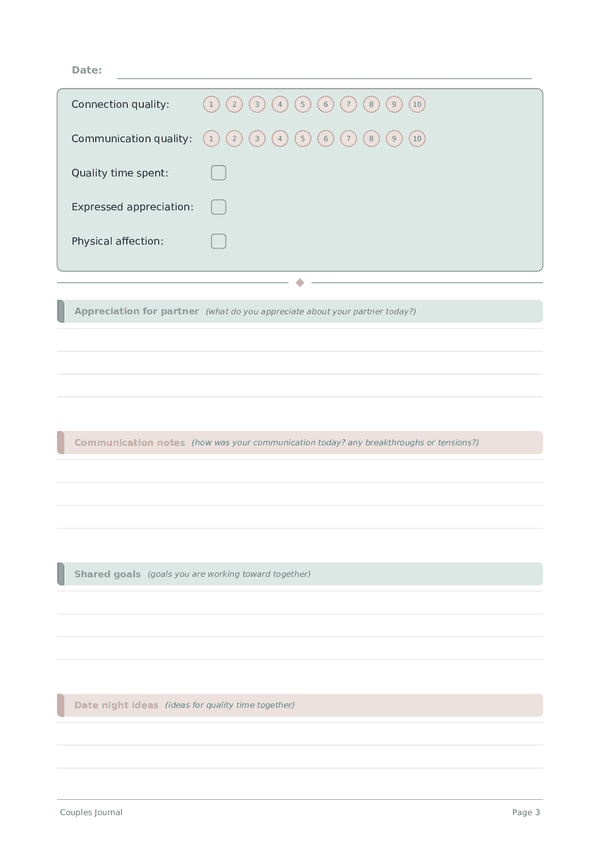
A hybrid journal designed for couples who want to nurture their relationship intentionally. The top section tracks daily connection quality, communication, quality time, appreciation, and physical affection — giving you measurable insight into your relationship patterns. The writing section below guides you through expressing gratitude for your partner, reflecting on communication, aligning on shared goals, planning dates, and honest relationship reflection. Based on Gottman's research and couples therapy best practices, this journal turns relationship maintenance into a simple daily ritual.
Customize fields
Toggle fields on or off. Click the pencil to rename, or add your own fields.
Benefits
How to Use
What is this journal?
A couples journal is a shared daily practice designed for partners to write together — or side by side — about their relationship. It tracks the vital signs of your connection while prompting deeper conversations about appreciation, communication, and shared dreams that busy daily life often crowds out.
This journal is ideal for couples who want to prioritize their relationship amidst demanding schedules, for partners rebuilding after conflict, or for any couple who believes that consistent small investments of attention compound into extraordinary partnership over time.
Couples therapy research consistently identifies two predictors of relationship longevity: expressed appreciation and intentional quality time. This journal builds both into a daily habit. Studies show that couples who regularly discuss their relationship — not just logistics — report 31% higher relationship satisfaction than those who do not.
Filled example
Here's what a typical entry looks like when filled in:
How to fill in each field
The top of each page has quick-fill fields (ratings, checkboxes, numbers). Below that is a lined section for writing. Here's what each field means:
Connection quality
How connected did you feel to your partner today? Rate from 1 (distant) to 10 (deeply bonded)
Communication quality
How well did you communicate today? Rate from 1 (poor) to 10 (open and clear)
Quality time spent
Did you spend meaningful time together today? Describe what you did or rate it
Expressed appreciation
Did you show gratitude or appreciation to your partner today? What did you say or do?
Physical affection
How much physical affection did you share today? Rate from 1 (none) to 10 (very affectionate)
Appreciation for partner
What do you appreciate about your partner today?
Communication notes
How was your communication today? Any breakthroughs or tensions?
Shared goals
Goals you are working toward together
Date night ideas
Ideas for quality time together
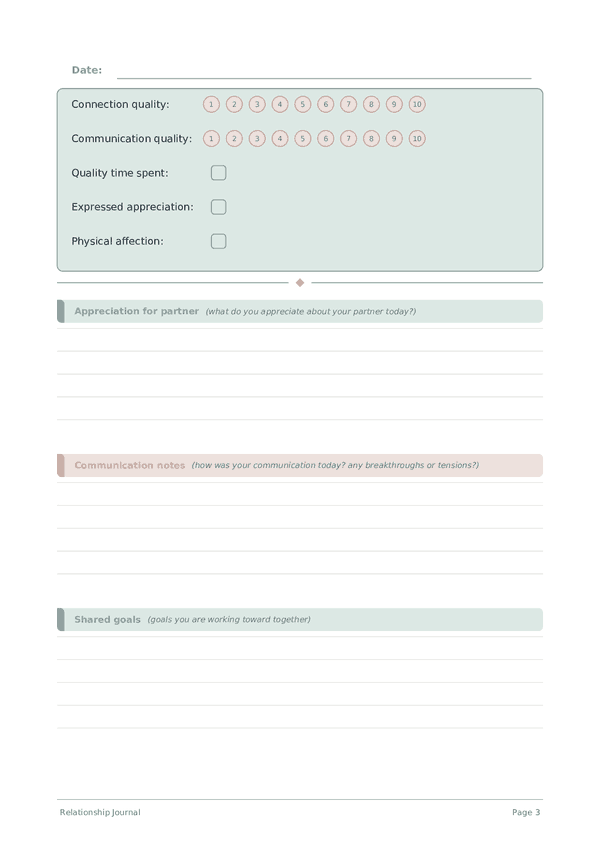
Relationship reflection
What do you appreciate about your partner today?
Tips for success
When and how often to write
Ideally, each partner writes individually 3–4 times per week, with one shared journaling session on weekends where you exchange entries or respond to a common prompt. Monthly, set aside 30 minutes to read through your entries side by side and discuss what you notice. This rhythm balances personal reflection with mutual understanding.
Frequently Asked Questions
How is the Couples Journal different from a regular shared diary?
It uses a daily structure rather than free writing: two 1-10 ratings (connection, communication), three checkboxes (quality time, appreciation, physical affection), and five guided prompts including date night ideas and honest relationship reflection. This mirrors the Gottman Method's emphasis on measurable relational habits over generalized 'sharing' (Gottman, 1999, The Seven Principles for Making Marriage Work), so patterns and gaps show up in data rather than mood.
Why are physical affection and quality time tracked as checkboxes rather than ratings?
Checkboxes prevent inflation. Rating affection 7/10 invites self-justification; the binary 'did it happen today, yes or no' forces honesty. Gottman's research on small daily 'bids for connection' (Gottman, 1999) found that whether partners turn toward bids — not how intensely — predicts marital trajectory. The checkbox captures frequency, the dimension his lab found most diagnostic of stability.
What goes in the date night ideas prompt — past dates or planned ones?
Use it for upcoming ideas you don't want to lose: a restaurant a friend mentioned, an exhibition closing soon, a hike for a free Saturday. Esther Perel argues novelty and anticipation are core to long-term eroticism (Perel, 2006, Mating in Captivity); a running list keeps planning easy. Past dates fit better in the relationship reflection or appreciation prompts.
Should both partners fill in their own journal or share one?
Each partner keeps a private copy. Honest 1-10 ratings require the page to be yours; sharing creates self-censorship. Compare entries during a weekly state-of-the-union conversation, a Gottman-recommended ritual (Gottman, 1999). The journal feeds the meeting with concrete data — 'connection averaged 5 this week' is a starting point that vague impressions are not.
Is the appreciation prompt useful if our relationship is going well?
Especially then. Gottman's longitudinal work shows the 5:1 positive-to-negative interaction ratio is what separates lasting marriages from divorces (Gottman, 1994, Why Marriages Succeed or Fail), and that ratio is built in calm periods, not during conflict. Daily specific appreciation banks goodwill — 'positive sentiment override' — that buffers the relationship when stress eventually hits.
What if my communication quality rating is consistently low?
Persistent low scores call for action. Look for Gottman's 'Four Horsemen' — criticism, contempt, defensiveness, stonewalling — in the communication notes prompt (Gottman, 1999, The Seven Principles for Making Marriage Work); contempt in particular predicts divorce. If you spot them across multiple weeks, consult a Gottman-trained or EFT couples therapist (Johnson, 2008, Hold Me Tight). A journal documents the pattern; therapy treats it.
How long is a meaningful entry — quick checks or paragraphs?
Five to seven minutes. The two ratings and three checkboxes take under a minute; the seven lines and four written prompts work best with one or two specific sentences each rather than essays. Specificity beats length — 'thanked her for handling bedtime so I could finish work' beats 'grateful for partner.' The Gottman habit literature stresses consistency over intensity (Gottman, 1999).
Can same-sex couples and non-married partners use this journal?
Yes. The Gottman Institute's research on same-sex couples (Gottman et al., 2003, Journal of Homosexuality, 45(1)) found the same predictors — positive affect, repair attempts, low contempt — operate across orientations. The journal's fields don't assume a particular relationship type. Cohabiting, engaged, long-distance, and queer couples can use the identical structure; the bond, not the legal status, is what the tracker measures.
You Might Also Like
Scroll to zoom, drag to move