Printable Parenting Journal
Cherish every moment of your parenting journey
A daily journal designed for parents to reflect on their emotional state, track quality time with their child, celebrate milestones, and grow through the beautiful challenges of parenthood. Five minutes a day can transform your relationship with your child and yourself.
Customize fields
Toggle fields on or off. Click the pencil to rename, or add your own fields.
Benefits
How to Use
What is this journal?
A parenting journal is a daily practice for tracking your own well-being as a parent while documenting your child's growth, milestones, and the moments that matter. By monitoring your mood, energy, and patience alongside reflective writing about highlights and proud moments, you create a more conscious parenting practice.
This journal is for parents at any stage — from the sleep-deprived newborn phase to the complex teenage years. It serves both as a self-care tool that helps you notice when you are running on empty and as a memory book that captures the fleeting details of your child's development that you think you will remember but often forget.
Parenting research shows that self-aware parents — those who regularly reflect on their emotions and reactions — are more likely to respond thoughtfully rather than react impulsively. This journal builds that reflective capacity while simultaneously creating a treasure trove of memories you will be grateful to have when your children are grown.
Filled example
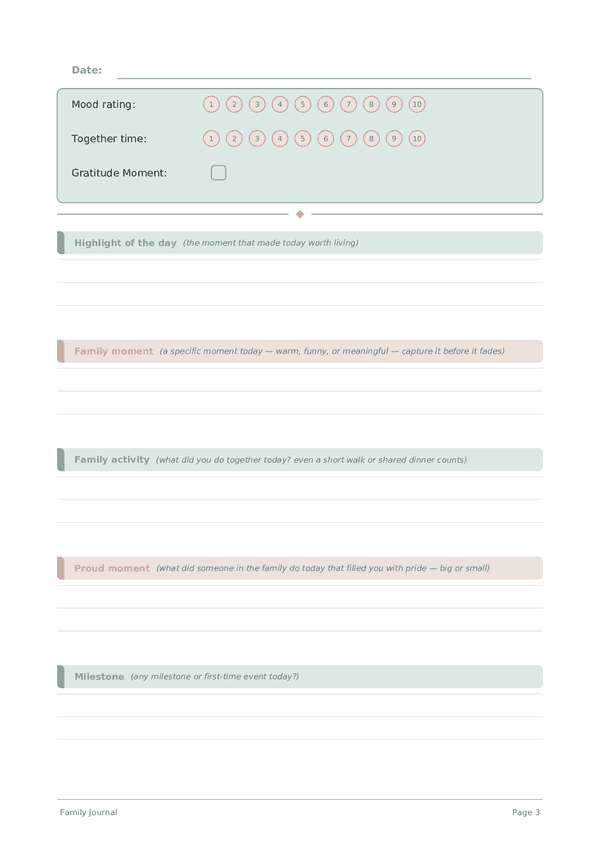
Here's what a typical entry looks like when filled in:
How to fill in each field
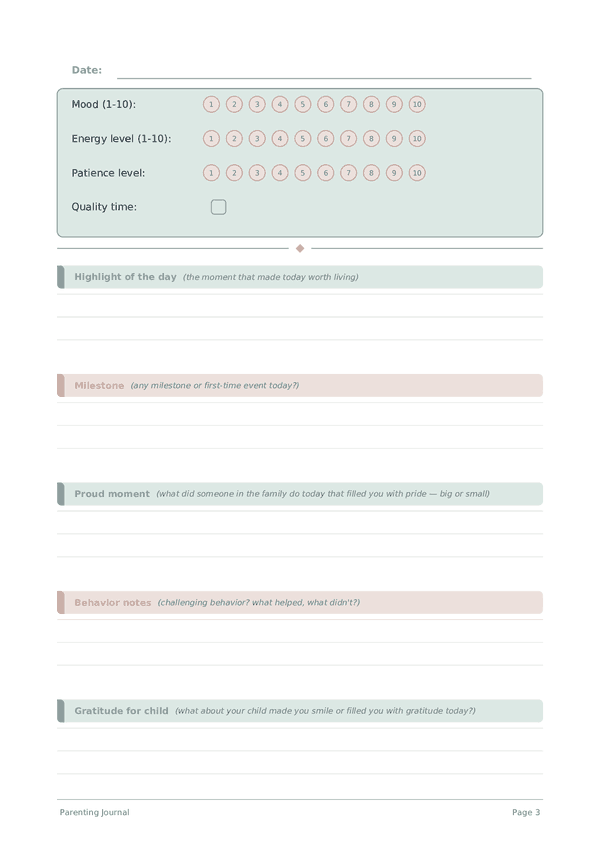
The top of each page has quick-fill fields (ratings, checkboxes, numbers). Below that is a lined section for writing. Here's what each field means:
Mood (1-10)
Rate your overall emotional state for the day. 1 means very low or depressed, 10 means exceptionally happy and positive. Don't overthink — go with your gut feeling.
Energy level (1-10)
Rate your physical and mental energy level. 1 means exhausted and drained, 10 means fully energized and alert. This helps you identify what activities boost or drain your energy.
Patience level
How patient were you with your child today? Rate from 1 (struggling) to 10 (calm)
Quality time
Did you have focused, present time with your child today? Describe it briefly
Highlight of the day
What was the best part of your day? Capture the moment that made today worth living. These highlights become a collection of your happiest memories.
Milestone
Any milestone or first-time event today?
Proud moment
What did someone in the family do today that filled you with pride — big or small
Behavior notes
Challenging behavior? What helped, what didn't?
Gratitude for child
What about your child made you smile or filled you with gratitude today?
Notes
Add any additional context or thoughts. This catch-all column is for anything that doesn't fit elsewhere but might be useful later.
Tips for success
When and how often to write
Write at least 3 times per week, ideally after the children are in bed when you can reflect calmly. Brief entries work fine on hectic days — even two sentences about what went well. Weekly, do a longer entry assessing the overall emotional climate at home. During particularly challenging phases (sleep regressions, school transitions, behavioral shifts), daily entries help you stay grounded and notice when things start improving.
Frequently Asked Questions
Why does the Parenting Journal track patience and energy alongside mood?
Patience and energy are the parent's resource levers, not the child's behavior. Daniel Siegel's interpersonal neurobiology framework (Siegel, 2011, The Whole-Brain Child) holds that parental regulation drives child co-regulation — a depleted parent cannot model calm. Rating patience and energy daily exposes burnout trajectories before they reach 'I yelled and don't know why,' turning vague exhaustion into a measurable signal.
What counts as quality time for the checkbox?
Focused, attention-undivided time with your child — no phone, no half-listening. The AAP's media use guidance and family-time recommendations consistently emphasize parental presence over duration; ten phone-free minutes spent on your child's chosen activity beats an hour of distracted parallel play. The binary checkbox stops you from inflating brief co-presence into 'quality time' it was not.
Should I write entries even on days I felt like a bad parent?
Especially then. Patience 3/10 days are diagnostic data, not failure. Brene Brown's research on shame versus guilt (Brown, 2012, Daring Greatly) distinguishes 'I did something hard' from 'I am bad' — journaling the specific moment in behavior notes keeps shame from globalizing one rough afternoon into identity. Patterns across hard days often point to a fixable trigger: sleep, hunger, transitions, screen overflow.
How does milestone differ from proud moment in this template?
Milestones are developmentally significant firsts and transitions (first words, riding a bike, reading independently, starting school) — the items pediatricians use as developmental markers (AAP developmental surveillance guidance). Proud moments are character-level glimpses: your child apologized unprompted, defended a smaller kid, persisted when frustrated. Milestones track what children can do; proud moments track who they are becoming.
Is journaling enough or do I also need to read parenting books?
Journaling is reflection on practice, not the practice itself. Pair it with evidence-based frameworks: Faber & Mazlish's communication tools (Faber & Mazlish, 1980, How to Talk So Kids Will Listen), Baumrind's authoritative parenting research (Baumrind, 1967, Genetic Psychology Monographs, 75), and Siegel's whole-brain framework (Siegel, 2011, The Whole-Brain Child). The journal shows you whether what you read is actually showing up in your day-to-day.
What if my patience score is consistently 4 or below?
Persistent low patience signals a system problem, not a willpower one. Check the energy and quality time entries: chronic low energy points to sleep, partner load, or unaddressed parental stress. Postpartum or perimenopausal patience drops warrant medical follow-up. If irritability comes with hopelessness or intrusive thoughts about harm, contact a clinician promptly — patience scores are no substitute for clinical assessment.
How can I use behavior notes constructively without labeling my child?
Write the behavior plus the context: 'meltdown at 5pm, missed snack, transition from screens.' Faber & Mazlish's approach (Faber & Mazlish, 1980, How to Talk So Kids Will Listen) and AAP guidance both stress describing behavior rather than the child ('he hit' not 'he is aggressive'). Notes over weeks reveal the antecedents — hunger, sleep deficit, sensory overload — that you can plan around.
When should weekly review surface concerns serious enough for a clinician?
Bring data to a pediatrician or child psychologist if you see persistent regression in milestones, marked behavior changes lasting weeks, your own patience or mood at 3/10 across most days, or any thoughts of harm to self or child. AAP recommends shared decision-making with developmental concerns. Your journal entries make the visit concrete; do not let documentation delay a call you sense is needed.
You Might Also Like
Scroll to zoom, drag to move