Printable Family Journal
Capture your family's daily moments and memories
A daily hybrid journal for families — track mood and togetherness at a glance, then write about the moments that made today special. Build a living archive of your family's story, one day at a time.
Customize fields
Toggle fields on or off. Click the pencil to rename, or add your own fields.
Benefits
How to Use
What is this journal?
A family journal is a daily practice for capturing the moments that make family life meaningful. By tracking time spent together and writing about highlights, milestones, and traditions, you create a living record that your family can treasure and revisit for years to come.
This journal is for any family member who wants to be more present and appreciative of everyday family life. Whether you are documenting your children's growth, preserving family traditions, or simply wanting to remember the beautiful chaos of life together, this journal turns ordinary days into cherished memories.
Family psychology research shows that families who share narratives — who tell and retell their stories — develop stronger bonds and greater resilience during difficult times. Children who know their family stories show higher self-esteem and a stronger sense of belonging. This journal creates the raw material for those stories.
Filled example
Here's what a typical entry looks like when filled in:
How to fill in each field
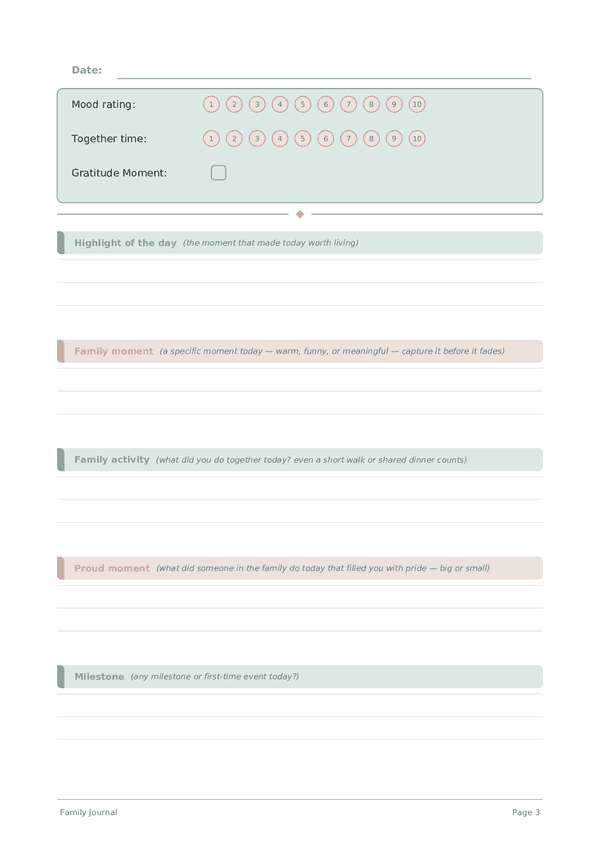
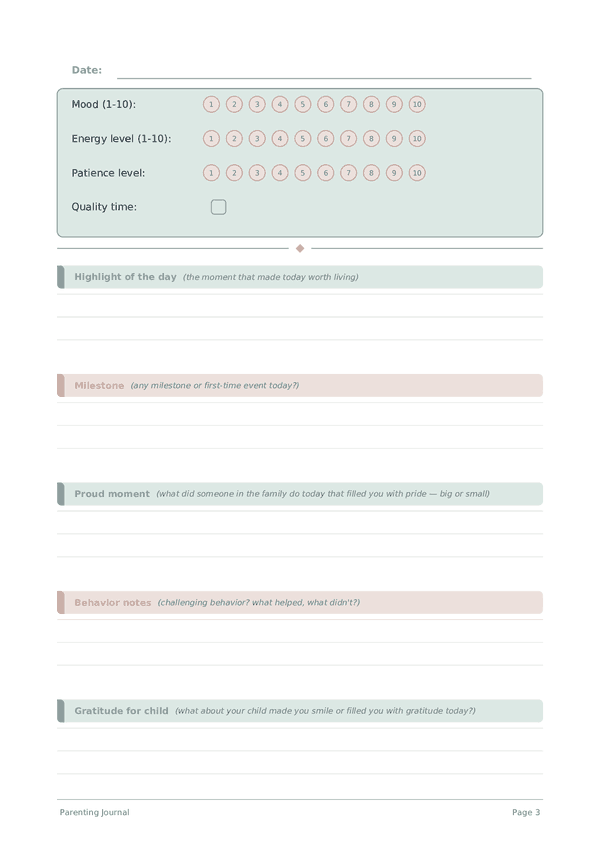
The top of each page has quick-fill fields (ratings, checkboxes, numbers). Below that is a lined section for writing. Here's what each field means:
Mood rating
Rate your emotional state (1-10) to track your healing trajectory
Together time
How much time did you spend together as a family today? Note the activity
Gratitude Moment
One specific thing you are grateful for from today's practice
Highlight of the day
What was the best part of your day? Capture the moment that made today worth living. These highlights become a collection of your happiest memories.
Family moment
A specific moment today — warm, funny, or meaningful — capture it before it fades
Family activity
What did you do together today? Even a short walk or shared dinner counts
Proud moment
What did someone in the family do today that filled you with pride — big or small
Milestone
Any milestone or first-time event today?
Family tradition
A tradition worth remembering or starting
Notes
Add any additional context or thoughts. This catch-all column is for anything that doesn't fit elsewhere but might be useful later.
Tips for success
When and how often to write
Write 2–3 times per week, focusing on recent family interactions and your emotional responses. Before major family events (holidays, reunions, visits), do a preparation entry noting your intentions and boundaries. After the event, reflect on what went well and what was challenging. Quarterly, reread your entries to notice evolving dynamics and celebrate growth in difficult relationships.
Frequently Asked Questions
What is the Family Journal designed for compared to a personal diary?
It is family-focused, not self-focused: the mood rating and together time ratings reflect the family unit, not just your day, and the gratitude moment checkbox flags shared positive experiences. The writing section captures family moment, family activity, proud moment, milestone, and family tradition — fields aimed at shared memory and continuity across generations rather than individual processing. It works as a family time capsule with daily friction low enough to actually sustain.
Who in the household should fill it in — one person or rotating?
Most families do best with one anchor keeper (often a parent) writing the entry, then inviting children old enough to add a sentence or drawing on family moment days. Daniel Siegel's work on shared narrative in family attachment (Siegel, 2011, The Whole-Brain Child) shows that co-constructing the family story strengthens children's sense of belonging and emotional regulation.
What goes in milestone — only big events like first steps or anything new?
Both. Conventional milestones (first day of school, lost tooth, walking, reading a sentence) plus smaller firsts (first solo bus ride, first time cooking dinner alone) belong here. The AAP's developmental surveillance guidance encourages documenting observable changes across motor, language, and social domains. Specific dates and contexts make the milestone retrievable years later, once memory has blurred the timeline.
How does the family tradition prompt actually help our family?
It makes implicit rituals explicit. Friday pizza nights, summer cabin trips, birthday morning songs — research on family rituals (Fiese et al., 2002, Journal of Family Psychology, 16(4)) links them to stronger family identity, better adolescent adjustment, and resilience during transitions. Writing them down lets you protect them when life gets busy and pass them down on purpose rather than by chance.
Should I write entries when the day was difficult or only on good days?
Write both. A family archive that records only highlights misreads your own history later. The mood rating gives space for honest 4/10 days; the writing area can hold a difficult moment alongside one small gratitude. Decades of family narrative research (Duke et al., 2003, Journal of Family Psychology) found that families with coherent stories — including struggle and recovery — show better adolescent well-being.
How is this different from posting family moments on social media?
Social posts are performed for an audience and curated for likes; a private journal records the unphotogenic textures — the inside joke, the hard week, the day no one took a photo. It also stays yours when platforms change or accounts close. Children later read a journal as their lived family story, not as a feed shaped by reach algorithms.
What if my children are too young to participate?
Then you are the family historian for them now. Note what they said, what made them laugh, what they were obsessed with that month. Bowlby's attachment work (Bowlby, 1969, Attachment) stressed that being witnessed and remembered is foundational to a secure base. A parent reading 2026's entries to a 12-year-old in 2034 is exactly that, in slow time.
How often should we re-read past entries together?
Quarterly read-alouds work well — a Sunday evening per season, reading aloud favorite family moment and milestone entries. This fits Fiese's family ritual research (Fiese et al., 2002, Journal of Family Psychology, 16(4)): the re-telling itself becomes a ritual. For special occasions — a birthday, year-end — read the matching month from prior years. The journal gains value as the archive grows.
You Might Also Like
Relationship Journal
Nurture your bond through daily reflection and intentional connection
Couples Journal
Strengthen your bond with daily connection tracking
Dating Journal
Track dates, rate chemistry, and discover what you truly want
Parenting Journal
Cherish every moment of your parenting journey
Scroll to zoom, drag to move