Printable Dating Journal
Track dates, rate chemistry, and discover what you truly want
A structured journal for navigating the dating world with clarity. Rate chemistry and comfort after each date, capture first impressions, note conversation highlights, and reflect on compatibility. Over time, patterns emerge that help you understand your own needs and make more intentional choices in love.
Customize fields
Toggle fields on or off. Click the pencil to rename, or add your own fields.
Benefits
How to Use
What is this journal?
A dating journal is a reflective practice for navigating the world of dating with clarity and self-awareness. By rating chemistry, excitement, and comfort after each date and writing structured reflections, you avoid the trap of making decisions based solely on initial chemistry — which often fades — and instead build a clear picture of what you truly need in a partner.
This journal is for anyone actively dating, whether casually or searching for a long-term partner. It is especially valuable if you tend to overlook red flags when attraction is high, rush into relationships, or struggle to articulate what you are looking for.
Relationship research shows that the strongest predictor of long-term compatibility is not initial chemistry but shared values, communication style, and emotional availability. This journal helps you track all of these from the very first date, building a record that reveals patterns in your choices and guides you toward healthier relationship decisions.
Filled example
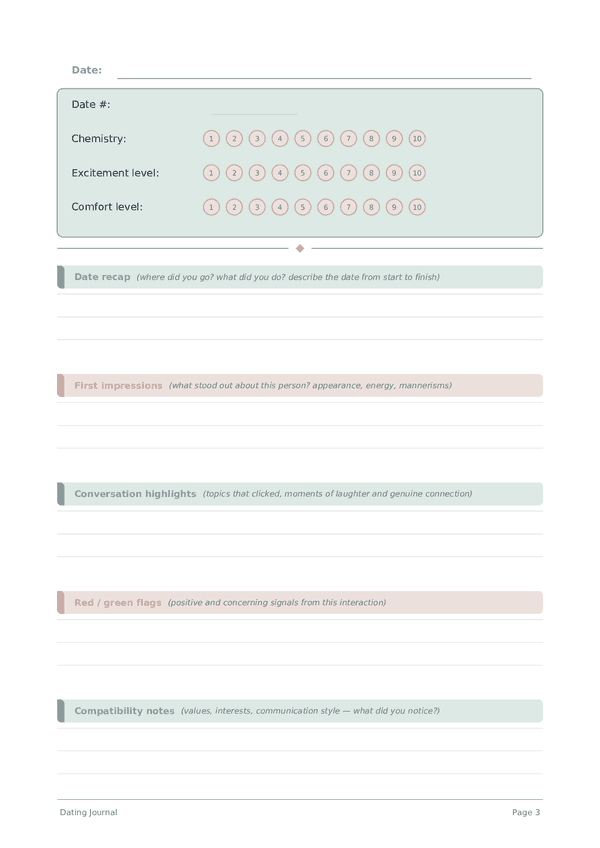
Here's what a typical entry looks like when filled in:
How to fill in each field
The top of each page has quick-fill fields (ratings, checkboxes, numbers). Below that is a lined section for writing. Here's what each field means:
Date #
Which date is this? Enter the number to track your dating journey over time
Chemistry
How strong was the chemistry between you two? Rate from 1 (low) to 10 (electric)
Excitement level
How excited are you about this idea? 1 = meh, 10 = can't stop thinking about it
Comfort level
How comfortable and at ease did you feel with this person? Rate from 1 (nervous) to 10 (relaxed)
Date recap
Where did you go? What did you do? Describe the date from start to finish
First impressions
What stood out about this person? Appearance, energy, mannerisms
Conversation highlights
Topics that clicked, moments of laughter and genuine connection
Red / green flags
Positive and concerning signals from this interaction
Compatibility notes
Values, interests, communication style — what did you notice?
What I learned
Write one new thing you learned today. It can be a fact, a skill, an insight about yourself, or a life lesson. Daily learning compounds into wisdom.
Next steps
What are the next concrete actions to move this project forward?
Tips for success
When and how often to write
Write after every date or significant interaction while the details are fresh — even 5 minutes of notes captures insights you will forget by morning. Weekly, review your entries to spot emotional patterns and recurring dynamics. If you are actively dating multiple people, a brief comparison entry each week helps clarify who genuinely aligns with your values versus who simply triggers excitement.
Frequently Asked Questions
Why does the Dating Journal separate chemistry, excitement, and comfort?
Helen Fisher's neuroscience research identifies three distinct brain systems — lust, romantic attraction, and attachment — that operate independently (Fisher, 2004, Why We Love). Chemistry maps to attraction, excitement to lust-novelty, comfort to nascent attachment. A date can score 9/9/3 (intense but unsafe) or 5/5/8 (calm, secure). Separating them prevents the common error of mistaking high arousal for relational fit.
How do I tell a red flag from a green flag when I'm still hooked on chemistry?
Use the red / green flags prompt the morning after, when limerence fades. Check behaviors against your non-negotiables — disrespect for your time, hot-cold patterns, and dismissed feelings count as red. Hazan and Shaver's adult attachment work (Hazan & Shaver, 1987, JPSP, 52(3)) shows people often pattern-match early signals to familiar but unsafe templates. Writing forces a conscious read instead of just going with your gut.
Should I number every date with date #, even casual coffee meetups?
Yes. The numeric tracker turns dating from emotional fog into reviewable data. After date 8 or 12 you can scan back across chemistry, excitement, and comfort ratings to see whether you keep picking partners who score high on excitement and low on comfort — Fisher's framework predicts this combination feels intoxicating but rarely converts to long-term bonds (Fisher, 2004, Why We Love).
What should go in compatibility notes after a first date?
Concrete observations on lifestyle, values, and pace: do their weekday rhythms work with yours; how they treated staff; how they handle disagreement on small things; whether their stated and lived priorities match. Sue Johnson's attachment-informed view (Johnson, 2008, Hold Me Tight) points to responsiveness — whether the person tunes in when you share — as a more durable signal than charm or wit.
Is journaling about dates healthy or does it cause overthinking?
Done daily right after the date, it ends rumination instead of feeding it — the structured prompts (recap, red/green flags, compatibility, next steps) close the loop. Replaying dates in your head for days without writing is what fuels overthinking. If you're journaling repeatedly about one person and feel destabilized, that warrants a conversation with a licensed therapist, not more pages.
How long until patterns about my dating type become visible?
Roughly 8-15 dates with consistent entries. Look across what I learned, red / green flags, and chemistry ratings for recurring themes: a type you keep choosing, a value you keep tolerating breaches of. Hazan and Shaver (1987, JPSP, 52(3)) showed attachment patterns repeat across partners until consciously interrupted; the review is where you spot the loop you're running.
What goes in next steps if I'm unsure about a second date?
Write the question, not the answer: 'Would I feel relieved or disappointed if they cancelled?' Brene Brown's vulnerability work (Brown, 2012, Daring Greatly) frames decisions made from clarity rather than fear as more durable. Pair that with your comfort and chemistry scores. If chemistry is 7 but comfort is 3 and you'd feel relieved by a cancellation, that's your answer.
Is this journal useful if I'm dating exclusively on apps?
Yes — maybe even more so. App dating compresses time and inflates choice, which research links to fatigue and snap dismissals. First impressions and conversation highlights force you to remember each person as a human rather than a swipe. Reviewing entries before the next date with the same person keeps you from conflating profiles and protects against the volume blur typical of app-based dating.
You Might Also Like
Scroll to zoom, drag to move