Printable Relationship Journal
Nurture your bond through daily reflection and intentional connection
A structured daily practice for couples who want to strengthen their relationship. Track your emotional connection and communication quality, note whether you shared quality time and appreciation, then reflect on what you value in your partner and the goals you share. Grounded in Gottman Method principles and attachment theory, this journal turns fleeting feelings into lasting patterns of closeness.
Customize fields
Toggle fields on or off. Click the pencil to rename, or add your own fields.
Benefits
How to Use
What is this journal?
A relationship journal is a daily practice for nurturing and strengthening your romantic partnership. By tracking connection quality and communication alongside reflective writing about appreciation, shared goals, and daily highlights, you create a deliberate habit of attention that deepens intimacy over time.
This journal is for anyone in a committed relationship who wants to be more intentional about their partnership. Whether your relationship is thriving and you want to protect that, or you are working through a difficult patch and need to reconnect, this structured reflection helps you notice patterns and celebrate what is working.
Research from the Gottman Institute shows that successful relationships maintain a 5:1 ratio of positive to negative interactions. This journal naturally builds that ratio by prompting you to actively notice and record moments of connection, appreciation, and shared joy — turning passive gratitude into deliberate relationship investment.
Filled example
Here's what a typical entry looks like when filled in:
How to fill in each field
The top of each page has quick-fill fields (ratings, checkboxes, numbers). Below that is a lined section for writing. Here's what each field means:
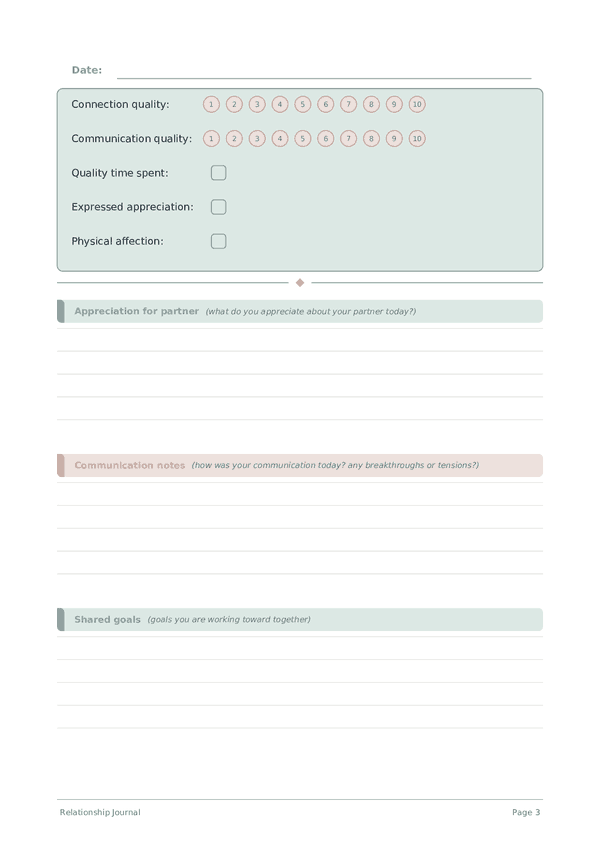
Connection quality
How connected did you feel to your partner today? Rate from 1 (distant) to 10 (deeply bonded)
Communication quality
How well did you communicate today? Rate from 1 (poor) to 10 (open and clear)
Quality time spent
Did you spend meaningful time together today? Describe what you did or rate it
Expressed appreciation
Did you show gratitude or appreciation to your partner today? What did you say or do?
Physical affection
How much physical affection did you share today? Rate from 1 (none) to 10 (very affectionate)
Appreciation for partner
What do you appreciate about your partner today?
Communication notes
How was your communication today? Any breakthroughs or tensions?
Shared goals
Goals you are working toward together
Highlight of the day
What was the best part of your day? Capture the moment that made today worth living. These highlights become a collection of your happiest memories.
Tips for success
When and how often to write
Write a brief entry every evening reflecting on your interactions and emotional connection that day. Once a week, do a longer check-in entry where you assess recurring themes, unresolved tensions, and moments of closeness. Monthly, review your entries together with your partner if comfortable — shared reflection strengthens understanding and prevents small issues from becoming entrenched patterns.
Frequently Asked Questions
What is the Relationship Journal designed to track day to day?
It captures five daily signals: connection quality (1-10), communication quality (1-10), and three checkboxes for quality time, expressed appreciation, and physical affection. The lined section prompts you to write what you appreciate about your partner plus notes on communication, shared goals, and a daily highlight. The structure mirrors Gottman's research (Gottman, 1999, The Seven Principles for Making Marriage Work), which identifies fondness and admiration as core predictors of marital stability.
Why does the journal emphasize daily appreciation of your partner?
Expressed appreciation builds what John Gottman calls 'positive sentiment override': couples who maintain a 5:1 ratio of positive to negative interactions stay stably married (Gottman, 1994, Why Marriages Succeed or Fail). The 'expressed appreciation' checkbox and the appreciation prompt make this a measurable daily habit rather than a vague intention, helping you build the fondness and admiration system Gottman identifies as a marriage's foundation.
How should I rate connection quality versus communication quality if they feel similar?
Connection quality measures felt emotional closeness: warmth, attunement, sense of 'we.' Communication quality measures the exchange itself: clarity, listening, conflict handling. Sue Johnson's Emotionally Focused Therapy framework (Johnson, 2008, Hold Me Tight) treats attachment-level closeness and surface communication as distinct layers. You can have a calm conversation while feeling distant, or argue while staying connected. Rating both separately surfaces those gaps.
Is this journal a substitute for couples therapy?
No. It is a structured self-reflection tool, not clinical treatment. Daily tracking can surface patterns and support work already happening with a couples therapist, but it does not address abuse, betrayal trauma, or entrenched conflict. If you face contempt, stonewalling, intimate partner violence, or are considering divorce, consult a licensed couples therapist. In the US, contact the National Domestic Violence Hotline 1-800-799-7233; elsewhere, consult your local domestic violence helpline.
How long until daily entries reveal useful relationship patterns?
Plan for at least four to six weeks of near-daily entries before reviewing. Gottman's longitudinal research on the 5:1 ratio (Gottman, 1999) was built on observation across weeks, not days. Short stretches can mislead, since one fight skews a week. With 4-6 weeks you can see whether checkboxes for quality time and affection co-vary with your connection rating, which is the practical signal worth acting on.
Can we share one Relationship Journal as a couple?
It works best as a private daily practice per person; your honest 1-10 rating only stays honest if the page is yours. Compare entries during a weekly check-in instead. Esther Perel describes mature intimacy as the meeting of two whole selves (Perel, 2006, Mating in Captivity); separate journals preserve that selfhood while shared review creates the dialogue.
What should the weekly review focus on?
Scan the seven connection and communication ratings for trends, then count checkboxes for quality time, appreciation, and affection. If a low-connection week shows three or fewer affection checkboxes, that is your lever. The Gottman 'Magic Five Hours' framework (Gottman, 1999) recommends roughly five weekly hours of intentional connection; your checkboxes are the proxy for hitting that target.
Does writing about shared goals actually strengthen a relationship?
Yes. Gottman's seventh principle, 'Create Shared Meaning' (Gottman, 1999, The Seven Principles for Making Marriage Work), treats jointly held goals, rituals, and dreams as a stabilizing layer of marriage. The shared goals prompt converts vague 'someday' talk into written commitments you can revisit, turning future planning from drift into deliberate co-authorship of the relationship's direction.
You Might Also Like
Scroll to zoom, drag to move