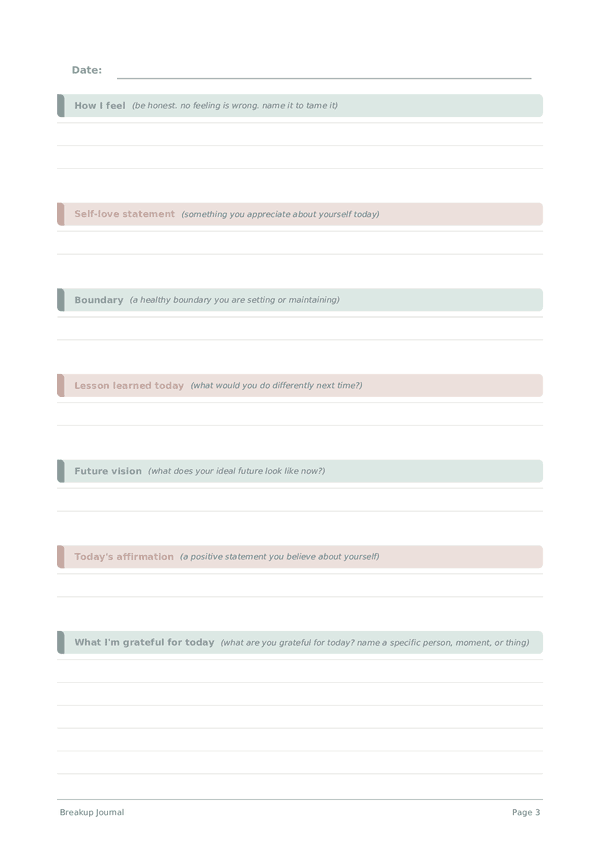
Printable Breakup Journal
Heal, grow, and rebuild yourself after heartbreak
Navigate the emotional journey of heartbreak with a structured daily journal rooted in self-compassion and healing psychology. Each entry guides you through naming your feelings, affirming your worth, setting protective boundaries, extracting wisdom from the experience, and building a vision of your thriving future.
Customize fields
Toggle fields on or off. Click the pencil to rename, or add your own fields.
Benefits
How to Use
What is this journal?
A breakup journal is a guided daily practice for navigating the emotional aftermath of ending a relationship. Each entry creates space for processing difficult feelings while deliberately building self-love, setting boundaries, and envisioning your future — transforming grief into growth.
This journal is for anyone going through a breakup, divorce, or the end of a significant relationship. Whether it was your decision or not, the loss of a partnership reshapes your identity and daily life. This journal provides structure during a time when everything feels unstructured.
Research on post-breakup recovery shows that expressive writing significantly reduces emotional distress and speeds healing. The key is not just venting — it is the structured reflection that combines emotional processing with forward-looking elements like self-affirmation and future visioning. People who journal through breakups report feeling "themselves again" 40% sooner than those who do not.
Filled example
Here's what a typical entry looks like when filled in:
How to fill in each field
Each day you'll find several labeled sections with lines for writing. Here's what each section is for:
How I feel
Describe how you feel right now in your own words. There are no wrong answers. Simply putting feelings on paper reduces their emotional charge.
Self-love statement
Something you appreciate about yourself today
Boundary
A healthy boundary you are setting or maintaining
Lesson learned today
Capture one insight from today's experience. Over time, these lessons become a personal wisdom library.
Future vision
What does your ideal future look like now?
Today's affirmation
Write a positive statement about yourself in the present tense, as if it's already true. For example: 'I am capable and resilient.' Repeating affirmations rewires your thinking patterns over time.
What I'm grateful for today
List 1–3 things you're grateful for today. They can be big or tiny — a good meal, a kind word, sunshine. Gratitude journaling is one of the most scientifically supported well-being practices.
Tips for success
When and how often to write
Write daily during the acute phase (first 2–4 weeks), even if entries are short and raw. As the intensity fades, shift to 3–4 times per week, focusing on progress rather than pain. After 2–3 months, weekly entries help you consolidate growth and recognize how far you have come. Stop journaling about the breakup specifically when you notice entries becoming repetitive — that is a sign you have processed the core emotions and are ready to redirect your energy.
Frequently Asked Questions
Why does the Breakup Journal walk through seven sections in a fixed order?
The sequence — feelings, self-love statement, boundary, lesson learned today, future vision, affirmation, what I'm grateful for today — moves from acknowledgment to integration to forward orientation. This matches grief work which, contrary to Kubler-Ross's mis-popularized 'stages', is nonlinear but benefits from structured re-entry. Russ Harris's ACT With Love (Harris, 2009) similarly pairs honest contact with painful emotions and committed action toward values.
What should the feelings section include — just naming emotions?
Name them specifically and let them coexist. 'Relieved, lonely, furious, ashamed, hopeful' in one entry is honest, not contradictory. Brene Brown's research on emotional granularity (Brown, 2012, Daring Greatly) shows precise naming reduces the intensity of difficult emotions. Three lines is enough — this is intake, not analysis. The next sections do the work of moving with what you named.
How do I write a self-love statement that doesn't feel fake?
Skip vague affirmations ('I am enough'). Write evidence-based statements: 'I was a steady partner who repaired after fights' or 'I am someone who chose honesty even when it cost me.' Brene Brown's distinction between guilt and shame (Brown, 2012, Daring Greatly) is relevant — accurate self-recognition of values lived through hard moments is what rebuilds worth, not generic positive thinking.
What kind of boundary belongs in the boundary section?
Specific, behavior-level limits you commit to today: 'I will not check their Instagram this week,' 'I will not respond to 'just one question' texts,' 'I will not discuss the relationship with mutual friends.' Boundaries are what you do, not what you ask them to do. Treat each entry as a 24-hour contract; longer commitments fail when grief spikes.
Is daily journaling enough or do I need therapy after a breakup?
Journaling supports recovery from typical breakup grief but is not treatment for trauma. If you experience persistent intrusive thoughts, inability to function for weeks, suicidal ideation, or you are leaving an abusive relationship, consult a licensed therapist. In the US, the National Domestic Violence Hotline is 1-800-799-7233; outside the US, consult your local DV helpline. Pages help you metabolize; therapy treats what won't metabolize on its own.
How long should I expect to need this journal?
Plan for 6-12 weeks of near-daily entries as a baseline, with frequency easing as stability returns. Research on adjustment following romantic dissolution (Sbarra & Emery, 2005, Personal Relationships, 12(2)) found most acute emotional distress eases substantially within the first eight to ten weeks for non-marital breakups, longer for marriages. Your future vision and what I'm grateful for today entries are usually the first to feel sincere again.
What if writing makes me feel worse rather than better?
If sessions consistently end with you more dysregulated than when you started — for over two weeks — that is a signal to pause solo journaling and bring the material to a licensed therapist. Pennebaker's expressive writing research (Pennebaker & Beall, 1986, Journal of Abnormal Psychology, 95(3)) shows benefits emerge over time, but the model assumes baseline regulation. Acute trauma writing without support can worsen symptoms.
How is the what I'm grateful for today section appropriate after a painful breakup?
Gratitude here is not gratitude for the breakup. It is two lines about anything sustaining you today — a friend who called, your work, your dog, the sky. Research on gratitude practice (Emmons & McCullough, 2003, Journal of Personality and Social Psychology, 84(2)) found brief daily gratitude entries improved well-being within weeks. The point is to keep your attention on what remains, not to perform peace you haven't reached.
You Might Also Like
Scroll to zoom, drag to move