Printable Fashion Journal
Daily outfit and style tracker
Document your daily outfits, track your personal style evolution, and build a visual wardrobe diary that inspires future fashion choices.
Customize fields
Toggle fields on or off. Click the pencil to rename, or add your own fields.
What is this journal?
A fashion journal is a daily outfit diary that helps you develop and refine your personal style. By tracking what you wear, rating how it made you feel, and reflecting on what worked and what to try next, you build a visual and written record of your evolving style identity.
This journal is for anyone who wants to be more intentional about how they dress — whether you are discovering your personal style, curating a capsule wardrobe, or simply want to stop the "nothing to wear" feeling by understanding what actually works for your body and lifestyle.
Fashion psychology research shows that clothing significantly affects mood, confidence, and cognitive performance — a phenomenon called "enclothed cognition." By tracking the connection between what you wear and how you feel, you develop a data-driven approach to getting dressed that maximizes both style and confidence. Over time, your journal reveals patterns that help you invest wisely and dress intentionally.
Filled example
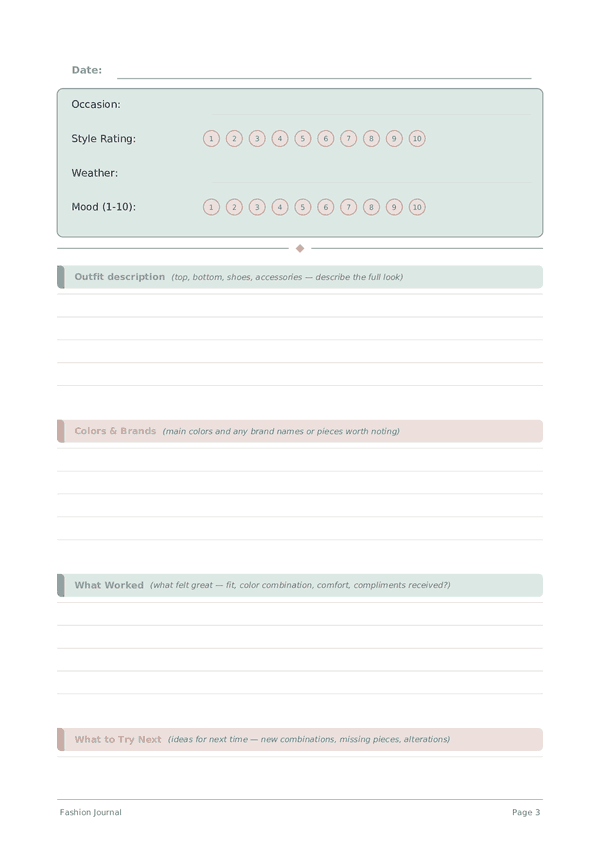
Here's what a typical entry looks like when filled in:
How to fill in each field
The top of each page has quick-fill fields (ratings, checkboxes, numbers). Below that is a lined section for writing. Here's what each field means:
Occasion
Work, casual, date night, party, gym, travel, special event...
Style Rating
How good did you feel in this outfit? (1=uncomfortable, 10=perfect)
Weather
Temperature and conditions — sunny, rainy, cold, hot...
Mood (1-10)
Rate your overall emotional state for the day. 1 means very low or depressed, 10 means exceptionally happy and positive. Don't overthink — go with your gut feeling.
Outfit description
Top, bottom, shoes, accessories — describe the full look
Colors & Brands
Main colors and any brand names or pieces worth noting
What Worked
What felt great — fit, color combination, comfort, compliments received?
What to Try Next
Ideas for next time — new combinations, missing pieces, alterations
Tips for success
When and how often to write
Log your outfit daily — even a 30-second entry builds a powerful style archive over time. Detailed entries (fabric notes, mood, occasion, comfort rating) are best for statement outfits or new purchases. Weekly, review what you wore most and least. Seasonally, use your journal to plan wardrobe edits: what to keep, donate, or replace. Before shopping trips, review your recent entries to avoid buying duplicates of what you already own.
Frequently Asked Questions
How does logging outfit, occasion, weather, and mood help me build a personal style?
Research in the Journal of Fashion Marketing and Management on wardrobe utilization shows that most wearers actively use only 20-30% of the garments they own. Logging occasion, weather, and mood alongside outfits surfaces which pieces earn repeat use across contexts — a basis for evidence-based wardrobe editing. Susie Faux's original capsule wardrobe concept (1970s) and Donna Karan's Seven Easy Pieces (1985) rest on the same idea: identify what works, then keep refining toward fewer, better items.
Why rate both style and mood — aren't they the same thing?
They diverge in meaningful ways. The Journal of Fashion Marketing and Management has documented enclothed cognition — the influence of clothing on the wearer's psychological state. A 9/10 mood with a 6/10 style rating tells you the outfit didn't look exceptional but felt right; a 9/10 style with 5/10 mood signals an impressive outfit that didn't serve you. Tracking both shows when style choices support well-being and when they're costuming.
How do I use what worked and what to try next prompts effectively?
These fields turn each entry into a small experiment. The capsule wardrobe methodology pioneered by Susie Faux (1970s) and refined in Donna Karan's Seven Easy Pieces (1985) depends on iterative learning: every outfit either confirms or revises a hypothesis about silhouette, color, proportion. 'What worked' captures successful elements (high-waist with cropped knit); 'what to try next' commits you to one specific test — a different sleeve length, a layering experiment, a new color combination.
How is this journal different from outfit-planning apps like Stylebook or Whering?
Apps photograph and catalog items but rely on you to remember why something worked. Writing forces articulation — naming proportion, fabric drape, occasion fit — which deepens learning. The Journal of Fashion Marketing and Management literature on style identity development emphasizes reflective practice over passive cataloging. Apps and journals work together: use the app for inventory and visual reference, the journal for the analysis that turns repeated outfits into a coherent personal style.
Can this journal support sustainable wardrobe choices?
Yes. The Ellen MacArthur Foundation's A New Textiles Economy (2017) documents that the apparel industry produces 53 million tonnes of fiber annually, much of it underused. McKinsey's State of Fashion reports similarly stress that wear frequency is the main personal sustainability lever. Logging outfit recurrence reveals cost-per-wear patterns — pieces worn 30+ times are far more sustainable than rarely worn statement items. The journal turns abstract sustainability goals into concrete wardrobe data.
How long until I can see my personal style emerge from entries?
Plan on 60-90 logged days. Capsule wardrobe methodology (Faux, 1970s; Karan, 1985) and Journal of Fashion Marketing and Management style identity research suggest that patterns of color preference, silhouette gravitation, and proportion intuition need a few months to clarify. Review monthly: which combinations earn 8+ style ratings repeatedly? Which colors appear in your highest-mood entries? Personal style is empirical, not aspirational — the journal makes it visible.
What should I write in the colors and brands prompt — and why does it matter?
Record specific colors (not 'blue' but 'navy' or 'cobalt') and exact brand names. Over 100+ entries, this data shows which brands earn repeat wear — useful for future purchases. The Journal of Fashion Marketing and Management's research on brand loyalty confirms that personal experience outweighs marketing in shaping long-term preferences. Color tracking also surfaces unconscious palette gravitation; many wearers discover they actually wear five colors in rotation, not the dozen they own.
Common mistakes that waste fashion journal entries?
First, photographing without writing — an image alone doesn't capture why an outfit succeeded. Second, scoring only the 'cute' outfits, skipping daily basics that fill 80% of life. Third, generic descriptions like 'jeans and tee' instead of specific cut, fit, and brand. Fourth, ignoring the weather field — a great winter look fails in July. Fifth, not reviewing entries; the Ellen MacArthur Foundation principle of wear-frequency tracking requires periodic data review, not just collection.
You Might Also Like
Scroll to zoom, drag to move