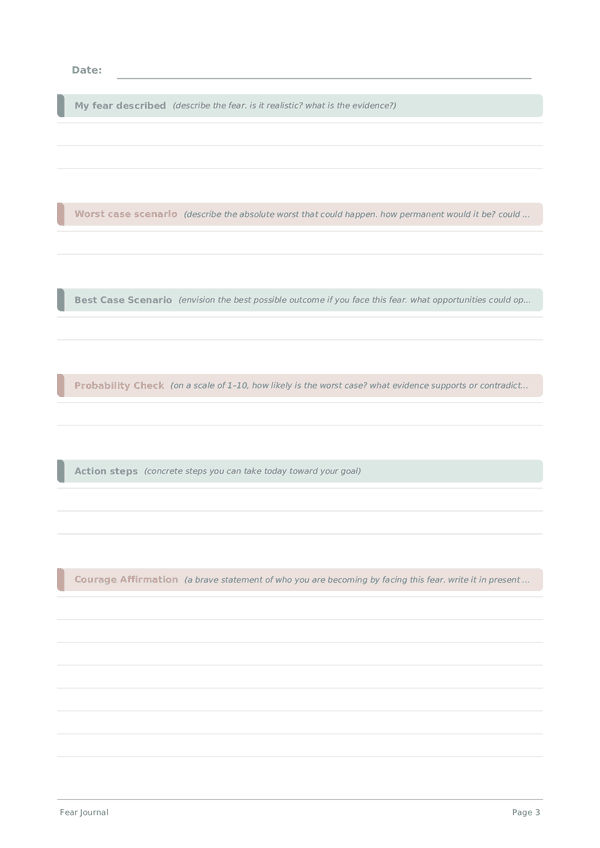
Printable Fear Journal
Fear exploration and courage-building journal
Face your fears with structured analysis and courageous action. Based on fear-setting methodology, this journal helps you examine fears rationally, envision outcomes, and take the steps that transform fear into freedom.
Customize fields
Toggle fields on or off. Click the pencil to rename, or add your own fields.
What is this journal?
A fear journal is a structured practice for confronting and dismantling the fears that hold you back. Each entry walks you through describing a fear, examining worst and best case scenarios, reality-testing the probability, and identifying concrete steps to move forward despite the fear.
This journal is for anyone who feels stuck, anxious, or held back by fears — whether rational or irrational. It works for major life fears (career changes, public speaking, relationship vulnerability) as well as the quiet, daily anxieties that accumulate and constrict your life over time.
Research from exposure therapy and cognitive behavioral therapy shows that naming fears precisely and examining them objectively reduces their emotional charge. The structured format of this journal mirrors the therapeutic technique of "cognitive defusion" — creating distance between you and your fearful thoughts so you can see them clearly rather than be controlled by them.
Filled example
Here's what a typical entry looks like when filled in:
How to fill in each field
Each day you'll find several labeled sections with lines for writing. Here's what each section is for:
My fear described
Describe what you're afraid of in detail. Often fears shrink when you put them on paper. Be honest — this journal is for your eyes only.
Worst case scenario
Write the absolute worst-case scenario. Then ask: how likely is this, really? And if it happened, could I survive it? Usually, the answer is yes.
Best Case Scenario
Envision the best possible outcome if you face this fear. What opportunities could open up for you?
Probability Check
On a scale of 1–10, how likely is the worst case? What evidence supports or contradicts your fear?
Action steps
Break your goal into concrete next actions. What exactly will you do, when, and how? The more specific, the better.
Courage Affirmation
A brave statement of who you are becoming by facing this fear. Write it in present tense.
Tips for success
When and how often to write
Write whenever a fear feels strong enough to influence your decisions — this could be daily or several times a week. The key is capturing the fear while it is active, not after it has passed. Spend 10 minutes examining one fear per entry rather than listing many superficially. Weekly, review your fear entries and notice patterns: are they clustered around certain themes (rejection, failure, loss)? Monthly, celebrate the fears you confronted. This journal is most effective as an as-needed tool with a weekly review ritual.