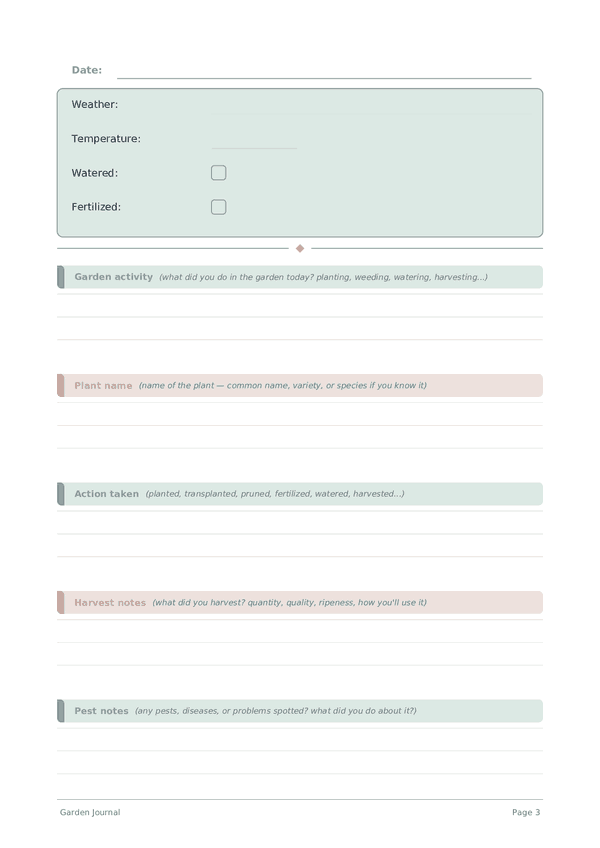
Printable Garden Journal
Plan, track, and learn from every growing season
A structured daily log for gardeners. Record weather, watering, fertilizing, plant activities, harvests, and pest observations — all in one place. Build a season-by-season knowledge base that helps you grow more successfully each year.
Customize fields
Toggle fields on or off. Click the pencil to rename, or add your own fields.
Benefits
How to Use
What is this journal?
A garden journal is a daily log for tracking weather conditions, plant care activities, and observations in your garden. By recording what you planted, watered, harvested, and noticed, you build a seasonal record that becomes more valuable each year — revealing what works in your specific soil, climate, and microenvironment.
This journal is for gardeners of all types — from balcony container growers to homesteaders with acres. Whether you grow flowers, vegetables, herbs, or a mix of everything, consistent journaling transforms your garden from a series of annual experiments into a cumulative body of knowledge.
Master gardeners consistently cite their journals as their most valuable tool. The garden journal captures information that no book or website can provide: what grew well in your specific conditions, when your microclimate's last frost actually occurs, which pest strategies worked in your soil, and the exact timing that produced your best harvests. Over years, this data becomes irreplaceable.
Filled example
Here's what a typical entry looks like when filled in:
How to fill in each field
The top of each page has quick-fill fields (ratings, checkboxes, numbers). Below that is a lined section for writing. Here's what each field means:
Weather
Sunny, cloudy, rain, wind — current conditions
Temperature
Record your basal body temperature. Temperature shifts help track ovulation and overall cycle health.
Watered
Did you water your garden or specific plants today?
Fertilized
Did you apply fertilizer or soil amendments to your plants today?
Garden activity
What did you do in the garden today? Planting, weeding, watering, harvesting...
Plant name
Name of the plant — common name, variety, or species if you know it
Action taken
Planted, transplanted, pruned, fertilized, watered, harvested...
Harvest notes
What did you harvest? Quantity, quality, ripeness, how you'll use it
Pest notes
Any pests, diseases, or problems spotted? What did you do about it?
Observations
General garden observations — growth progress, weather effects, soil condition, wildlife
Tips for success
When and how often to write
During the growing season, write a brief entry every day or every other day \u2014 even just noting weather, watering, and any visible changes. Weekly, do a deeper walkthrough and record plant health, new growth, and pest activity. At season\u2019s end, review the full log and write a summary of what worked, what failed, and what to change. In the off-season, revisit your journal monthly when planning next year\u2019s garden.