Printable Goal Journal
Track your progress, stay motivated, and achieve more every day
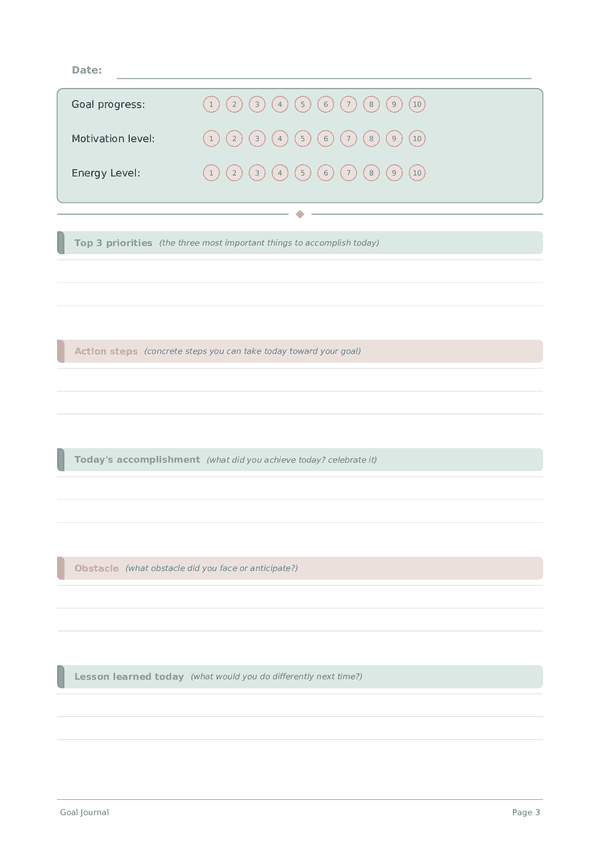
A hybrid goal journal that combines daily progress tracking with structured writing. Rate your goal progress, motivation, and energy at a glance, then dive deeper with priority setting, action planning, and reflection. Designed to keep you focused and accountable.
Customize fields
Toggle fields on or off. Click the pencil to rename, or add your own fields.
Benefits
How to Use
What is this journal?
A goal journal is a structured daily practice that bridges the gap between setting goals and actually achieving them. Rather than simply writing down what you want to accomplish, this journal guides you through a daily cycle of planning, acting, and reflecting — the three pillars of consistent progress.
This journal is designed for anyone who sets goals but struggles with follow-through. Whether you are working toward career milestones, fitness targets, creative projects, or personal development, the combination of progress tracking and reflective writing helps you stay accountable and adapt your approach as you learn what works.
Research in behavioral psychology shows that people who write down their goals and track progress daily are 42% more likely to achieve them. By rating your motivation and energy alongside your written reflections, you build a rich dataset of your own patterns — when you are most productive, what obstacles recur, and which strategies actually move the needle.
Filled example
Here's what a typical entry looks like when filled in:
How to fill in each field
The top of each page has quick-fill fields (ratings, checkboxes, numbers). Below that is a lined section for writing. Here's what each field means:
Goal progress
How much progress did you make today? Describe steps taken or milestones reached
Motivation level
How motivated did you feel today? Rate from 1 (drained) to 10 (unstoppable)
Energy Level
How energized do you feel this morning? (1=exhausted, 5=fully charged)
Top 3 priorities
The three most important things to accomplish today
Action steps
Break your goal into concrete next actions. What exactly will you do, when, and how? The more specific, the better.
Today's accomplishment
Write something you achieved today, no matter how small. Acknowledging daily wins builds confidence and momentum.
Obstacle
What obstacle did you face or anticipate?
Lesson learned today
Capture one insight from today's experience. Over time, these lessons become a personal wisdom library.
Goals for Tomorrow
What do you want to accomplish tomorrow?
Tips for success
When and how often to write
Fill in one page each evening, reviewing what you did today toward your goals. Weekly, spend 10 minutes reading back through the week to spot patterns. Monthly, reassess whether your goals still align with what matters most to you. If a goal no longer excites you, it's okay to replace it — that's growth, not failure.
Frequently Asked Questions
How do I choose 'top 3 priorities' that actually get done?
Pick three or fewer — not a long list. Locke and Latham's goal-setting theory (2002, American Psychologist, 57(9)) showed that specific, difficult, consciously committed goals produced higher performance than 'do your best' across hundreds of studies. The seven-line section is intentionally narrow — write three concrete deliverables you can verify by evening, not aspirational themes.
What's the right way to write action steps?
Use if-then implementation intentions. Gollwitzer (1999, American Psychologist, 54(7)) and Gollwitzer and Sheeran (2006, Advances in Experimental Social Psychology, 38, meta-analyzing 94 studies) found if-then plans roughly doubled goal-completion rates. Instead of 'work on report,' write 'after lunch I'll draft section 2 for 45 minutes.' Specificity around time and trigger is what makes the difference.
Why rate motivation and energy separately?
They diverge. You can be highly motivated but low on energy, or the reverse. Self-Determination Theory (Deci and Ryan, 2000, Psychological Inquiry, 11(4)) treats motivation as a matter of quality and source — autonomous versus controlled — distinct from physiological energy. Tracking both on 0-10 scales lets you distinguish whether low output stems from a motivational issue (purpose, autonomy) or a recovery issue (sleep, fatigue).
How should I use the 'obstacle' line?
Write the obstacle and your response to it. Duckworth ('Grit', Scribner, 2016) and her peer-reviewed work (Duckworth et al., 2007, JPSP, 92(6)) emphasize that obstacle-handling — not obstacle-absence — predicts long-term goal achievement. Two lines enforces brevity: name the friction and one adjustment, not a complaint. Patterns across weeks will reveal recurring blockers worth restructuring around.
What makes a 'momentum check' worth doing?
A momentum check is one sentence on whether the past few days moved you closer to or further from your goal. Carver and Scheier's control theory (1990, Psychological Review, 97(1)) treats progress velocity as a key affective signal. Rate honestly — accelerating, holding, or losing ground. Three slipping days in a row warrant a system review, not more willpower.
Should daily goals connect to bigger goals?
Yes. Translating 'why it matters' across levels prevents drift. Sheldon and Elliot (1999, JPSP, 76(3)) on self-concordant goals found that goals aligned with intrinsic motives produced more effort and greater well-being than externally imposed goals. When today's action steps roll up to a goal you can name, daily effort accumulates rather than scatters. Daily completion plus weekly review keeps short-cycle action aligned with longer-term goals.
How is this different from a to-do list?
A to-do list tracks tasks; this journal tracks the relationship between tasks and your motivational state. The tracker — goal progress, motivation level, energy level — plus reflection (accomplishment, lesson learned, goals for tomorrow) operationalizes Locke and Latham's feedback principle (2002, American Psychologist, 57(9)): goals need progress feedback to remain motivating. Lists alone don't supply that. Daily completion plus weekly review keeps short-cycle action aligned with longer-term goals.
What if I miss my daily goals consistently?
Diagnose rather than push harder. Persistent misses typically signal one of these: goals too ambitious for available time, low energy from sleep or illness, competing priorities, or goals that aren't self-concordant (Sheldon and Elliot, 1999, JPSP, 76(3)). Review a week of entries before making adjustments. Repeated failure is data about the system — not a verdict on your character.
You Might Also Like
Scroll to zoom, drag to move