Printable Gratitude Journal
Cultivate thankfulness and positivity daily
Transform your mindset by focusing on the good in your life. This journal provides a simple daily structure to record what you are grateful for, capture positive moments, and affirm your best self.
Customize fields
Toggle fields on or off. Click the pencil to rename, or add your own fields.
Benefits
How to Use
What is this journal?
A gratitude journal is one of the most researched and effective wellbeing practices in positive psychology. The concept is simple: each day, you deliberately focus on the good things in your life — from major blessings to small everyday pleasures. This conscious shift in attention rewires your brain over time, making you naturally more attuned to positivity.
Developed from research by psychologists Robert Emmons and Michael McCullough, gratitude journaling has been shown to increase happiness by 25%, improve sleep quality, and reduce symptoms of depression. The practice takes just 5-10 minutes per day but compounds dramatically over weeks and months.
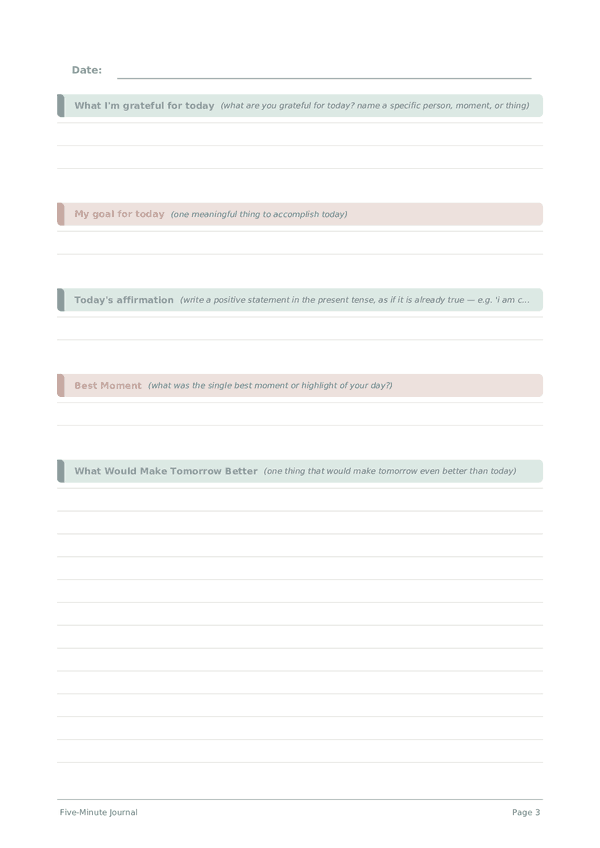
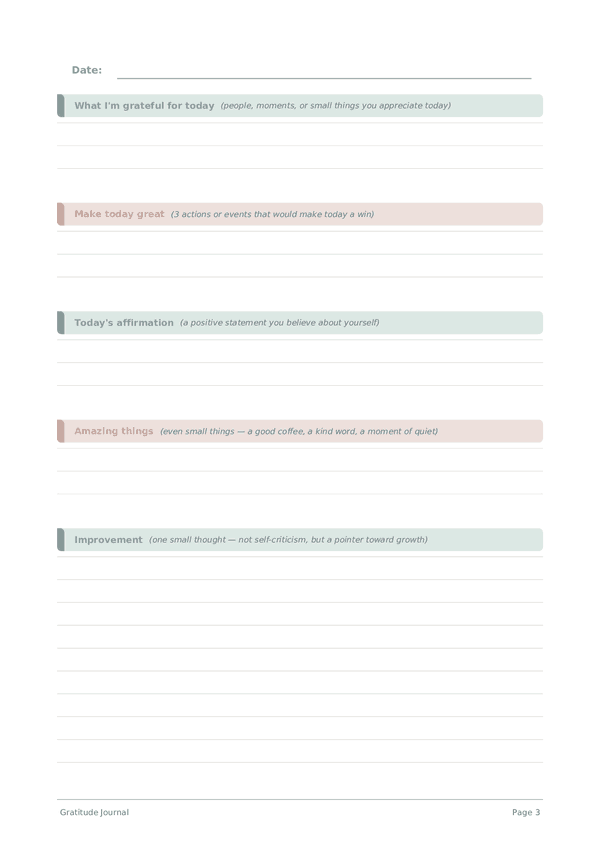
This journal uses a proven five-section structure: what you are grateful for, how to make today great, a personal affirmation, amazing things that happened, and what you could improve. This balanced approach ensures you are not just counting blessings but actively shaping a more positive, intentional life.
Filled example
Here's what a typical entry looks like when filled in:
How to fill in each field
Each day you'll find several labeled sections with lines for writing. Here's what each section is for:
What I'm grateful for today
List 1–3 things you're grateful for today. They can be big or tiny — a good meal, a kind word, sunshine. Gratitude journaling is one of the most scientifically supported well-being practices.
Make today great
3 actions or events that would make today a win
Today's affirmation
Write a positive statement about yourself in the present tense, as if it's already true. For example: 'I am capable and resilient.' Repeating affirmations rewires your thinking patterns over time.
Amazing things
Even small things — a good coffee, a kind word, a moment of quiet
Improvement
One small thought — not self-criticism, but a pointer toward growth
Tips for success
When and how often to write
Write every evening before bed — gratitude journaling at night has been shown to improve sleep quality (research by Emmons & McCullough, 2003). It takes just 5 minutes. If daily feels like too much, three times per week still produces significant well-being benefits. The key is writing at a consistent time so it becomes automatic.