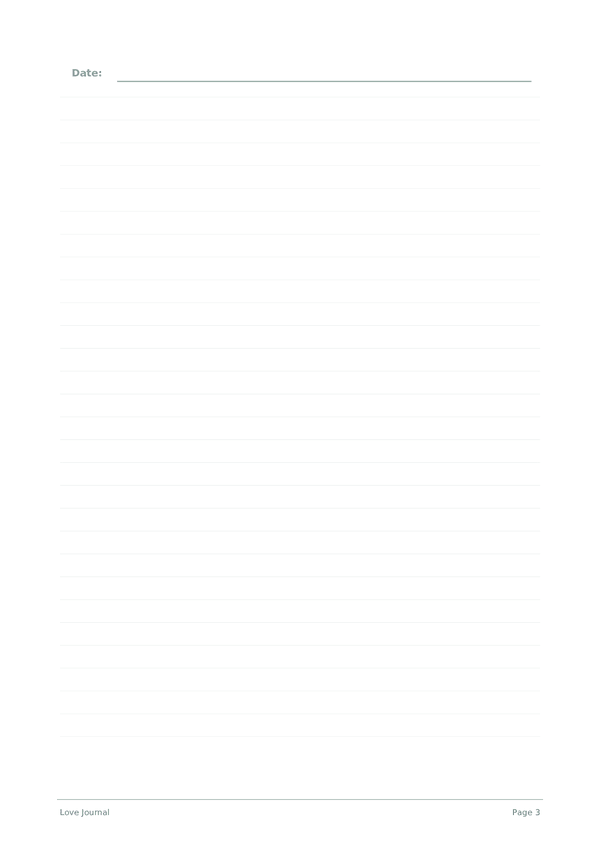
Printable Love Journal
A private space to nurture love, gratitude, and romance
Softly lined pages designed for couples and partners who want to deepen their connection through writing. Capture love letters, cherished memories, daily gratitude for each other, and reflections on your relationship journey — all in one beautiful journal.
Benefits
How to Use
What is this journal?
A love journal is a freeform writing space dedicated to exploring and celebrating the love in your life. Through guided prompts about daily reflections, cherished memories, and gratitude for your partner, you create a deeply personal love letter that unfolds over weeks, months, and years.
This journal is for anyone who wants to nurture romantic love with intentional reflection — whether you are in a new relationship discovering each other, or a long partnership where it is easy to let appreciation go unspoken. It can also be a beautiful gift, shared with your partner as a testament to what you have built together.
Love researchers have found that the simple act of writing about a partner with gratitude and specificity increases relationship satisfaction for both the writer and the partner. The practice of recalling and recording favorite memories also strengthens the emotional bonds associated with those memories, essentially deepening love through the act of remembering it.
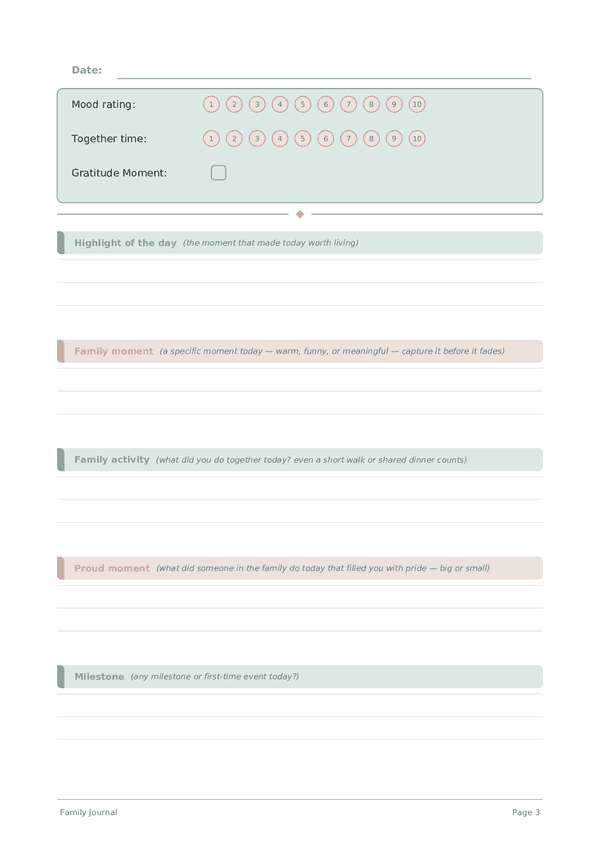
Filled example
Here's what a typical entry looks like when filled in:
Tips for success
When and how often to write
Write whenever love moves you — there is no wrong frequency for a love journal. That said, aim for at least once a week to maintain the practice. Many people find it natural to write after meaningful moments together or when missing their partner. There are no rules about length: a single heartfelt sentence can be more powerful than a full page. The key is authenticity, not consistency.
Frequently Asked Questions
Who is the Love Journal designed for — solo or shared?
Both work, in different modes. Solo: write love letters, daily grateful for my partner entries, and favorite memory captures that become a private keepsake. Shared: alternate entries with your partner, or write to each other and read together monthly. Esther Perel argues the erotic in long-term relationships depends on maintained selfhood (Perel, 2006, Mating in Captivity); solo writing protects that, shared writing builds the dialogue.
How is freeform writing different from the structured Couples Journal?
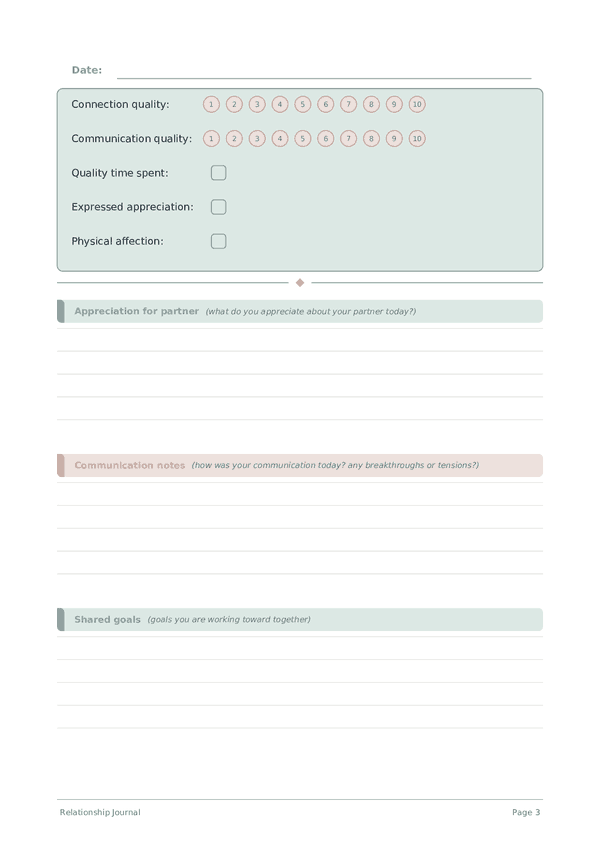
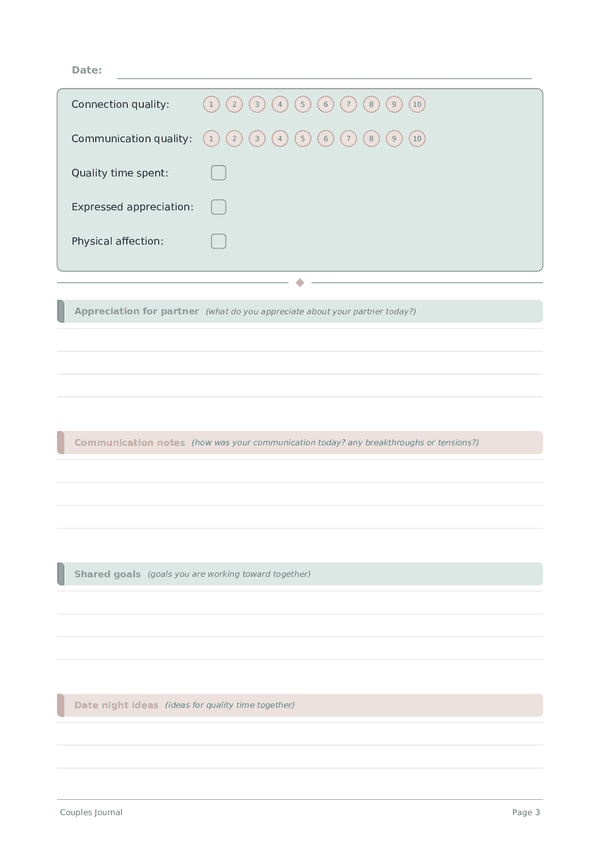
Couples Journal enforces daily ratings and checkboxes — useful for habit and pattern tracking. Love Journal uses lined pages with light prompts (prompt of the day, favorite memory, grateful for my partner), allowing longer letters, memories, and free reflection. Pick by intent: behavioral data and weekly review choose Couples; love letters, anniversaries, and narrative-rich entries choose Love.
What kinds of entries belong in favorite memory?
Specific scenes, not summaries. 'The hike in October when we got lost and ended up at that pierogi place' beats 'we had a great year.' Sensory detail — what you saw, said, ate, laughed about — makes memory retrievable decades later. Research on autobiographical memory consistently shows specific episodic detail anchors recall; vague summaries fade fast.
How often should I write in the Love Journal?
Choose a rhythm you will sustain — daily is rare and unnecessary. Once or twice weekly works for most couples, with deeper entries on anniversaries, after meaningful trips, or after good conversations. Gottman's research (Gottman, 1999, The Seven Principles for Making Marriage Work) emphasizes ongoing 'fondness and admiration' maintenance over intensity; the journal should feel like a ritual, not a chore.
Is the daily prompt enough, or should I plan what to write?
Start with prompt of the day and let it lead. The freeform structure rewards following whatever rises — a memory the prompt sparked, an unsent love letter, a thank-you that was never spoken aloud. Brene Brown's vulnerability framework (Brown, 2012, Daring Greatly) treats unguarded writing as practice in courage; pre-planning often produces polished but emotionally distant entries.
Can long-distance couples use this journal meaningfully?
Yes — arguably more so. Long-distance partners often lack the daily micro-touches that build attachment; written letters re-introduce sustained attention and slow, considered words. Sue Johnson's EFT framework (Johnson, 2008, Hold Me Tight) treats accessibility and responsiveness as core to attachment. Reading each other's entries during reunions creates the dense emotional rehydration distance wears down.
What if I find writing about love uncomfortable or cheesy?
Start with specific facts rather than declarations. 'You made coffee the way I like it on Tuesday without me asking' is more powerful than 'I love you forever.' Gary Chapman's framework (Chapman, 1992, The Five Love Languages — note: a popular framework with limited peer-review support) suggests appreciation lands when matched to behavior. Specifics also feel less performative; declarations come later, if at all.
How does re-reading past entries strengthen a relationship?
Returning to written memories rekindles what Gottman calls fondness and admiration (Gottman, 1999, The Seven Principles for Making Marriage Work) — the most protective layer against marital decline. Pages from a hard year remind you the relationship has weathered worse; pages from an easy year remind you the ordinary days mattered. Schedule anniversary reads — they reset perspective when stress narrows it.
You Might Also Like
Scroll to zoom, drag to move