Printable Meditation Journal
Track your practice, notice patterns, deepen your stillness
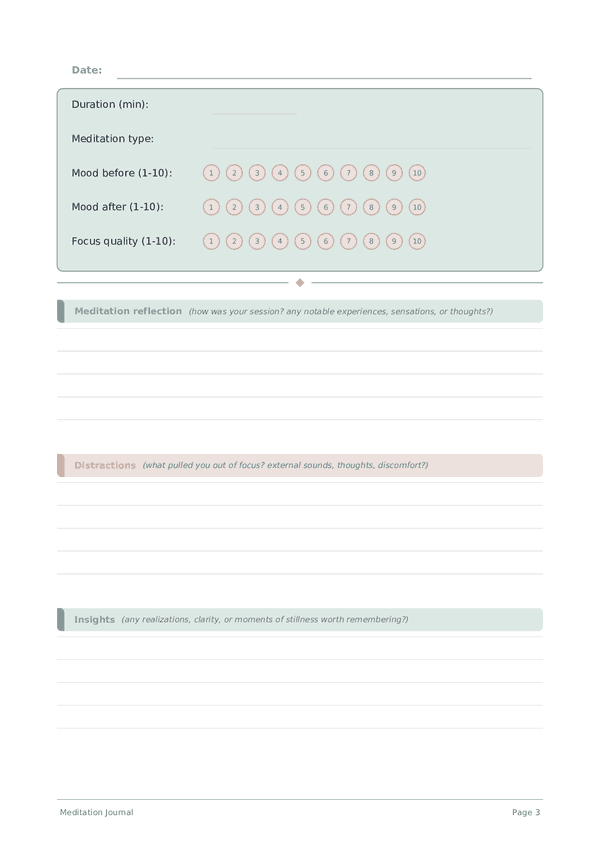
A daily meditation journal that combines a structured tracker — duration, type, mood before and after, focus quality — with a free-writing reflection area. Record what you noticed, what distracted you, and what insights arose. Over time, see exactly how meditation is changing your mind and mood.
Customize fields
Toggle fields on or off. Click the pencil to rename, or add your own fields.
Benefits
How to Use
What is this journal?
A meditation journal helps you deepen your meditation practice by creating a written record of each session. Just as athletes review game footage to improve performance, meditators who journal about their practice develop faster, notice subtler patterns, and maintain motivation through plateaus.
Whether you practice mindfulness meditation, transcendental meditation, body scanning, loving-kindness, or any other technique, this journal captures the key metrics of each session — duration, type, mood before and after, and focus quality — alongside space for detailed reflections on your experience.
The hybrid format makes it easy to log sessions quickly (the tracker takes 30 seconds) while the writing section invites deeper exploration of your inner landscape. Over time, you will see which techniques work best for you, how meditation affects your daily mood, and what insights emerge from regular contemplative practice.
Filled example
Here's what a typical entry looks like when filled in:
How to fill in each field
The top of each page has quick-fill fields (ratings, checkboxes, numbers). Below that is a lined section for writing. Here's what each field means:
Duration (min)
How many minutes did you meditate?
Meditation type
Breathwork, body scan, loving-kindness, guided, mantra, open awareness...
Mood before (1-10)
Rate your mood before sitting: 1=very agitated, 10=very calm
Mood after (1-10)
Rate your mood after sitting: 1=still agitated, 10=deeply calm
Focus quality (1-10)
How well could you maintain focus? 1=very scattered, 10=fully absorbed
Meditation reflection
How was your session? Any notable experiences, sensations, or thoughts?
Distractions
What pulled you out of focus? External sounds, thoughts, discomfort?
Insights
Any realizations, clarity, or moments of stillness worth remembering?
Gratitude
What are you grateful for today? Name one specific person, moment, or thing
Tips for success
When and how often to write
Fill in your tracker right after each meditation session — even short 5-minute sits count. The mood-before and mood-after fields take 10 seconds but reveal the most powerful data over time. Write your reflection within 2 minutes of finishing. If you meditate daily, journal daily. If you meditate a few times a week, capture each session.
Frequently Asked Questions
Why track 'mood before (1-10)' and 'mood after (1-10)' on every session?
It quantifies the immediate effect a single session produces. Schumer, Lindsay, and Creswell (2018, Journal of Consulting and Clinical Psychology, 86(7)) found brief mindfulness inductions reliably shift state affect. Over weeks the gap between mood before (1-10) and mood after (1-10) becomes a personal dose-response curve — which type and length actually move your state, not what teachers claim should work.
What goes in 'meditation type'?
Be specific about the technique: focused attention (breath, mantra), open monitoring, loving-kindness (metta), body scan, or guided. Fox et al. (2016, Neuroscience and Biobehavioral Reviews, 65) showed different styles produce different neural and psychological effects. Logging the exact technique lets you compare — concentration practices may sharpen focus quality (1-10), loving-kindness more often shifts mood after (1-10).
How honest should I be about 'focus quality (1-10)'?
Brutally. A scattered session is data, not failure. Goyal et al. (2014, JAMA Internal Medicine, 174(3)) and beginner-meditator data consistently show focus is highly variable in early practice. Rating a 3 on a distracted day teaches you which times, settings, or pre-session conditions correlate with deeper focus. Inflated ratings remove that signal.
How long should 'duration (min)' be to count?
Even five minutes counts as data. Basso et al. (2019, Behavioral Brain Research, 356) found 13 minutes daily for eight weeks produced measurable mood and attention changes in novice meditators. Longer is not strictly better; MBSR-derived programs use 20-45 minutes, but adherence beats heroic single sessions you cannot sustain across weeks.
What should I write about 'distractions'?
Name them concretely — 'work email', 'sound of dog', 'replaying argument'. Mrazek et al. (2013, Psychological Science, 24(5)) and broader mind-wandering research show distractions cluster around specific themes per person. Logging recurring distractions reveals what your mind is processing — often more useful than the meditation itself for understanding your current concerns.
Is meditation journaling appropriate for everyone?
Use caution if you have a trauma history or psychotic-spectrum diagnosis. Britton et al. (2021, Clinical Psychological Science, 9(6)) documented adverse effects in some meditators including dissociation and increased anxiety. Treleaven ('Trauma-Sensitive Mindfulness', Norton, 2018) outlines modifications. If you experience distress that worsens with practice, consult a licensed mental health professional with meditation experience.
What's the difference between this and a mindfulness journal?
The Mindfulness Journal structures a daily writing-based MBSR-style practice. This Meditation Journal supports a sitting practice — tracking duration, type, and outcomes around an actual meditation session. Choose by what you do: if you sit silently, use this; if you want guided journaling to cultivate present-moment awareness through writing, use the Mindfulness Journal.
Will I see results from logging sessions?
Self-monitoring strengthens behavior. Harkin et al. (2016, Psychological Bulletin, 142(2)) meta-analyzed 138 monitoring studies and found progress recording reliably improved goal attainment. For meditation specifically, Lacaille et al. (2018, Mindfulness, 9(2)) showed adherence increased when practitioners tracked sessions. The journal works as both behavior support and progress evidence. Even brief logged sessions accumulate into the practice base that yields measurable change.
You Might Also Like
Scroll to zoom, drag to move