Printable Mental Health Journal
A comprehensive daily check-in for your mind
Track mood, anxiety, energy, and sleep in one place to get a holistic view of your mental health. Reflect on your day to build emotional awareness and resilience.
Customize fields
Toggle fields on or off. Click the pencil to rename, or add your own fields.
Benefits
How to Use
What is this journal?
A mental health journal is a structured daily check-in that combines mood and wellness tracking with reflective writing. By rating key indicators like mood, anxiety, energy, and sleep quality each day, you build a longitudinal picture of your emotional landscape and the factors that influence it.
This journal serves anyone invested in their psychological well-being — whether you are managing a diagnosed condition, working through a difficult period, or simply want to understand yourself better. Therapists and counselors frequently recommend journaling as a complement to professional treatment.
Research published in the Journal of Affective Disorders indicates that consistent self-monitoring of mood and emotional states improves emotional regulation and helps people identify early warning signs before a downturn becomes a crisis. The combination of quantitative tracking and qualitative reflection creates both data and narrative — two powerful tools for self-understanding.
Filled example
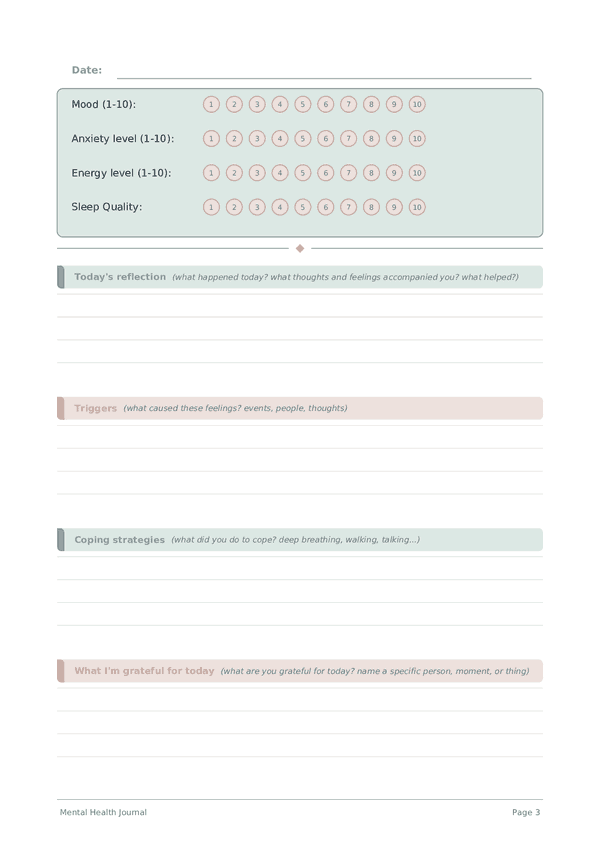
Here's what a typical entry looks like when filled in:
How to fill in each field
The top of each page has quick-fill fields (ratings, checkboxes, numbers). Below that is a lined section for writing. Here's what each field means:
Mood (1-10)
Rate your overall emotional state for the day. 1 means very low or depressed, 10 means exceptionally happy and positive. Don't overthink — go with your gut feeling.
Anxiety level (1-10)
Rate your anxiety level today. Putting a number on it makes the feeling more manageable and trackable.
Energy level (1-10)
Rate your physical and mental energy level. 1 means exhausted and drained, 10 means fully energized and alert. This helps you identify what activities boost or drain your energy.
Sleep Quality
Rate how restful your sleep was. 1 means terrible and restless, 5 means deep and refreshing. Quality matters as much as quantity.
Today's reflection
Look back at your day honestly. What went well? What could be better? This isn't about judgment — it's about learning and growing.
Triggers
Identify what caused your emotional reactions — events, people, thoughts, environments. Recognizing triggers gives you the power to prepare for or avoid them.
Coping strategies
What did you do to cope? Deep breathing, walking, talking...
What I'm grateful for today
List 1–3 things you're grateful for today. They can be big or tiny — a good meal, a kind word, sunshine. Gratitude journaling is one of the most scientifically supported well-being practices.
What went well
Even small wins count — name at least one
Tips for success
When and how often to write
Fill in the tracker daily to build a reliable mental health baseline. The writing section can be brief on good days (2–3 sentences) and longer on hard days (as much as you need). Review weekly to spot trends. If you're in therapy, review your journal before each session — it helps you make the most of your time with your therapist.
Frequently Asked Questions
What does this journal capture that a single mood score doesn't?
It separates four dimensions — mood, anxiety level (1-10), energy, sleep quality — on 0-10 scales. NIMH's HiTOP and clinical assessment frameworks treat these as distinguishable indicators rather than one composite. A day with low energy but stable mood reads differently from low mood with normal energy, and the reflection section lets you record context the numbers alone cannot capture.
How should I share this with my therapist?
Bring two to four weeks of completed entries to a session. APA's clinical practice guidance treats client-generated symptom data as adjunctive to assessment. Highlight days where ratings diverged sharply, or where a single trigger appeared in multiple entries. Many therapists use this format as between-session data; ask whether they prefer the tracker, the reflection, or both.
What goes in 'triggers' versus 'what went well'?
Triggers are situations, thoughts, people, or environments that shifted your ratings downward. What went well captures the opposite — moments that lifted mood or restored energy. Together they map your daily affect regulation. Fredrickson's broaden-and-build theory (2001, American Psychologist, 56(3)) supports actively logging positive events to widen behavioral repertoires over time. Sustained tracking surfaces patterns invisible in single days and supports informed clinical conversations.
How is this different from the Anxiety Journal or Mood Journal?
The Mental Health Journal is broader and lower-frequency: it samples four core dimensions plus open reflection, suited to a daily check-in. The Anxiety Journal centers on CBT thought records; the Mood Journal emphasizes emotional granularity. Choose by need — diagnosed anxiety pulls toward the Anxiety Journal, broad self-monitoring toward this one.
Can this help me notice early warning signs of decline?
Yes, that's a core use. Beck's cognitive model and Lewinsohn's behavioral model of depression both highlight slow drift in sleep, energy, and mood as prodromal signals. Tracking weeks of 0-10 ratings makes downward trends visible before they reach crisis thresholds. If you see sustained decline, contact a licensed mental health professional promptly.
What should I write in 'coping strategies'?
Note specifically what you did and how it landed. Aldao, Nolen-Hoeksema, Schweizer (2010, Clinical Psychology Review, 30(2)) found cognitive reappraisal and acceptance correlate with better outcomes; rumination and avoidance with worse. Categorizing your strategies — 'I took a walk', 'I scrolled social media' — over weeks reveals which actually help your ratings.
Is this safe to use if I'm having thoughts of self-harm?
Journaling is not a substitute for crisis care. If you're experiencing thoughts of self-harm or suicide, contact emergency services or a crisis line immediately. WHO Mental Health and APA crisis guidelines emphasize professional intervention as primary. The journal may complement ongoing treatment with a licensed mental health professional but should not delay urgent help.
How often should I complete the reflection section?
Aim for daily on the tracker, three to five times weekly on reflection. Daily reflection works for some but produces fatigue in others; Burton and King (2004, Journal of Research in Personality, 38(2)) showed even brief expressive writing produced effects, while Pennebaker (1997, Psychological Science, 8(3)) demonstrated three to four sessions weekly is often sufficient for emotional processing benefits.
You Might Also Like
Scroll to zoom, drag to move