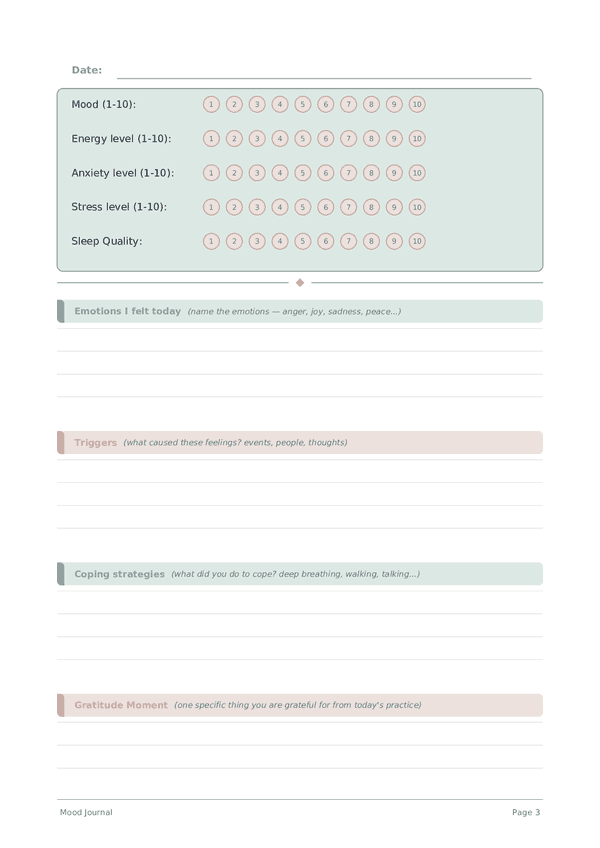
Printable Mood Journal
Track emotions, spot patterns, and build emotional awareness
A comprehensive daily mood journal that combines quantitative tracking with reflective writing. Rate your mood, energy, anxiety, stress, and sleep quality each day, then explore what emotions you felt, what triggered them, how you coped, what you are grateful for, and what patterns you noticed. Grounded in cognitive behavioral therapy and positive psychology research, this hybrid format helps you develop emotional intelligence, recognize recurring triggers, and build a personalized toolkit for emotional resilience.
Customize fields
Toggle fields on or off. Click the pencil to rename, or add your own fields.
Benefits
How to Use
What is this journal?
A mood journal is a daily self-monitoring tool that helps you understand the connection between your emotions, energy, sleep, and daily experiences. By tracking your mood numerically alongside written reflections, you create a personal emotional map that reveals patterns invisible in the moment.
Mood tracking is widely recommended by therapists and psychologists as a foundational practice for emotional intelligence. It helps you identify what triggers negative moods, what activities boost your wellbeing, and how factors like sleep and stress interact with your emotional state. Over weeks, the data becomes genuinely insightful.
This journal combines quick numerical ratings (mood, energy, anxiety, stress, sleep quality) with guided writing prompts for deeper exploration. The hybrid format means you can fill in the tracker in under a minute on busy days, while the writing section invites you to dig deeper when you have more time.
Filled example
Here's what a typical entry looks like when filled in:
How to fill in each field
The top of each page has quick-fill fields (ratings, checkboxes, numbers). Below that is a lined section for writing. Here's what each field means:
Mood (1-10)
Rate your overall emotional state for the day. 1 means very low or depressed, 10 means exceptionally happy and positive. Don't overthink — go with your gut feeling.
Energy level (1-10)
Rate your physical and mental energy level. 1 means exhausted and drained, 10 means fully energized and alert. This helps you identify what activities boost or drain your energy.
Anxiety level (1-10)
Rate your anxiety level today. Putting a number on it makes the feeling more manageable and trackable.
Stress level (1-10)
Rate your stress on a scale of 1–10. Over time, you'll identify your stress patterns and which coping strategies work best.
Sleep Quality
Rate how restful your sleep was. 1 means terrible and restless, 5 means deep and refreshing. Quality matters as much as quantity.
Emotions I felt today
Name the specific emotions you experienced. Research shows that labeling emotions reduces their intensity and increases self-awareness.
Triggers
Identify what caused your emotional reactions — events, people, thoughts, environments. Recognizing triggers gives you the power to prepare for or avoid them.
Coping strategies
What did you do to cope? Deep breathing, walking, talking...
Gratitude Moment
One specific thing you are grateful for from today's practice
Mood insight
What pattern or lesson about your emotions did you notice today?
Tips for success
When and how often to write
Fill in your mood tracker at the end of each day, ideally at the same time (before bed works well). The tracker numbers take under a minute. Add a few sentences of reflection — this is where the real insight lives. After two weeks, start reviewing your data weekly to spot which days score highest and what they have in common.
Frequently Asked Questions
How do five ratings plus narrative beat a single mood score?
Five 0-10 scales — mood, energy, anxiety level, stress level, and sleep quality — separate distinct constructs that move independently. Watson, Clark, and Tellegen's PANAS research (1988, JPSP, 54(6)) established that positive and negative affect are not opposite ends of one axis. Pairing numbers with narrative captures both the dimensional shape of your day and its meaning.
What is a 'mood insight,' and how do I arrive at one?
A mood insight is one pattern, lesson, or observation you noticed about your emotional life today — the synthesis step. Wilson and Gilbert's work on affective forecasting (2003, Advances in Experimental Social Psychology, 35) shows we predict our emotions poorly without data. Writing one weekly insight from your ratings turns abstract feelings into actionable self-knowledge.
How specific should I be in 'emotions I felt today'?
Use precise words, not 'good' or 'bad.' Kashdan, Barrett, and McKnight (2015, Current Directions in Psychological Science, 24(1)) showed that emotional granularity — distinguishing 'lonely' from 'rejected' from 'isolated' — predicts better regulation. The 7-line section gives you room to name three or four distinct feelings, and the journal's 'mood insight' depends on that level of resolution.
How does this journal apply positive psychology?
Through the gratitude moment and the insight section. Seligman's positive psychology framework (Seligman et al., 2005, American Psychologist, 60(5)) integrates positive emotion identification with meaning-making — both present here. Lyubomirsky ('The How of Happiness', Penguin, 2007) reports that gratitude practices contribute to lasting well-being gains. The hybrid format pairs that foundation with CBT-style trigger and coping tracking.
What patterns should I look for after a month of entries?
Run three checks: which weekdays correlate with low mood, which triggers appear in more than three entries, and whether sleep quality precedes the next-day mood shift. Watson et al.'s circadian and weekly affect research and the rumination patterns mapped by Watkins (2008, Psychological Bulletin, 134(2)) both suggest that weekly review surfaces patterns invisible on a day-to-day basis.
Should I complete mood ratings at the same time each day?
Yes — ideally in the evening for a retrospective assessment of the day. Time of day strongly affects rated mood (Stone et al., 2006, Emotion, 6(1), on diurnal mood patterns). Sampling at varying times introduces diurnal noise into your trend line. Pick one time and protect it; measurement consistency reveals real change rather than time-of-day artifact.
Is this journal sufficient for clinical mood disorders?
No. The journal supports self-awareness and can supplement treatment, but diagnosed mood disorders — major depression, bipolar disorder, dysthymia — require clinical care. APA, NIMH, and WHO Mental Health guidelines recommend evidence-based treatment from a licensed mental health professional. Many clinicians use mood charting alongside therapy; ask yours whether this format would be useful.
How is this different from emotion-tracking apps?
Apps generate longitudinal data but reduce reflection to taps. The hybrid layout requires written processing — Lieberman et al. (2007, Psychological Science, 18(5)) showed that labeling emotions in words reduces amygdala reactivity, an effect produced by language rather than by selection. The seven-line narrative captures the appraisals driving the ratings, which is what makes the data actionable.
You Might Also Like
Scroll to zoom, drag to move