Printable Motivation Journal
Daily motivation and goal-driven action journal
Fuel your motivation and drive consistent action toward your goals. Connect daily tasks to your deeper purpose, overcome obstacles, and build unstoppable momentum through intentional daily practice.
Customize fields
Toggle fields on or off. Click the pencil to rename, or add your own fields.
What is this journal?
A motivation journal is a daily practice designed to keep you connected to your purpose and moving forward with intention. Each entry reconnects you with your "why," sets a clear goal, plans action steps, and celebrates progress — creating a self-reinforcing cycle of motivation.
This journal is for anyone who struggles with consistency, procrastination, or losing steam on important projects. Whether you are building a business, training for a marathon, or working through a personal transformation, this journal keeps the fire lit by focusing on purpose, progress, and reward.
Research on intrinsic motivation shows that connecting daily actions to meaningful purpose increases persistence by up to 3x. The combination of goal clarity, obstacle anticipation, and deliberate self-reward creates what psychologists call a "motivation scaffold" — external support that sustains effort until habits become self-sustaining.
Filled example
Here's what a typical entry looks like when filled in:
How to fill in each field
Each day you'll find several labeled sections with lines for writing. Here's what each section is for:
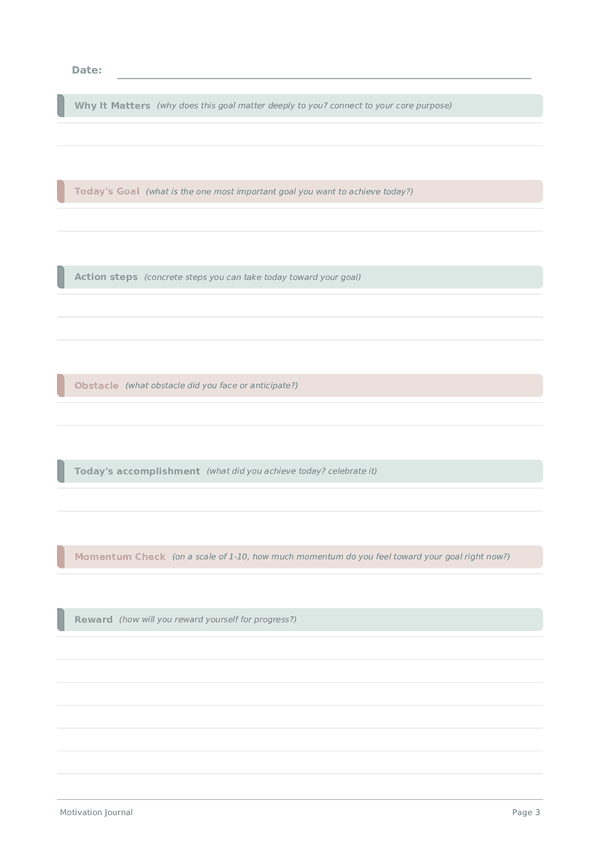
Why It Matters
Why does this goal matter deeply to you? Connect to your core purpose
Today's Goal
What is the one most important goal you want to achieve today?
Action steps
Break your goal into concrete next actions. What exactly will you do, when, and how? The more specific, the better.
Obstacle
What obstacle did you face or anticipate?
Today's accomplishment
Write something you achieved today, no matter how small. Acknowledging daily wins builds confidence and momentum.
Momentum Check
On a scale of 1-10, how much momentum do you feel toward your goal right now?
Reward
How will you reward yourself for progress?
Tips for success
When and how often to write
Write every morning to set your motivational tone for the day — 5 minutes is enough. Define your top priority and connect it to your deeper purpose. In the evening, spend 3 minutes noting what energized you and what drained you. This morning-evening pattern reveals your motivational rhythm over time. After two weeks, review to discover your peak motivation days and what conditions created them. Use this data to structure your week around your natural energy cycles.
Frequently Asked Questions
How does 'why it matters' drive motivation?
Self-Determination Theory (Deci and Ryan, 2000, Psychological Inquiry, 11(4); Ryan and Deci, 2000, American Psychologist, 55(1)) shows intrinsic motivation, pursuing goals tied to autonomy, competence, and relatedness, produces more persistence than external pressure. Sheldon and Elliot (1999, JPSP, 76(3)) on self-concordant goals confirms this. Two lines force you to connect today's action to a personally held reason.
What's the right way to fill 'today's goal'?
One concrete deliverable, not a theme. Locke and Latham (2002, American Psychologist, 57(9)) on goal-setting theory show specific and challenging goals outperform 'do your best' across 1,000+ studies. Two lines give you space for one verifiable target by end of day. 'Write 500 words on the proposal' beats 'work on the proposal'.
How does 'action steps' differ from 'today's goal'?
Action steps break the goal into time-bound implementation intentions. Gollwitzer (1999, American Psychologist, 54(7)) and Gollwitzer and Sheeran (2006, Advances in Experimental Social Psychology, 38) meta-analyzed 94 studies and found if-then plans doubled completion rates. Three lines for three concrete actions with cues, when, where, how, turn intention into scheduled behavior.
What does 'momentum check' help with?
It's a brief progress signal. Carver and Scheier's control theory (1990, Psychological Review, 97(1)) treats velocity of goal progress as a key motivational input. Rate honestly whether the past few days accelerated, held steady, or slipped. The line forces awareness early; declining momentum across three days warrants a system review rather than additional effort.
Why have a 'reward' field?
Behavioral psychology (Skinner; Wood and Neal, 2007, Psychological Review, 114(4) on habit) treats immediate reinforcement as essential for behavior consolidation. Naming a daily reward, even a small one, closes the cue-action-reward loop Charles Duhigg popularized ('The Power of Habit', Random House, 2012). One line; the reward should be proportional, not aspirational.
What if motivation drops despite using this journal?
Diagnose the source. Deci and Ryan (2000) suggest checking autonomy (am I choosing this?), competence (can I do this?), relatedness (does this connect me to others?). A sustained motivation drop may also signal burnout, depression, or values-misalignment. If it persists, consult a licensed mental health professional; journaling cannot resolve clinical-level motivation collapse.
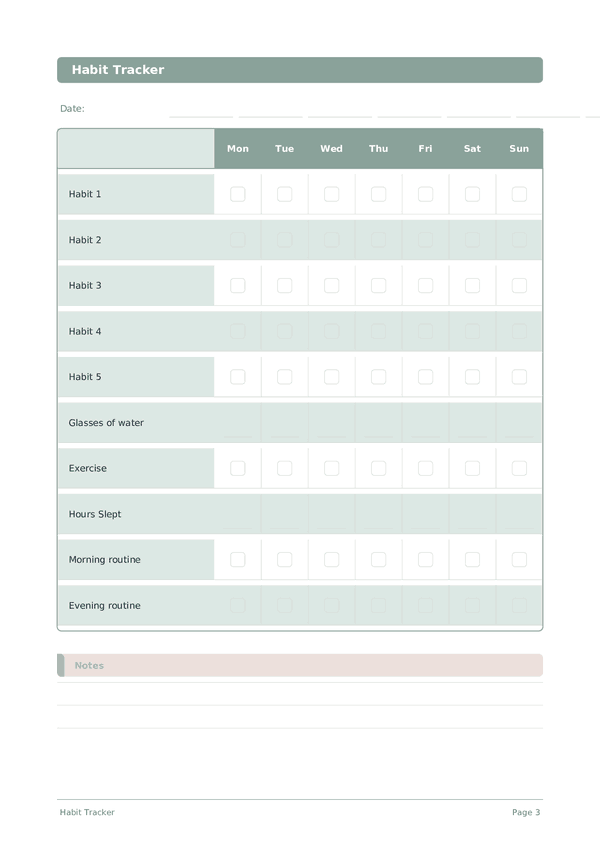
How is this different from a habit tracker?
Habit trackers reinforce automaticity for established behaviors; this journal targets the motivational layer underneath, why you act and what obstacles arise. Lally et al. (2010, European Journal of Social Psychology, 40(6)) on habit formation shows automaticity takes 66 days median; before that, structured motivation support like this format helps the behavior reach automaticity.
Is this useful for long-term goals?
Yes, with weekly review. Daily entries capture short-cycle motivation; weekly reading of accumulated entries reveals whether daily actions roll up to the larger goal. Duckworth ('Grit', Scribner, 2016) and Duckworth et al. (2007, JPSP, 92(6)) found long-term goal achievement depends on sustained interest across months, and the journal's accumulated record is your evidence base for that sustenance.
You Might Also Like
Scroll to zoom, drag to move