Printable Personal Growth Journal
Daily personal growth and self-improvement journal
Accelerate your personal development with daily intention-setting, mindset reflection, and growth tracking. Step outside your comfort zone and build the skills and habits of your best self.
Customize fields
Toggle fields on or off. Click the pencil to rename, or add your own fields.
What is this journal?
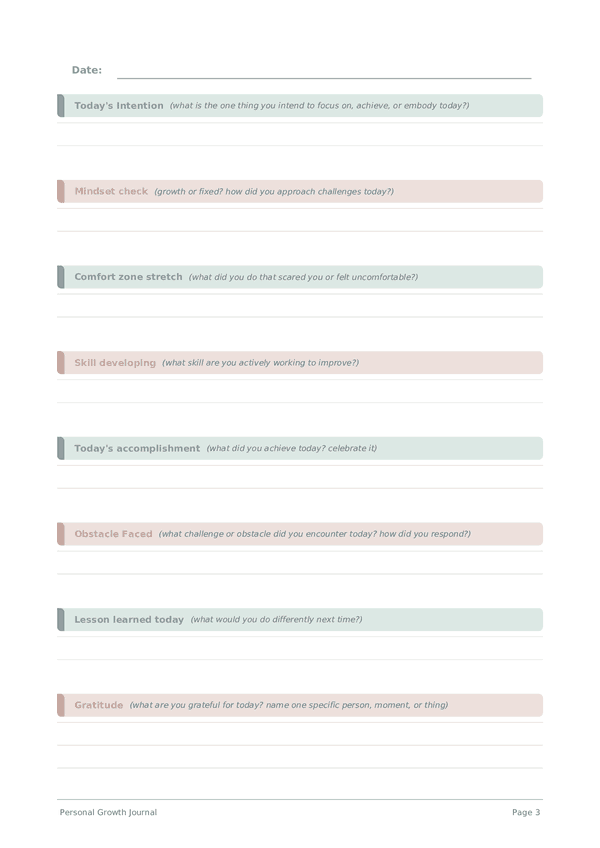
A personal growth journal is your daily companion for intentional self-improvement. It provides a structured framework for setting micro-goals, tracking your mindset, pushing beyond comfort zones, developing new skills, and reflecting on progress — all in one page per day.
Personal growth is not about dramatic overnight transformations. Research on behavior change shows that small, consistent actions compound into remarkable results over time. This journal captures that daily 1% improvement, creating a written record of your evolution that keeps you motivated when progress feels invisible.
The eight-section format covers your daily intention, mindset check, comfort zone stretch, skill development, accomplishment, obstacle faced, lesson learned, and gratitude. Together, these create a holistic view of your growth that balances ambition with self-compassion.
Filled example
Here's what a typical entry looks like when filled in:
How to fill in each field
Each day you'll find several labeled sections with lines for writing. Here's what each section is for:
Today's Intention
What is the one thing you intend to focus on, achieve, or embody today?
Mindset check
Growth or fixed? How did you approach challenges today?
Comfort zone stretch
What did you do that scared you or felt uncomfortable?
Skill developing
What skill are you actively working to improve?
Today's accomplishment
Write something you achieved today, no matter how small. Acknowledging daily wins builds confidence and momentum.
Obstacle Faced
What challenge or obstacle did you encounter today? How did you respond?
Lesson learned today
Capture one insight from today's experience. Over time, these lessons become a personal wisdom library.
Gratitude
What are you grateful for today? Name one specific person, moment, or thing
Tips for success
When and how often to write
Write every evening, reflecting on how you grew today — even slightly. The entries are short enough for daily use (10 minutes). Each section builds on the others: today's goal leads to tomorrow's comfort zone stretch, which feeds next week's mindset insights. Skipping days is fine, but aim for at least 5 days per week to build momentum.
Frequently Asked Questions
Why does this journal include a 'mindset check' section?
It targets fixed versus growth mindset, a construct from Carol Dweck ('Mindset', Random House, 2006) and her peer-reviewed work. Dweck's research found that beliefs about whether ability is fixed or developable predict how people respond to setbacks. Two lines invite a daily check: where did you treat ability as fixed today, and where as developable? Naming the pattern weakens the fixed-mindset default.
What goes in 'comfort zone stretch'?
Write the specific action you took today that pushed beyond familiar territory — speaking up, declining a default, trying a new method. Yerkes-Dodson research and Bjork's desirable difficulties (Bjork and Bjork, 2011) both suggest learning happens at the edge of capacity. Two lines is room for one concrete stretch and how it landed, not aspirational themes.
How do I write a useful 'today's intention'?
Sheldon and Elliot (1999, JPSP, 76(3)) on self-concordant goals found that intentions tied to intrinsic values produced more well-being and persistence than externally-driven ones. Write an intention rooted in why it matters to you, not why it should. Two lines forces clarity — one quality you want to embody or one outcome you'll pursue, with the value behind it.
What's the difference between 'skill developing' and 'accomplishment'?
Skill developing names the deliberate practice you invested in — what Ericsson ('Peak', Eamon Dolan, 2016) and his research call effortful skill refinement. Accomplishment is the day's tangible win. The pairing matters: deliberate practice often produces no visible accomplishment, yet accumulates capability. Logging both prevents discouragement on no-output days and builds the input data growth requires across months of practice.
How is 'lesson learned today' useful day after day?
Kolb's experiential learning cycle and Park's meaning-making research (2010, Psychological Bulletin, 136(2)) treat reflection as the step that compounds experience into capability. One lesson per day across a year is a personal field guide. Two lines forces synthesis — one transferable principle, not a journal entry restating what happened. The daily reflection builds the input data growth requires over months.
Is 'obstacle faced' for venting or analysis?
Analysis. Pennebaker and Smyth research on expressive writing (Smyth, 1998, Journal of Consulting and Clinical Psychology, 66(1)) found benefits emerged when participants moved from venting to cognitive processing across sessions. Two lines forces compression: name the obstacle, name one thing about how you engaged with it. Pure venting suits crisis writing, not growth tracking.
How does this compare to a goal journal?
A goal journal optimizes execution of pre-set objectives; a personal growth journal develops the underlying person. Both track action, but this one targets mindset, comfort-zone work, and skill development — the inputs Dweck (Random House, 2006) and Duckworth (Scribner, 2016) identify as upstream of consistent goal achievement. Use both if you want execution plus development.
How long until I see growth from this practice?
Three to six months for identity-level changes. Lally et al. (2010, European Journal of Social Psychology, 40(6)) found habit formation took 66 days median; identity-level shifts take longer. Yeager et al. (2019, Nature, 573) showed brief mindset interventions produced effects on academic outcomes years later. Consistency over months beats intensity in shorter windows.
You Might Also Like
Scroll to zoom, drag to move