Printable Positive Thinking Journal
Daily positive thinking and optimism practice journal
Train your brain to notice and amplify the good. Build an optimistic mindset through daily recognition of positive moments, reframing challenges, acts of kindness, and intentional gratitude.
Customize fields
Toggle fields on or off. Click the pencil to rename, or add your own fields.
What is this journal?
A positive thinking journal is a daily practice that trains your brain to notice and amplify the good in your life. Each entry guides you through finding silver linings, reframing challenges, and recognizing moments of joy and kindness — gradually shifting your default lens from what is wrong to what is right.
This journal is for anyone who wants to cultivate a more optimistic outlook without ignoring reality. It is especially helpful if you tend toward rumination, pessimism, or simply want to build resilience during uncertain times.
Neuroscience research on neuroplasticity shows that deliberately focusing on positive experiences for even 15-30 seconds strengthens the neural pathways associated with well-being. Over weeks of consistent practice, this journal literally rewires your brain's tendency to scan for threats toward scanning for opportunities and gratitude.
Filled example
Here's what a typical entry looks like when filled in:
How to fill in each field
Each day you'll find several labeled sections with lines for writing. Here's what each section is for:
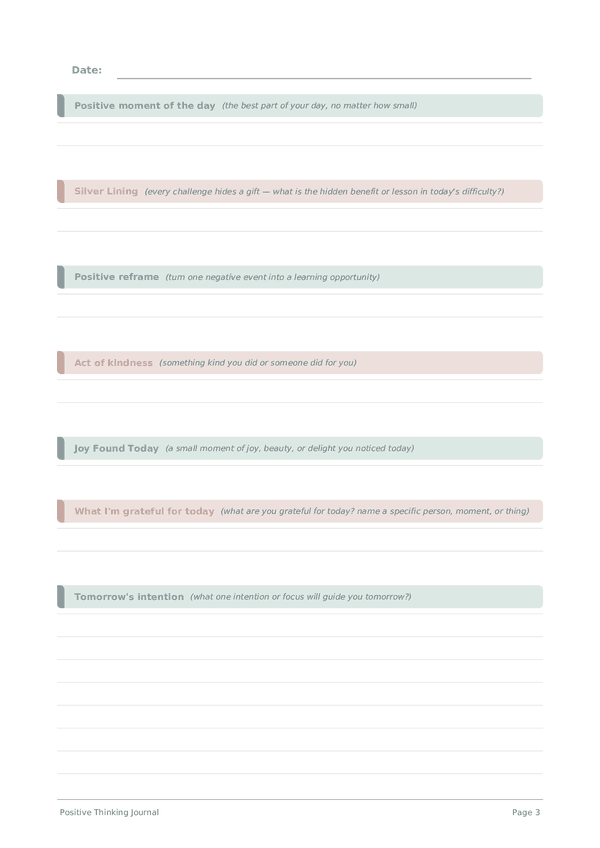
Positive moment of the day
Describe one positive moment from today, no matter how small. Training your brain to notice good moments shifts your overall outlook toward optimism.
Silver Lining
Every challenge hides a gift — what is the hidden benefit or lesson in today's difficulty?
Positive reframe
Turn one negative event into a learning opportunity
Act of kindness
Something kind you did or someone did for you
Joy Found Today
A small moment of joy, beauty, or delight you noticed today
What I'm grateful for today
List 1–3 things you're grateful for today. They can be big or tiny — a good meal, a kind word, sunshine. Gratitude journaling is one of the most scientifically supported well-being practices.
Tomorrow's intention
What one intention or focus will guide you tomorrow?
Tips for success
When and how often to write
Write every evening, taking 5-10 minutes to capture positive moments from your day. Morning entries work too, focused on intentions and what you appreciate right now. The critical habit is consistency — positive thinking patterns take roughly 21 days of daily practice to start feeling automatic. If you miss a day, simply resume without guilt. Weekly, re-read your entries and notice how your perspective is shifting. The journal trains your reticular activating system to filter for good.
Frequently Asked Questions
Is 'positive thinking' supported by research?
Yes, with caveats. Positive psychology — founded by Martin Seligman (Seligman et al., 2005, American Psychologist, 60(5)) — works not as forced optimism but as deliberate attention to positive content. The 'three good things' exercise is its best-validated practice. Forced positivity — denying negatives — is associated with poorer outcomes. This journal's structure follows the evidence-based variant.
How is 'silver lining' different from toxic positivity?
Silver lining identifies a learning, perspective shift, or unexpected positive within a difficulty — it does not erase the difficulty. Folkman (2008, Anxiety, Stress, and Coping, 21(1)) on meaning-focused coping showed that finding positive meaning during stress predicts better adjustment. Toxic positivity denies the negative entirely. Two lines is room to acknowledge the hard thing and one genuine reframe — not pretend.
What is 'positive reframe' specifically?
Cognitive reappraisal — choosing a different interpretation of a situation. Gross (2002, Psychophysiology, 39(3)) and meta-analyses (Webb, Miles, Sheeran, 2012, Psychological Bulletin, 138(4)) consistently find reappraisal reduces negative emotion without the costs of suppression. Two lines forces compression: write the situation as you first saw it and the reframe, not paragraphs of justification.
Why include 'act of kindness'?
Acts of kindness reliably boost well-being. Curry et al. (2018, Journal of Experimental Social Psychology, 76) meta-analyzed 27 studies and found prosocial behavior produced small but consistent well-being gains. Layous, Nelson, Lyubomirsky and colleagues have shown the effect strengthens when acts vary across days. Logging the act builds the behavioral pattern, not just the intention.
Will this journal work if I'm a natural pessimist?
Especially then. Seligman's learned optimism research and Beck's CBT both treat pessimistic explanatory style as modifiable. Forcing brief daily attention to positive moments — the three to seven small events the structure asks for — gradually reweights the attentional bias documented in Mor and Winquist (2002, Psychological Bulletin, 128(4)). Expect resistance early; persistence reshapes the pattern.
Is positive thinking helpful during depression?
Use carefully. Depression involves more than negative thinking; major depression requires clinical care. Wood, Perunovic, Lee (2009, Psychological Science, 20(7)) found low-self-esteem participants worsened with forced positive affirmations. If you have diagnosed depression, consult a licensed mental health professional. This journal may complement treatment such as CBT or behavioral activation, not replace it.
How does this compare to a gratitude journal?
Gratitude focuses on appreciation of received goods; positive thinking is broader — reframing, kindness, joy-finding, optimistic intention. Emmons and McCullough (2003, JPSP, 84(2)) established gratitude effects specifically. Sin and Lyubomirsky (2009, Journal of Clinical Psychology, 65(5)) meta-analyzed positive psychology interventions and found multi-component approaches (like this journal) often outperformed single-mechanism ones.
What if some days have no 'joy found today'?
Find the smallest. Fredrickson's broaden-and-build theory (2001, American Psychologist, 56(3)) showed even micro-positive emotions have measurable effects when noticed. A line allows for the small — sun through a window, a familiar song. Bryant's savoring research (2003, Journal of Mental Health, 12(2)) suggests training attention to micro-joys increases their frequency over weeks.
You Might Also Like
Scroll to zoom, drag to move