Printable Reflection Journal
End each day with clarity, insight, and intention
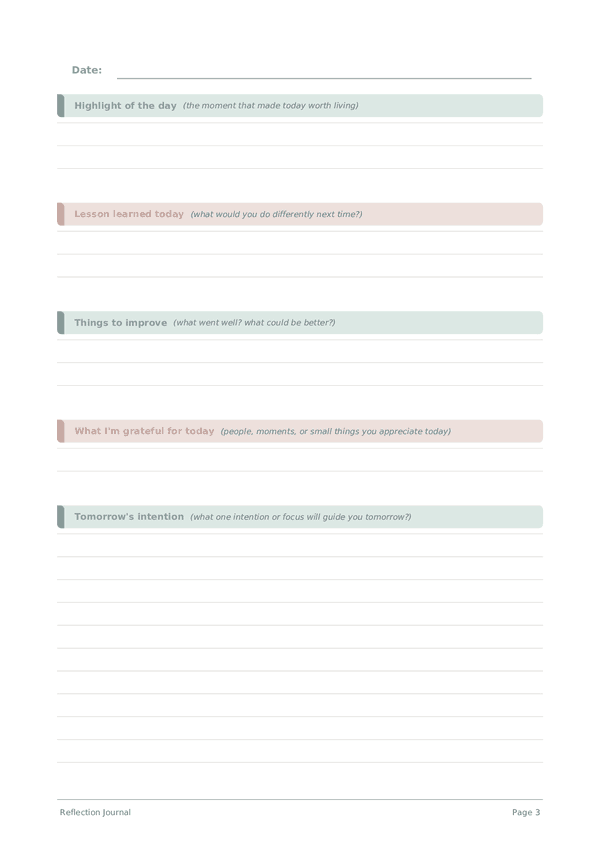
The Reflection Journal is a structured end-of-day review that takes just 5–10 minutes. Capture the day's highlight, the key lesson you learned, one area to improve, what you're grateful for, and your intention for tomorrow. This five-part ritual turns daily experience into lasting growth — building self-awareness, gratitude, and purposeful momentum one evening at a time.
Customize fields
Toggle fields on or off. Click the pencil to rename, or add your own fields.
Benefits
How to Use
What is this journal?
A reflection journal is your daily space for looking back at the day with honest eyes. Unlike forward-looking planners, this journal is about learning from lived experience — celebrating wins, processing challenges, extracting lessons, and consciously designing better tomorrows based on what today taught you.
Reflective practice is a cornerstone of continuous improvement, used by everyone from military leaders to CEOs to therapists. Studies show that employees who spend 15 minutes reflecting at the end of the day perform 23% better than those who do not. The act of reflection transforms raw experience into usable wisdom.
This journal's five-section structure — highlight, lesson learned, areas for improvement, gratitude, and tomorrow's intention — creates a balanced reflective practice that avoids both toxic positivity and unproductive self-criticism. Each entry becomes a conversation with yourself about what matters most.
Filled example
Here's what a typical entry looks like when filled in:
How to fill in each field
Each day you'll find several labeled sections with lines for writing. Here's what each section is for:
Highlight of the day
What was the best part of your day? Capture the moment that made today worth living. These highlights become a collection of your happiest memories.
Lesson learned today
Capture one insight from today's experience. Over time, these lessons become a personal wisdom library.
Things to improve
Identify one specific area where you can do better tomorrow. Be constructive, not critical — this is about growth, not self-judgment.
What I'm grateful for today
List 1–3 things you're grateful for today. They can be big or tiny — a good meal, a kind word, sunshine. Gratitude journaling is one of the most scientifically supported well-being practices.
Tomorrow's intention
What one intention or focus will guide you tomorrow?
Tips for success
When and how often to write
Write every evening as part of your wind-down routine — 10–15 minutes before bed. Reflection works best when you have the full day to look back on, but you're not yet exhausted. If daily is too much, write at least on Wednesday (mid-week check-in) and Sunday (full-week reflection). Over time, the evening reflection habit becomes a form of self-coaching.
Frequently Asked Questions
What makes this five-part structure effective?
Highlight, lesson learned today, things to improve, what I'm grateful for today, and tomorrow's intention together cover positive event amplification (Bryant's savoring research, 2003, Journal of Mental Health, 12(2)), meaning-making (Park, 2010, Psychological Bulletin, 136(2)), gratitude, and implementation intentions (Gollwitzer, 1999, American Psychologist, 54(7)). Each evidence-based mechanism takes one short section, fitting the 5-10 minute window without diluting the active ingredients.
How do I write a useful 'lesson learned today'?
Convert experience into a transferable principle, not a self-criticism. Park (2010, Psychological Bulletin, 136(2)) on meaning-making and Kolb's experiential learning cycle both treat reflection as the step that turns events into learning. A useful lesson is one sentence stating what you now know that you can apply tomorrow: not 'I shouldn't have done X' but 'meetings at 8am drain my morning focus'.
Why is there a 'tomorrow's intention' line?
Implementation intentions, or if-then plans, close the gap between knowing and doing. Gollwitzer (1999, American Psychologist, 54(7)) and Gollwitzer and Sheeran (2006, Advances in Experimental Social Psychology, 38) meta-analyzed 94 studies showing intentions specified with situational cues doubled action rates. Two lines is space for one clear if-then statement, not a long to-do list.
Is 'things to improve' the same as self-criticism?
No, and the distinction matters. Neff (2011, 'Self-Compassion', William Morrow) showed self-compassion correlates with growth and motivation; harsh self-criticism predicts the opposite. Frame the line as a constructive next step, what you'd do differently, not a moral judgment. Three lines should yield one specific, actionable change, not a list of failures.
When should I do this - really at night?
End of day is conventional, but research is mixed. Sleep consolidates emotional memories (Walker, 2009, Annals of the New York Academy of Sciences, 1156); reflecting before sleep can prime processing. Some find late-evening reflection ruminative; Trapnel and Campbell (1999, JPSP, 76(2)) distinguished healthy reflection from rumination. If reflection keeps you awake, shift it to early evening.
What if my day had no real 'highlight'?
Find the smallest positive moment honestly. Fredrickson's broaden-and-build theory (2001, American Psychologist, 56(3)) showed even small positive events have measurable effects when noticed. Bryant's savoring research suggests deliberately attending to micro-positives, a good coffee or a kind exchange, trains positive affect detection. Three lines accommodates the small; you don't need a peak experience.
How is this different from a gratitude journal?
A gratitude journal focuses on one mechanism. The Reflection Journal adds meaning-making, constructive review, and forward intention: a fuller end-of-day cycle. Emmons and McCullough (2003, JPSP, 84(2)) established gratitude effects; reflection-focused interventions like Seligman et al.'s 'best possible self' (2005, American Psychologist, 60(5)) operate via different but complementary mechanisms.
How quickly should I expect results?
Seligman et al. (2005, American Psychologist, 60(5)) found a structured positive psychology exercise produced well-being changes detectable within a week and sustained six months. For pattern-spotting across days, expect 2-4 weeks. The five-part structure is densely loaded, so daily completion across one month is the minimum dose to see whether it suits your needs.
You Might Also Like
Scroll to zoom, drag to move