Printable Self-Esteem Journal
Daily self-esteem building and inner strength journal
Strengthen your self-worth through daily recognition of accomplishments, positive qualities, and strengths. Challenge negative self-talk, practice self-compassion, and build unshakeable confidence from within.
Customize fields
Toggle fields on or off. Click the pencil to rename, or add your own fields.
What is this journal?
A self-esteem journal is a daily writing practice that systematically builds a healthier relationship with yourself. Each entry guides you through recognizing your accomplishments, identifying your positive qualities, and reframing negative self-talk — the three pillars of sustainable self-worth.
This journal is for anyone who struggles with self-criticism, imposter syndrome, or a persistent inner voice that minimizes their achievements. It is particularly valuable during transitions — new jobs, relationship changes, or any period when self-doubt tends to amplify.
Psychological research on self-compassion, led by Dr. Kristin Neff, demonstrates that structured positive self-reflection rewires habitual thought patterns over time. By writing down evidence of your strengths and worth daily, you counteract the negativity bias that makes criticism stick and compliments slide off.
Filled example
Here's what a typical entry looks like when filled in:
How to fill in each field
Each day you'll find several labeled sections with lines for writing. Here's what each section is for:
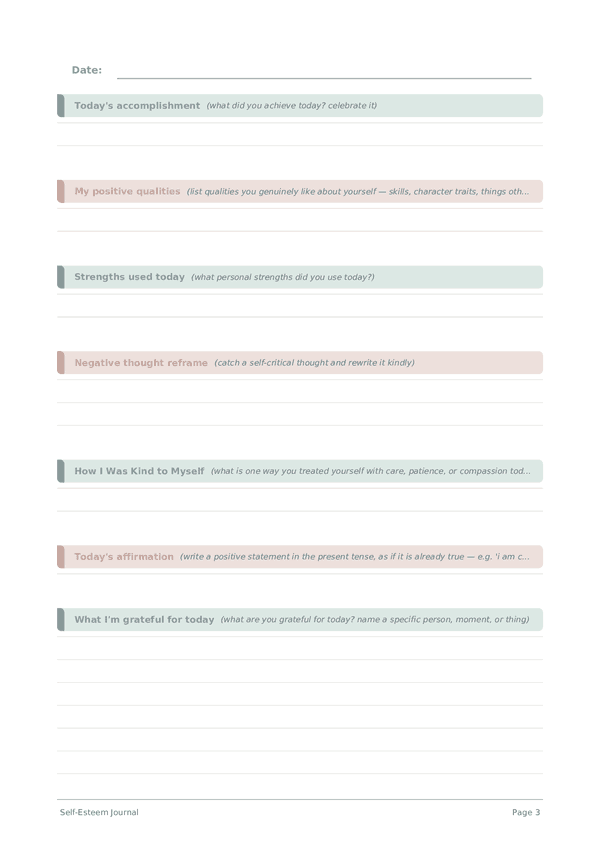
Today's accomplishment
Write something you achieved today, no matter how small. Acknowledging daily wins builds confidence and momentum.
My positive qualities
List your strengths, talents, and positive traits. We often forget our own qualities. Reading this list on hard days can be remarkably uplifting.
Strengths used today
What personal strengths did you use today?
Negative thought reframe
Catch a self-critical thought and rewrite it kindly
How I Was Kind to Myself
What is one way you treated yourself with care, patience, or compassion today?
Today's affirmation
Write a positive statement about yourself in the present tense, as if it's already true. For example: 'I am capable and resilient.' Repeating affirmations rewires your thinking patterns over time.
What I'm grateful for today
List 1–3 things you're grateful for today. They can be big or tiny — a good meal, a kind word, sunshine. Gratitude journaling is one of the most scientifically supported well-being practices.
Tips for success
When and how often to write
Write every evening, spending 10 minutes reflecting on how you spoke to yourself today. Self-esteem shifts gradually, so daily practice matters more than session length. After two weeks of daily entries, review them all in one sitting — you will likely notice you are kinder to yourself than you realized. Monthly, revisit your strengths list and add new ones. Building self-esteem is slow, steady work, and this journal is your daily proof that you are showing up for yourself.
Frequently Asked Questions
Why does the journal include 'negative thought reframe'?
Low self-esteem is maintained partly by negative automatic thoughts about the self. Fennell ('Overcoming Low Self-Esteem', Robinson, 1999) and CBT for self-esteem (based on Beck, 'Cognitive Therapy and the Emotional Disorders', 1976) treat thought identification and restructuring as central. The three-line section gives space to write the negative thought verbatim and one balanced alternative, which is the active mechanism.
How is 'my positive qualities' different from accomplishment?
Accomplishment is what you did; my positive qualities are who you are. The VIA Classification of character strengths (Peterson and Seligman, 2004, 'Character Strengths and Virtues', Oxford) treats traits like kindness, perseverance, and fairness as identity-level attributes. Two lines for naming one or two qualities you noticed in yourself today shifts attention from output to character.
Why combine self-esteem work with self-compassion ('how i was kind to myself')?
Neff (2003, Self and Identity, 2(2); 2011, 'Self-Compassion', William Morrow) showed self-compassion correlates with stable well-being without the contingency that high self-esteem can introduce. Crocker and Wolfe (2001, Psychological Review, 108(3)) on contingencies of self-worth warned that self-esteem tied to performance is fragile. The journal pairs them to anchor worth in self-treatment, not achievements.
What's a useful 'strengths used today' entry?
Identify a specific moment plus the strength deployed: 'I gave honest feedback in the meeting; that's courage'. Niemiec's strengths-spotting work and the VIA classification (Peterson and Seligman, 2004) suggest daily strengths-spotting builds awareness that low self-esteem otherwise filters out. Two lines force selection; you're training perception, not cataloguing. Small daily evidence adds up to measurable self-concept shifts across two to three months.
Will writing affirmations actually raise self-esteem?
Carefully. Wood, Perunovic, Lee (2009, Psychological Science, 20(7)) found generic positive affirmations worsened mood in low-self-esteem participants. The journal pairs affirmation with concrete evidence in other fields, which research supports. Use the affirmation line for statements you can credibly hold. If self-esteem stays persistently low, consult a licensed mental health professional; CBT and schema therapy address this directly.
How does daily entry retrain self-perception?
Through cumulative attention bias change. Mor and Winquist (2002, Psychological Bulletin, 128(4)) on self-focused attention and self-discrepancy research (Higgins, 1987, Psychological Review, 94(3)) show repeated focus on self-content shapes self-concept. Logging accomplishments, qualities, and strengths daily reweights which self-relevant data your mind retains. Think months, not days; expect measurable shifts after 8-12 weeks.
Is this suitable if I have clinical depression?
It can support treatment but not replace it. Low self-esteem co-occurs with depression but the two are distinct constructs (Sowislo and Orth, 2013, Psychological Bulletin, 139(1) meta-analysis). If you have diagnosed depression, consult a licensed mental health professional; CBT, behavioral activation, or pharmacotherapy may be indicated. The journal works alongside such treatment as supportive practice, not substitute care.
What if my entries feel false at first?
Common and expected. Wood et al. (2009, Psychological Science, 20(7)) and Fennell ('Overcoming Low Self-Esteem', Robinson, 1999) both note negative self-schemas resist positive evidence at first. Write the smallest defensible truth: 'I returned a hard email today' beats grand claims. Over weeks, evidence accumulates faster than the schema can dismiss it.
You Might Also Like
Scroll to zoom, drag to move