Printable Shadow Work Journal
A guided journey into your shadow self for healing, integration, and wholeness
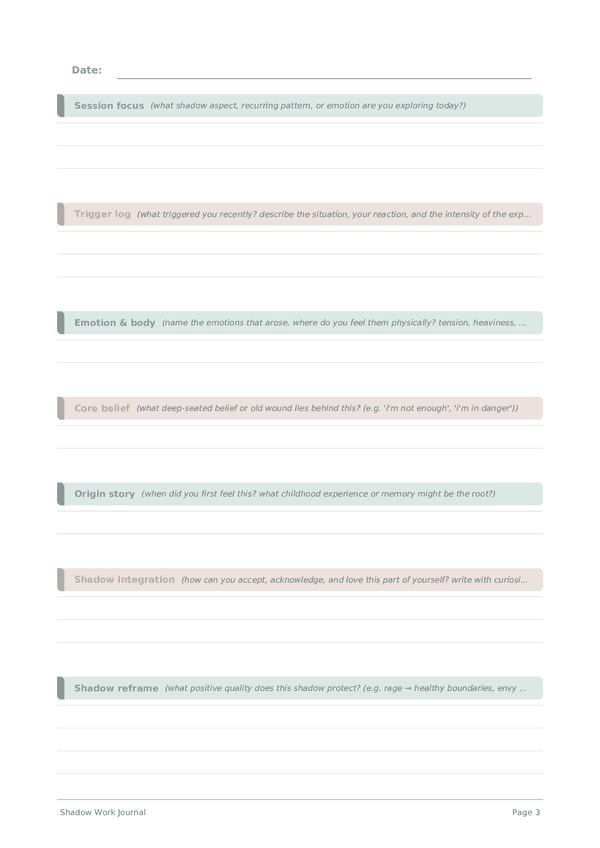
A structured journal for shadow work — the psychological practice of exploring the hidden, repressed, and rejected parts of yourself. Each session guides you through identifying a trigger, tracing its emotional and physical signature, uncovering the core belief beneath it, finding its origin, and integrating it with compassion. Based on Jungian psychology and inner child work.
Customize fields
Toggle fields on or off. Click the pencil to rename, or add your own fields.
Benefits
How to Use
What is this journal?
A shadow work journal is a deep psychological practice for exploring the hidden, rejected, and unconscious parts of yourself. Drawing from Carl Jung's concept of the shadow, each entry guides you through identifying triggers, tracing them to core beliefs, exploring their origins, and integrating these disowned aspects into a more whole and authentic self.
This journal is for anyone engaged in serious self-exploration — people in therapy, spiritual seekers, and anyone who has noticed recurring patterns of self-sabotage, projection, or emotional reactivity that they cannot explain through surface-level analysis.
Jungian psychology holds that what we repress does not disappear — it drives our behavior from the unconscious. Shadow work makes the unconscious conscious, which Jung called "the essential task of the second half of life." Research on emotional integration shows that acknowledging and exploring difficult emotions reduces their power, while suppression amplifies them. This journal provides a structured, safe container for that courageous inner work.
Filled example
Here's what a typical entry looks like when filled in:
How to fill in each field
Each day you'll find several labeled sections with lines for writing. Here's what each section is for:
Session focus
What shadow aspect, recurring pattern, or emotion are you exploring today?
Trigger log
What triggered you recently? Describe the situation, your reaction, and the intensity of the experience
Emotion & body
Name the emotions that arose. Where do you feel them physically? Tension, heaviness, warmth, tightness...
Core belief
What deep-seated belief or old wound lies behind this? (e.g. 'I'm not enough', 'I'm in danger')
Origin story
When did you first feel this? What childhood experience or memory might be the root?
Shadow integration
How can you accept, acknowledge, and love this part of yourself? Write with curiosity and compassion
Shadow reframe
What positive quality does this shadow protect? (e.g. rage → healthy boundaries, envy → desire for love)
Tips for success
When and how often to write
Write one entry per day in the evening, when the day\u2019s interactions have given you material to examine. Shadow work journaling is intense, so keep sessions to 15-20 minutes to avoid emotional overwhelm. If an entry brings up strong emotions, write them out fully, then close the journal and do something grounding before bed. Weekly, re-read your entries with fresh eyes and notice patterns. Take breaks when needed — shadow work is a marathon, not a sprint, and sustainable consistency matters more than daily perfection.
Frequently Asked Questions
What is shadow work in psychological terms?
Shadow refers to disowned or repressed aspects of the self, a concept from Carl Jung's analytical psychology (Jung, 'Aion', 1951). Several clinical traditions overlap with shadow work: schema therapy (Young, Klosko, Weishaar, 2003, 'Schema Therapy', Guilford) addresses early maladaptive schemas; Internal Family Systems (Richard Schwartz) works with exiled parts. The journal's structure puts this into practice through trigger and integration mapping.
How does the 'trigger log' connect to shadow?
Strong reactions out of proportion to the situation often point to shadow material; the trigger activates a disowned part. The three-line section asks you to describe the trigger without filtering. Beck's CBT (Beck, 'Cognitive Therapy and the Emotional Disorders', 1976) and schema therapy both treat outsized reactions as diagnostic, since they reveal underlying schemas the conscious mind doesn't track.
What is a 'core belief' in this context?
A core belief is a fundamental statement about self, others, or the world, often formed in childhood and operating outside awareness. Beck's cognitive model and Young's schema therapy (Young, Klosko, Weishaar, 2003, 'Schema Therapy', Guilford) both treat core beliefs as the deep structure beneath situational thoughts. Two lines force compression: write the belief in raw form, 'I'm not enough', not its qualified version.
Why 'origin story'?
Tracing the belief back to when it formed helps separate it from current reality. Schema therapy (Young, Klosko, Weishaar, 2003) uses imagery work to reach origin memories where schemas formed. Two lines give space for one identifying memory or period: the situation that taught the belief. Knowing the belief is learned, not factual, is the first step to reweighing it.
What does 'shadow integration' actually involve?
Integration means acknowledging and accepting the disowned part instead of suppressing or projecting it. Jung framed this as wholeness work. IFS (Richard Schwartz) approaches it as building a relationship with exiled parts. Three lines for writing how you'd welcome rather than reject this part of yourself: what need it carried, what protection it offered.
Is the 'shadow reframe' the same as positive thinking?
No. Positive reframing swaps out a negative interpretation; shadow reframe finds the protective function or hidden strength a shadow trait carried. Jungian and schema-therapy traditions both treat shadows as holding rejected resources. Two lines: write what value the disowned part was guarding, such as boundaries, ambition, or vulnerability, rather than pretending the wound didn't happen.
Is shadow work safe to do alone?
With care, and not for trauma. Shadow material is difficult by definition; structured journaling can help with mild work, but trauma-level material such as abuse, neglect, or severe attachment wounds needs professional support. Briere and Scott ('Principles of Trauma Therapy', SAGE, 2014) and trauma-informed care literature recommend supervised work for these. Consult a licensed mental health professional if material destabilizes you.
How often and how long for shadow work?
Weekly to twice-weekly, not daily. The seven structured sections invite depth, and daily depth-work risks emotional flooding. Schema therapy protocols typically space imagery and chair work across weekly sessions over months. Expect months of work on the same recurring shadow themes. Jung's individuation and schema therapy's modification both treat this as long-term work, not quick resolution.
You Might Also Like
Scroll to zoom, drag to move