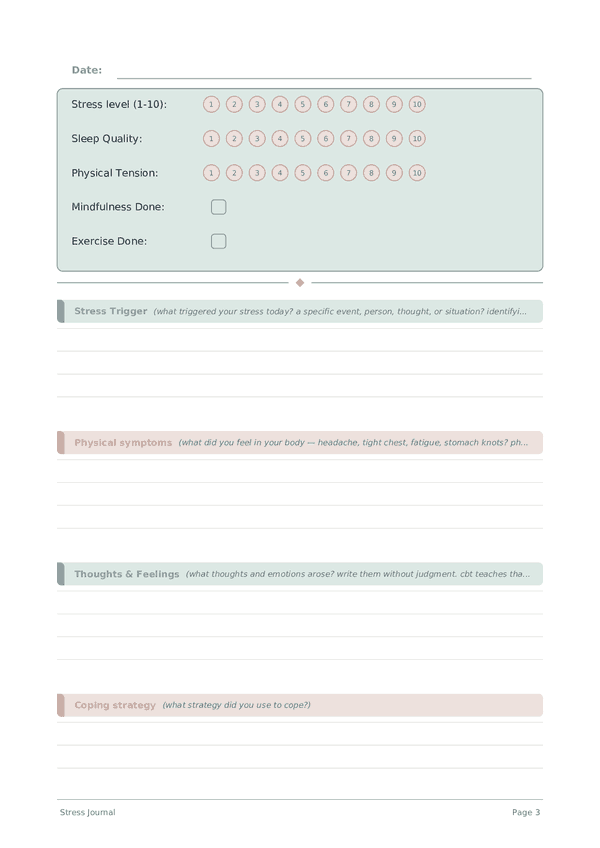
Printable Stress Journal
Daily stress tracking and management journal
Take control of stress with daily tracking, trigger identification, and evidence-based coping strategies. Build resilience by understanding your stress patterns and what truly helps you recover.
Customize fields
Toggle fields on or off. Click the pencil to rename, or add your own fields.
What is this journal?
A stress journal is a daily practice that helps you identify patterns in what causes your stress and how it affects your body and mind. By tracking stress levels alongside reflective writing, you create a personal map of your triggers and the coping strategies that actually work for you.
This journal is designed for anyone who feels overwhelmed, burned out, or simply wants to manage stress more effectively. Whether your stress comes from work, relationships, health, or daily pressures, the act of writing it down externalizes the burden and makes it easier to process.
Studies in psychoneuroimmunology show that expressive writing about stressful experiences can reduce cortisol levels and improve immune function. By consistently recording your stress triggers and responses, you build self-awareness that transforms reactive stress into something you can anticipate and manage proactively.
Filled example
Here's what a typical entry looks like when filled in:
How to fill in each field
The top of each page has quick-fill fields (ratings, checkboxes, numbers). Below that is a lined section for writing. Here's what each field means:
Stress level (1-10)
Rate your stress on a scale of 1–10. Over time, you'll identify your stress patterns and which coping strategies work best.
Sleep Quality
Rate how restful your sleep was. 1 means terrible and restless, 5 means deep and refreshing. Quality matters as much as quantity.
Physical Tension
Rate the physical tension in your body today — tight shoulders, clenched jaw, chest tightness. Body awareness is the foundation of stress management.
Mindfulness Done
Did you practice mindfulness today? Even 5 minutes of mindful breathing or a body scan reduces cortisol and builds stress resilience over time.
Exercise Done
Did you exercise today? Even a short walk counts. Movement is one of the most effective natural anxiety reducers.
Stress Trigger
What triggered your stress today? A specific event, person, thought, or situation? Identifying triggers is the first step in CBT-based stress management.
Physical symptoms
What did you feel in your body — headache, tight chest, fatigue, stomach knots? Physical symptoms are your body's stress signals worth tracking.
Thoughts & Feelings
What thoughts and emotions arose? Write them without judgment. CBT teaches that examining our thoughts helps break the stress-thought cycle.
Coping strategy
What strategy did you use to cope?
What I Can Control
Separate what you can control from what you cannot. Focus your energy on the controllable — this is a core CBT and Stoic resilience technique.
Tips for success
When and how often to write
Fill in the tracker every evening. On high-stress days, use the writing section during the day as an emergency release valve — even 3 minutes of writing reduces cortisol levels. Weekly, review your stress scores to identify your most stressful day of the week and your most effective coping strategies. This journal works best as a daily practice, but even 4 times a week captures enough data to reveal patterns.
Frequently Asked Questions
How does this journal use 'stress trigger' analysis?
It uses the Lazarus and Folkman transactional stress model (1984, 'Stress, Appraisal, and Coping', Springer). Stress comes from how you appraise demands relative to resources, not the event alone. The six-line trigger section asks what happened plus how you read it. Naming the appraisal ('I saw this as threatening') separates the stressor from the stress response, which is where intervention works.
Why log 'physical tension' separately from stress level (1-10)?
Stress shows up in the body before conscious labels. McEwen's allostatic load research (McEwen, 2007, Physiological Reviews, 87(3)) documents physiological signatures of chronic stress including muscle tension. Rating physical tension 0-10 alongside subjective stress level (1-10) reveals mismatches; high body tension with mild reported stress signals you're underreporting load, a common pattern in burnout.
What is 'what i can control' meant to identify?
It separates the controllable and uncontrollable parts of the stressor, the foundation of problem-focused coping (Folkman and Lazarus). Stoic frameworks formalize this distinction; CBT applies it through cognitive restructuring (Beck, 1976). The line forces a question many people skip under stress: which part of this can I actually influence with action? Two lines focus you on agency.
Why the 'mindfulness done' checkbox?
Mindfulness-based stress reduction (Kabat-Zinn; Khoury et al., 2015, Journal of Psychosomatic Research, 78(6)) showed moderate effects on stress in healthy adults. The checkbox enforces behavior tracking. Over weeks, correlate days with mindfulness done=true against stress level (1-10); many users find a 1-2 point reduction tied to regular practice, but only when documented.
How is this different from a generic mood journal?
This journal targets the stress-response system specifically: rated stress level (1-10), sleep quality, physical tension, behavioral coping (exercise done, mindfulness done) plus structured trigger and appraisal analysis. A mood journal captures emotional state broadly. Lazarus and Folkman's stress model and McEwen's allostatic load research both treat stress as a distinct construct with its own intervention points.
What patterns should I look for after two weeks?
Three: which stress triggers recur, whether sleep quality precedes next-day stress level (1-10), and which coping strategies actually lower ratings on later entries. Aldao, Nolen-Hoeksema, Schweizer (2010, Clinical Psychology Review, 30(2)) meta-analyzed coping strategies and found reappraisal and problem-solving consistently outperform avoidance and rumination across two weeks of data. Patterns emerge from two to four weeks of entries, longer for significant chronic load.
Is this safe if I'm experiencing burnout?
Use with care. Burnout (Maslach and Leiter, 2016, World Psychiatry, 15(2)) involves emotional exhaustion that simple tracking won't reverse. The journal can identify patterns useful for systemic change, like reducing demands and increasing recovery, but if you're persistently exhausted, cynical, and disengaged, consult an occupational health clinician or licensed mental health professional. Burnout is not solved by better journaling.
How long until I see results?
Two to four weeks for pattern visibility, eight weeks for self-reported stress reduction. Khoury et al. (2015, Journal of Psychosomatic Research, 78(6)) found mindfulness programs took roughly eight weeks for measurable stress effects. The journal's tracker section combined with coping behaviors works through similar mechanisms; expect insight before symptom relief, especially when triggers are environmental.
You Might Also Like
Scroll to zoom, drag to move