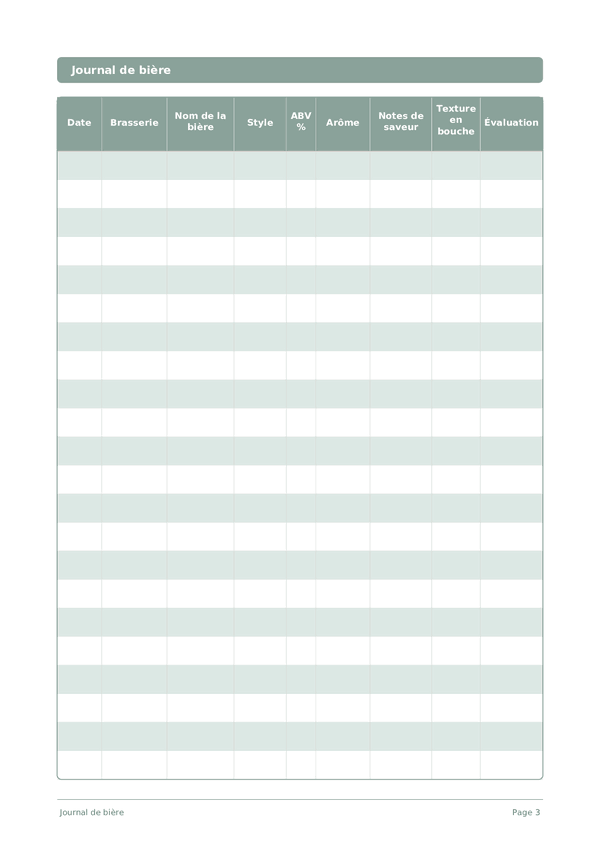
Printable Journal de bière
Suivez et notez chaque bière artisanale que vous goûtez
A structured tasting log to record every craft beer you encounter — brewery, beer name, style, ABV, aroma, flavor notes, mouthfeel, and your personal rating. Build a personal database of beers you love, discover patterns in your taste preferences, and always remember what you ordered at that amazing taproom.
Personnaliser les champs
Activez ou désactivez les champs. Cliquez sur le crayon pour renommer, ou ajoutez vos propres champs.
Avantages
Comment utiliser
Qu'est-ce que ce journal ?
A beer journal is a tasting log for documenting your explorations of craft beer and beyond. By recording brewery, style, ABV, and detailed notes on aroma, flavor, and mouthfeel, you develop your palate and build a personal reference that guides you toward the styles and breweries you love most.
This journal is for beer enthusiasts who want to be more intentional about their tasting — from craft beer newcomers exploring IPA styles to experienced tasters pursuing rare barrel-aged stouts. It is also valuable for homebrewers who want to study what makes their favorite commercial beers exceptional.
Beer appreciation, like wine, deepens through deliberate tasting and recording. The Cicerone certification program emphasizes that writing tasting notes is the single most effective way to train your palate. By tracking aroma, flavor, and mouthfeel separately, you learn to isolate and identify the individual components that make a beer memorable or forgettable.
Exemple rempli
Voici à quoi ressemble une entrée typique une fois remplie :
| Date | Brasserie | Nom de la bière | Style | ABV % | Arôme | Notes de saveur | Texture en bouche | Évaluation |
|---|---|---|---|---|---|---|---|---|
| 2025-03-04 | Tree House Brewing | Julius | New England IPA | 6.8 | Tropical fruit explosion — mango, passion fruit, tangerine peel. Slight pine resin. | Juicy mango and peach dominate. Soft citrus bitterness that does not linger. Slight dank hop character in the background. Finishes clean and fruity. | Pillowy soft, medium body, moderate carbonation, creamy | 9 |
| 2025-03-04 | Weihenstephan | Hefe Weissbier | Hefeweizen | 5.4 | Classic banana and clove. Fresh bread dough. Hint of vanilla. | Banana bread with clove spice. Light wheat sweetness. Refreshing and balanced with a clean, dry finish. Effervescent. | Light-medium body, high carbonation, refreshing, slightly creamy from the wheat | 8 |
| 2025-03-04 | Founders Brewing | KBS (Kentucky Breakfast Stout) | Imperial Stout (Bourbon Barrel-Aged) | 12.2 | Rich dark chocolate, espresso, bourbon vanilla, oak, faint maple sweetness. | Decadent — dark chocolate truffle, espresso, caramel, bourbon warmth. Roasted malt backbone. Dried fruit in the background. Long, warming finish. | Full, viscous, low carbonation, warming alcohol, velvety | 9 |
Comment remplir chaque champ
Chaque page est un tableau avec des colonnes. Remplissez une ligne par entrée. Voici à quoi sert chaque colonne :
Date
Inscrivez la date du jour. Cela ancre votre entrée dans le temps et aide lors de la relecture ultérieure.
Brasserie
Nom de la bière
Style
ABV %
Arôme
Notes de saveur
Texture en bouche
Évaluation
Note globale de l'expérience
Conseils pour réussir
Quand et à quelle fréquence écrire
Log each new beer you try — the table format makes it fast enough to fill in at the bar or brewery. For homebrewers, log every batch with detailed recipe parameters. Aim for 2-4 entries per week if you are actively exploring styles. During brewery visits or festivals, jot quick ratings and expand notes afterward. Monthly, review your entries to map which styles, regions, and breweries consistently score highest on your personal scale.
Questions fréquentes
Comment décrire précisément le style d'une bière — et si je ne connais pas la catégorie BJCP ?
Commence par le style indiqué sur l'étiquette, puis consulte les Beer Judge Certification Program (BJCP) Style Guidelines (édition actuelle, 2021) qui organisent près de 100 catégories de l'American IPA à la Berliner Weisse. La Brewers Association publie aussi des Beer Style Guidelines annuels utilisés au Great American Beer Festival. Si tu n'es pas sûr, note le style le plus proche avec un point d'interrogation — avec le temps, la culture stylistique se compound, et les erreurs d'identification elles-mêmes deviennent un signal d'apprentissage utile.
Comment noter correctement l'arôme, les notes de saveur et la texture en bouche séparément ?
Les fiches d'évaluation BJCP évaluent l'arôme, l'apparence, la saveur, la texture en bouche et l'impression générale comme des dimensions distinctes pour une raison — elles varient indépendamment. Arôme : houblon (résine, agrumes, tropical), malt (pain, caramel, chocolat), fermentation (banane, girofle, poivre). Saveur : intensité de l'amertume, douceur du malt, défauts (diacétyle, DMS). Texture en bouche : poids du corps, carbonatation, chaleur de l'alcool, sécheresse. Le programme Cicerone Certification forme les évaluateurs à cette séparation exacte ; mélanger ces dimensions dilue la valeur des données.
Comment lire et noter le degré d'alcool — et que prédit-il sur la bière ?
Le degré alcoolique (ABV) figure sur la plupart des étiquettes de bière artisanale. Les BJCP Style Guidelines (2021) ancrent les styles à des plages d'ABV : bières de session en dessous de 4,5 %, standard 4,5-6 %, forte 6-9 %, très forte 9 %+. Suivre l'ABV face à tes scores révèle des schémas de tolérance — beaucoup de buveurs préfèrent systématiquement 5-7 %, trouvant un ABV élevé fatigant pour le palais. L'ABV est aussi corrélé à la perception du corps et de la douceur via les sucres résiduels, utile pour les comparaisons inter-styles.
Comment distinguer une brasserie que j'aime d'une bière que j'aime ?
Note délibérément la brasserie et le nom de la bière dans des colonnes séparées. Après 30 à 50 entrées, trie mentalement par brasserie : la Brasserie X obtient-elle régulièrement 8+, ou seulement sa bière phare ? La Brewers Association recense plus de 9 000 brasseries artisanales aux États-Unis, alors la fidélité à une brasserie sans données sur les bières spécifiques gaspille des opportunités d'achat. À l'inverse, identifier une brasserie dont toute la gamme score bien est exceptionnellement précieux — c'est un signal de discipline de process, de profil d'eau et de levure maison.
Ce journal papier comparé aux applications comme Untappd ?
Untappd est excellent pour la découverte sociale et les check-ins rapides mais biaise les scores via les moyennes communautaires visibles avant la dégustation. L'évaluation de style BJCP et Cicerone exige une analyse sensorielle délibérée et non biaisée — plus facile sur papier sans notifications. Les applications encouragent aussi les réactions en une ligne, alors que des colonnes arôme/saveur/texture séparées imposent une évaluation plus complète. Utilise les deux : l'application pour l'inventaire de cave et le social, le journal pour l'enregistrement analytique qui développe ton palais sur des années.
Ce journal convient-il aux bières non artisanales, au cidre, à l'hydromel ou à la bière sans alcool ?
Oui. Les colonnes — brasserie, nom, style, ABV, arôme, saveur, texture en bouche, score — fonctionnent pour toute boisson fermentée. Les recommandations BJCP incluent des catégories cidre et hydromel avec leurs propres descripteurs. La bière artisanale sans alcool est un segment en croissance selon les rapports annuels de la Brewers Association ; note-la de façon identique. Le principe du journal — observation sensorielle reproductible — transcende les étiquettes de catégories.
À quelle fréquence revisiter les entrées plus anciennes, et que chercher ?
Une révision mensuelle aide à détecter l'évolution du palais. Le programme Cicerone Certification souligne que la perception du goût elle-même change avec l'exposition — des bières notées 6 il y a un an peuvent maintenant scorer 8 à mesure que tu apprends le style. Trie par score et style : tends-tu vers les styles houblonnés, maltés ou acides ? Une révision annuelle révèle une identité stylistique au-delà des récits marketing.
Erreurs courantes qui nuisent à la précision de la dégustation ?
Premièrement, noter directement à la bouteille sans verre adapté — les volatiles aromatiques ont besoin de surface, selon le protocole de jugement BJCP. Deuxièmement, manger des aliments épicés ou fortement aromatisés juste avant. Troisièmement, le biais d'auréole des brasseries très médiatisées. Quatrièmement, scorer après une seule gorgée — la saveur et la fin de bouche nécessitent 2 à 3 gorgées minimum. Cinquièmement, ignorer les défauts par politesse ; le kit Cicerone Off-Flavor entraîne spécifiquement à identifier le diacétyle, l'acétaldéhyde, le DMS et le caractère lumière.
Vous aimerez aussi
Journal pour animaux de compagnie
Carnet de soins quotidien pour votre compagnon à quatre pattes
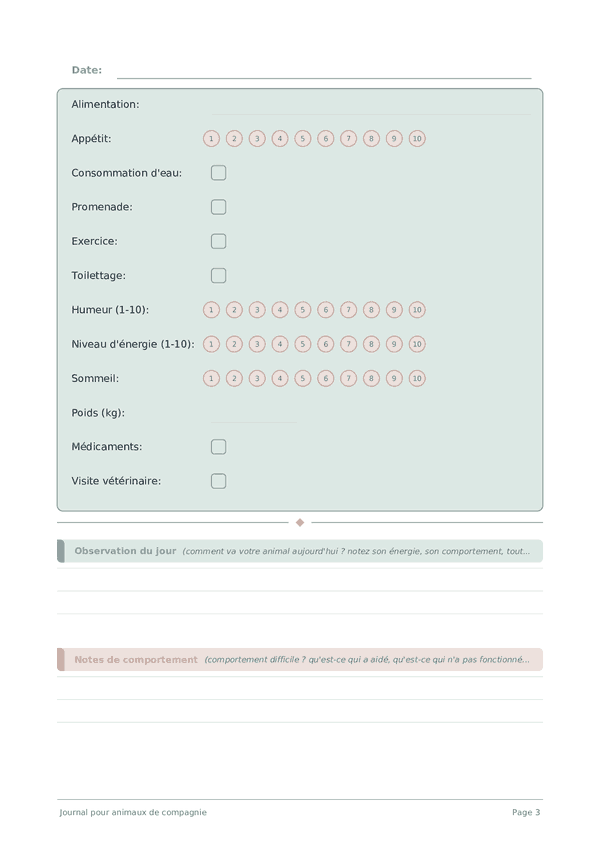
Journal de dégustation de vin
Documentez vos expériences de dégustation de vin
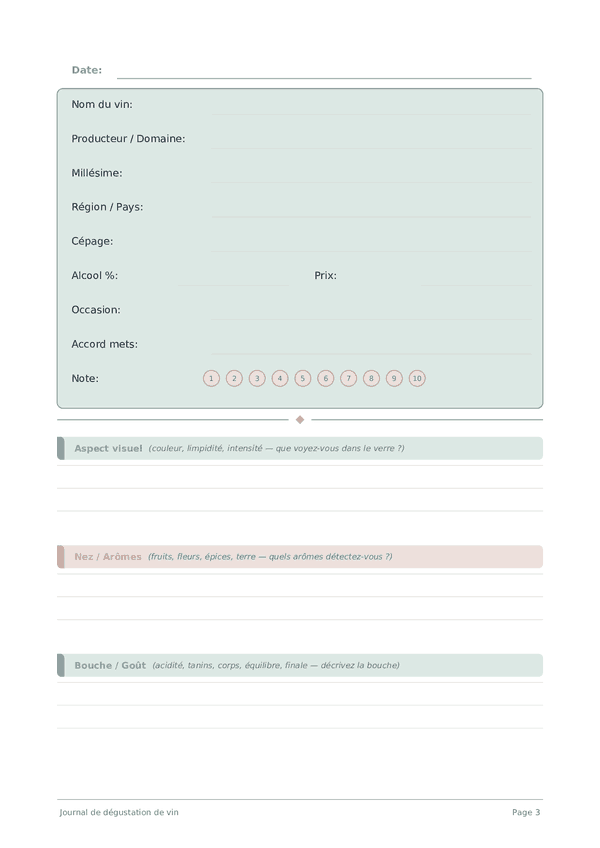
Journal de café
Suivez vos infusions, ajustez les paramètres et développez votre palais
Journal de thé
Suivez chaque tasse — de la feuille à la dernière gorgée
Molette pour zoomer, glisser pour déplacer