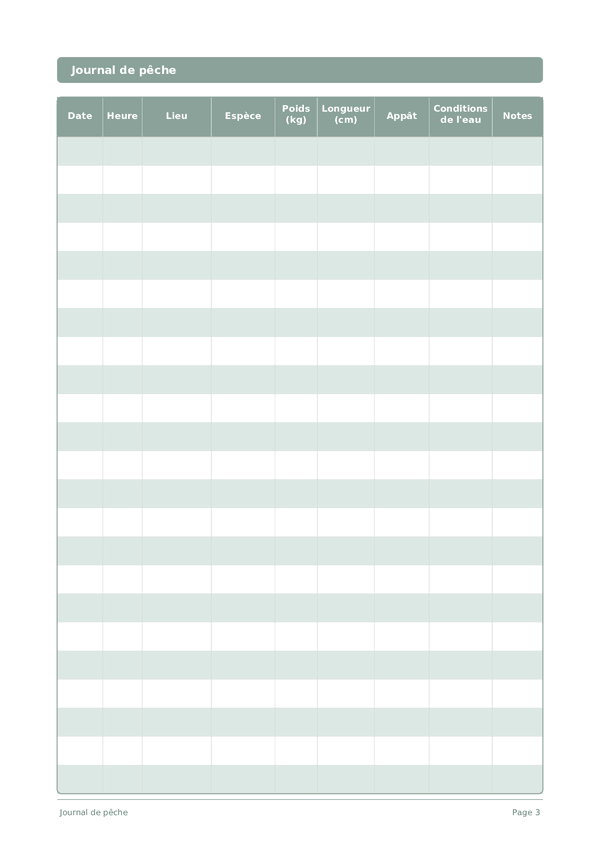
Printable Journal de pêche
Notez les prises, les lieux et les conditions de pêche
Track every fishing trip in detail — species caught, weight, length, bait used, and water conditions. Over time your log reveals the patterns behind your best catches and helps you replicate success on future trips.
Personnaliser les champs
Activez ou désactivez les champs. Cliquez sur le crayon pour renommer, ou ajoutez vos propres champs.
Avantages
Comment utiliser
Qu'est-ce que ce journal ?
A fishing journal is a detailed log for recording every fishing trip — the catches, the conditions, and the techniques that worked. By tracking species, weight, bait, and water conditions alongside your own notes, you build a personal reference that makes you a more effective angler over time.
This journal is for anglers of all levels — from weekend hobbyists to dedicated sportfishers. It is especially valuable because fish behavior follows predictable patterns based on weather, water temperature, season, and time of day. By recording these variables, you build a database that tells you exactly when and how to fish each of your favorite spots.
Experienced anglers universally recommend keeping a log. The patterns that emerge over months and years — which baits produce in which conditions, which spots are productive at which water levels, which moon phases correlate with activity — give you an edge that cannot be gained from any guide book. Your fishing journal becomes your most reliable fishing partner.
Exemple rempli
Voici à quoi ressemble une entrée typique une fois remplie :
| Date | Heure | Lieu | Espèce | Poids (kg) | Longueur (cm) | Appât | Conditions de l'eau | Notes |
|---|---|---|---|---|---|---|---|---|
| 2025-03-04 | 6:30 | Mirror Lake, east bank | Rainbow Trout | 1.8 | 38 | Olive woolly bugger, size 10 | Clear, 8C, slight current | Hit on the third cast near submerged log. Strong fight for its size. Released. |
| 2025-03-04 | 7:15 | Mirror Lake, east bank | Rainbow Trout | 0.9 | 28 | Olive woolly bugger, size 10 | Clear, 8C, slight current | Smaller fish, same area. Feeding actively near the log structure. |
| 2025-03-04 | 8:40 | Mirror Lake, inlet stream | Brown Trout | 2.4 | 44 | Gold Rapala, 5cm | Slightly murky at inlet, 7C | Best fish of the day. Took the lure on a slow retrieve. Beautiful coloring. Photo taken, released. |
| 2025-03-04 | 10:00 | Mirror Lake, west cove | 0 | 0 | Various flies and spinners | Clear, warming to 10C, wind picking up | No bites after 9:30. Sun got high and wind pushed bait fish away from cove. Packed up. |
Comment remplir chaque champ
Chaque page est un tableau avec des colonnes. Remplissez une ligne par entrée. Voici à quoi sert chaque colonne :
Date
Inscrivez la date du jour. Cela ancre votre entrée dans le temps et aide lors de la relecture ultérieure.
Heure
Enregistrez l'heure de la mesure ou de l'événement. Un horaire constant rend les données comparables et révèle des tendances selon le moment de la journée.
Lieu
Où la photo a-t-elle été prise ?
Espèce
Nom de l'espèce de poisson pêché
Poids (kg)
Enregistrez votre poids si vous le suivez. Pesez-vous à la même heure chaque jour pour des données cohérentes. Concentrez-vous sur les tendances hebdomadaires, pas sur les fluctuations quotidiennes.
Longueur (cm)
Longueur du poisson en centimètres
Appât
Appât vivant, cuiller, mouche, jig, leurre souple, leurre de surface...
Conditions de l'eau
Claire, trouble, agitée, calme, vitesse du courant, marée...
Notes
Ajoutez tout contexte ou réflexion supplémentaire. Cette colonne fourre-tout est pour tout ce qui ne rentre pas ailleurs mais pourrait être utile plus tard.
Conseils pour réussir
Quand et à quelle fréquence écrire
Fill in one row per catch (or attempted catch) during every fishing trip. Enter data on the water if possible, or immediately after returning. Before each new trip, review your log entries for the same location, season, and conditions to choose bait and timing based on your own proven data. Monthly, scan for patterns across all trips. Serious anglers who log consistently for a full year report significantly higher catch rates in the second year.
Questions fréquentes
Quelles données noter pour chaque session de pêche ?
Pour chaque sortie, consigne : appât et leurre utilisés, conditions de l'eau (température, clarté, niveau), météo, heure de départ et de fin. Pour chaque prise : espèce, poids, longueur, lieu exact et technique utilisée. Note aussi les données négatives — ce qui n'a pas fonctionné. Ces informations sont aussi précieuses que les succès pour comprendre le comportement des poissons et affiner ta stratégie.
Pourquoi noter les données négatives (absence de prise) ?
L'absence de résultat est une information. Si tu ne prends rien avec un leurre rouge par temps couvert, mais que tu réussis avec le même leurre par temps ensoleillé, tu as identifié une corrélation. Les conditions de non-prise, notées avec autant de rigueur que les succès, constituent une base de données personnelle que nulle application comme Fishbrain ne peut produire pour ton cours d'eau spécifique. La pêche est une science autant qu'un art.
Comment utiliser la pression barométrique et la phase lunaire ?
Note la pression atmosphérique (en hausse, stable ou en baisse) et la phase de la lune (croissant, pleine, décroissant, nouvelle). De nombreux pêcheurs expérimentés observent que les poissons sont plus actifs lors des variations barométriques (chute avant un orage) et pendant les phases de lune croissante et pleine. Ces corrélations sont controversées scientifiquement, mais tes propres données sur plusieurs années te montreront si elles s'appliquent à ton coin de pêche.
Comment mesurer et noter les prises de façon précise ?
Pour le poids, utilise une balance de pêche étanche. Pour la longueur, une règle souple ou un décamètre. Note toujours la taille depuis la bouche jusqu'à la fourche de la queue (longueur à la fourche), standard utilisé par les biologistes halieutiques. Si tu pratiques le no-kill, minimise le temps hors de l'eau et note quand même ces données : elles contribuent à la connaissance des populations locales.
Comment comparer mes données avec les informations communautaires ?
Fishbrain et les forums de pêche locaux donnent une image générale, mais tes données personnelles sur un lieu précis sont bien plus pertinentes. Compare tes statistiques de prise (saison, technique, météo) avec les tendances régionales. Tu identifieras peut-être des spécificités locales que les plateformes générales ne voient pas : un gobeur systématique à marée montante, une activité exceptionnelle certains matins de printemps.
Comment organiser mon journal par lieu de pêche ?
Crée une section par site : lac, rivière, tronçon spécifique. Pour chaque lieu, accumule les données de conditions (saison, niveau d'eau, végétation) et de résultats. Avec le temps, tu construis une cartographie personnelle précise : les postes productifs selon le débit, les espèces présentes selon la saison, les techniques qui fonctionnent dans ce contexte particulier. Ce savoir local est le vrai trésor du pêcheur assidu.
Mon journal de pêche peut-il contribuer à la conservation ?
Oui. En France, les associations de pêche et les fédérations départementales de pêche collectent des données sur les populations de poissons. Tes notes sur les espèces, les tailles et les lieux de capture ont une valeur pour la gestion des rivières. Si tu observes une chute brutale des captures d'une espèce ou des poissons présentant des anomalies, signale-le à ta fédération locale : ce peut être le signe d'une pollution ou d'une perturbation de l'habitat.
Comment tirer les leçons d'une session peu productive ?
Après une sortie sans résultat, relire tes notes des sessions précédentes sur le même site peut révéler ce qui diffère : l'eau était-elle plus haute ou plus froide ? L'heure était-elle différente ? Avais-tu changé d'appât ? Systématise cette analyse post-sortie en quelques lignes dans ton journal. Les pêcheurs qui progressent le plus vite sont ceux qui traitent chaque session, même infructueuse, comme une donnée supplémentaire dans leur base de connaissances.
Vous aimerez aussi
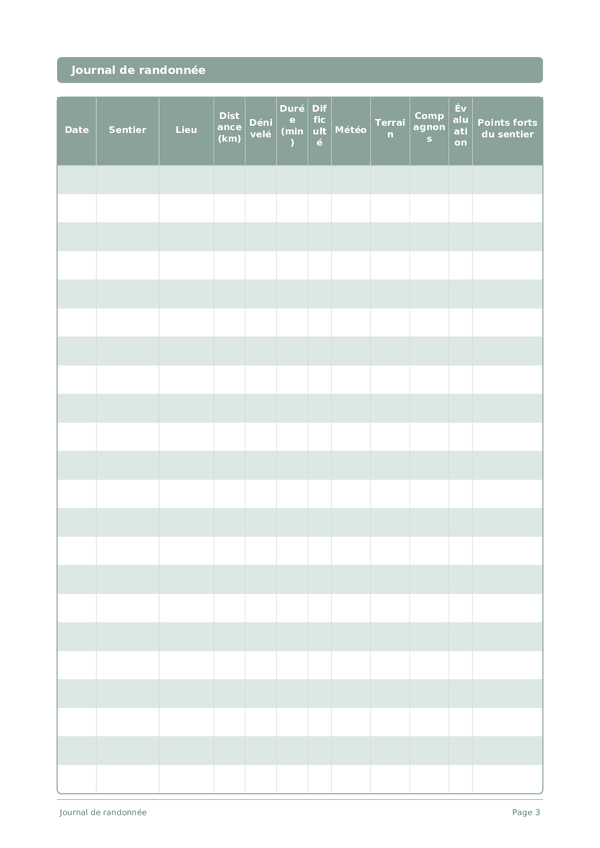
Journal de randonnée
Suivez chaque sentier, sommet et aventure en plein air
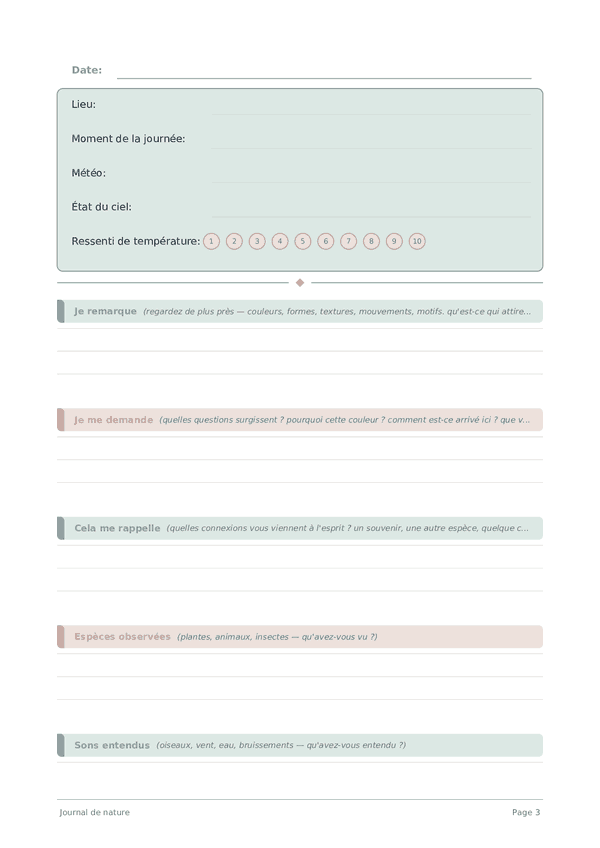
Journal de nature
Observez, émerveillez-vous et connectez-vous avec le monde naturel
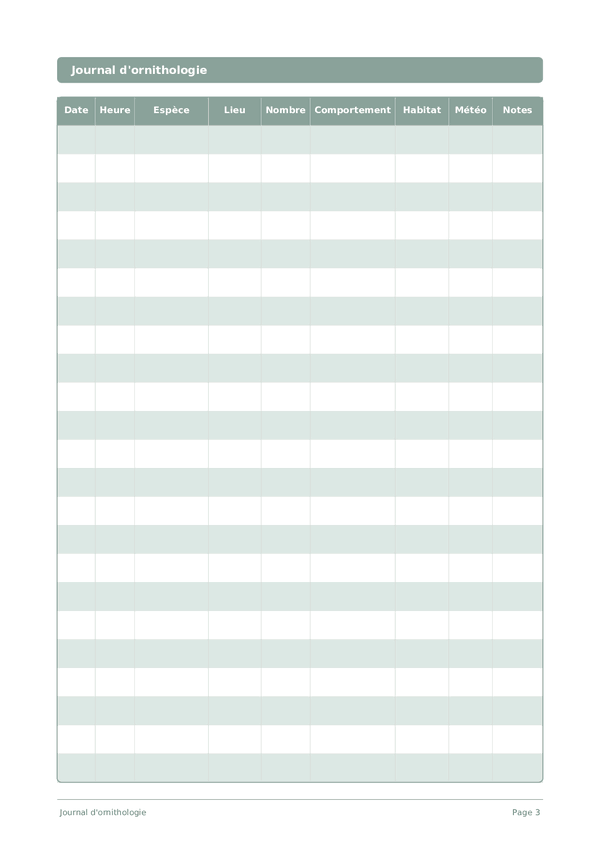
Journal d'ornithologie
Notez chaque observation d'oiseau avec l'espèce, l'habitat et le comportement
Journal de jardin
Planifiez, suivez et apprenez de chaque saison de culture
Molette pour zoomer, glisser pour déplacer