Printable Journal de nature
Observez, émerveillez-vous et connectez-vous avec le monde naturel
A structured nature journal inspired by the John Muir Laws method of "I Notice, I Wonder, It Reminds Me Of." Each page combines quick environmental data — location, weather, sky conditions, and temperature — with guided observation prompts that train you to see nature more deeply. Record species, sounds, and sketches alongside your reflections to build a personal field record over time.
Personnaliser les champs
Activez ou désactivez les champs. Cliquez sur le crayon pour renommer, ou ajoutez vos propres champs.
Avantages
Comment utiliser
Qu'est-ce que ce journal ?
A nature journal is a daily observation practice that trains you to see the natural world with fresh, attentive eyes. By recording what you notice, what you wonder about, and what species you observe, you develop the naturalist's art of careful attention that transforms any outdoor moment into a discovery.
This journal is for nature lovers, aspiring naturalists, environmental educators, and anyone who wants to slow down and actually see the world around them. You do not need to be an expert — the practice of noticing and wondering is itself the skill being developed.
Environmental education research shows that regular nature journaling increases ecological awareness, scientific thinking skills, and reported connection to the natural world. The practice of writing "I notice" and "I wonder" — championed by naturalist John Muir Laws — bypasses the need for expert knowledge and activates genuine curiosity, making every outdoor experience richer and more meaningful.
Exemple rempli
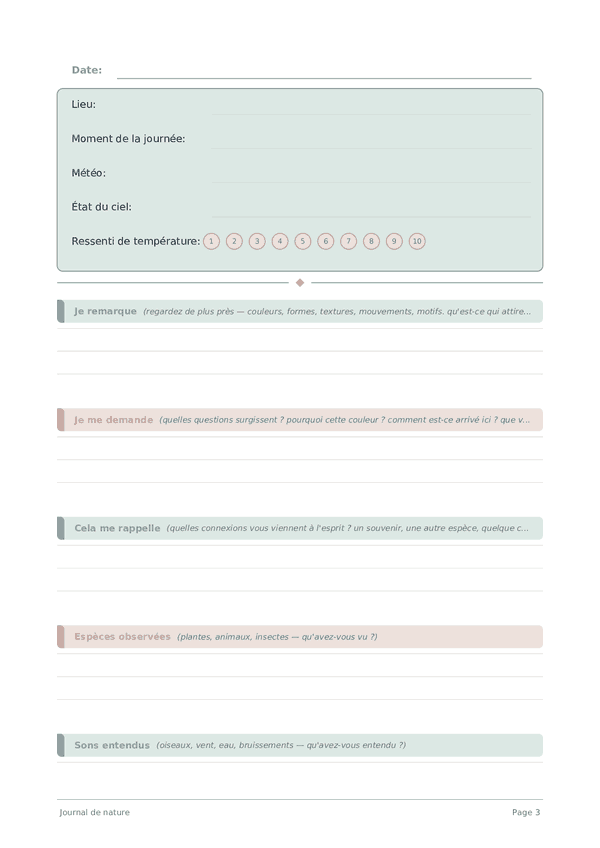
Voici à quoi ressemble une entrée typique une fois remplie :
Comment remplir chaque champ
Le haut de chaque page comporte des champs à remplissage rapide (évaluations, cases à cocher, chiffres). En dessous se trouve une section lignée pour écrire. Voici ce que signifie chaque champ :
Lieu
Où la photo a-t-elle été prise ?
Moment de la journée
Matin, après-midi, soir, nuit
Météo
Ensoleillé, nuageux, pluie, vent — conditions actuelles
État du ciel
À quoi ressemble le ciel en ce moment ? Décrivez les nuages, la clarté ou la météo
Ressenti de température
Comment ressentez-vous la température sur votre peau ? Décrivez-la avec vos propres mots
Je remarque
Regardez de plus près — couleurs, formes, textures, mouvements, motifs. Qu'est-ce qui attire votre regard ?
Je me demande
Quelles questions surgissent ? Pourquoi cette couleur ? Comment est-ce arrivé ici ? Que va-t-il se passer ensuite ?
Cela me rappelle
Quelles connexions vous viennent à l'esprit ? Un souvenir, une autre espèce, quelque chose que vous avez lu ?
Espèces observées
Plantes, animaux, insectes — qu'avez-vous vu ?
Sons entendus
Oiseaux, vent, eau, bruissements — qu'avez-vous entendu ?
Croquis et notes
Croquis rapide de votre observation — pas besoin de savoir dessiner, juste des formes et des légendes
Conseils pour réussir
Quand et à quelle fréquence écrire
Bring your journal every time you step outdoors with intention \u2014 whether it is a park walk, a forest hike, or sitting in your backyard. Write for 15\u201320 minutes while observing. Aim for at least twice a week to build a continuous seasonal record. Review entries monthly to notice phenological patterns like when certain birds appear, when wildflowers bloom, and when insects emerge. Over a year, your journal becomes a personal field guide for your area.
Questions fréquentes
Qu'est-ce que la méthode « Je remarque, Je me demande, Ça me rappelle » ?
Cette méthode développée par le naturaliste John Muir Laws structure l'observation en trois temps. « Je remarque » : décris ce que tu perçois objectivement (couleur, forme, comportement). « Je me demande » : formule une question (pourquoi cette feuille est-elle percée ainsi ?). « Ça me rappelle » : fais le lien avec une expérience ou une connaissance passée. Cette progression affûte ton regard et stimule ta curiosité naturelle.
Pourquoi noter les sons entendus dans la nature ?
Le son est souvent négligé au profit du visuel, mais il enrichit considérablement l'observation. Note les sons dans la rubrique dédiée : chants d'oiseaux, bruissement de feuilles, écoulement d'eau, silence lui-même. La théorie de la restauration de l'attention (Kaplan, 1995) montre que les environnements naturels, y compris leurs sons, réduisent la fatigue cognitive. Décrire ces sons ancre le souvenir de façon unique.
Je ne suis pas artiste — dois-je quand même faire des croquis ?
Oui, et la qualité artistique n'a aucune importance. Le croquis te force à regarder vraiment : combien de segments dans cette feuille ? Comment se répartissent les nervures ? Ce processus d'observation lente est plus précieux que le résultat. John Muir Laws insiste sur ce point : un mauvais croquis fait avec attention vaut mieux qu'une belle photo prise sans regarder. Commence par des formes simples.
Comment identifier les espèces que j'observe ?
Note d'abord tout ce que tu vois : taille, couleur, comportement, habitat, heure. Consulte ensuite un guide de terrain ou une application (iNaturalist, Merlin pour les oiseaux, PlantNet pour les plantes). Le Cornell Lab of Ornithology propose aussi d'excellentes ressources en ligne. L'identification après observation est plus efficace que de chercher pendant : tu retiens mieux ce que tu as pris le temps de décrire toi-même.
À quelle fréquence devrais-je aller dans la nature pour bénéficier des effets positifs ?
La recherche (White et al., 2019) fixe un seuil de 120 minutes par semaine. Mais même de courtes sorties régulières ont un effet cumulatif. L'idéal est de créer un rituel : même lieu, même heure de la semaine. Observer les changements saisonniers sur un seul espace — un arbre, un coin de jardin, un bord de chemin — développe une relation profonde et révèle des détails invisibles lors des visites sporadiques.
Comment organiser mes notes entre observations concrètes et ressentis ?
Sépare clairement les deux dans ton journal. D'un côté, les données objectives : espèces observées, sons entendus, conditions météo, heure, lieu. De l'autre, tes impressions subjectives : comment tu te sens, ce que ça évoque, ce que tu veux approfondir. Cette distinction t'aide à relire tes notes avec profit, que ce soit pour identifier des espèces ou pour retrouver un état d'esprit.
Que faire si je ne sais pas nommer ce que j'observe ?
Note-le quand même, avec le maximum de détails descriptifs. « Oiseau brun, taille moineau, queue rousse, chant répétitif en 3 notes » vaut mieux que rien. Laisse la case d'identification vide et reviens-y plus tard. Cette pratique de description sans étiquette renforce tes capacités d'observation et te libère de la pression de « tout savoir ». La curiosité prime sur l'exactitude taxonomique.
Le journal de nature peut-il se pratiquer en milieu urbain ?
Absolument. Un arbre de rue qui change de feuillage, les pigeons d'un square, le ciel entre deux immeubles — tout cela est de la nature. Le Cornell Lab encourage l'observation en tout lieu. En ville, tu développes une attention particulière aux micro-habitats : une touffe d'herbe dans un trottoir, un mur végétalisé, une mare dans un parc. Ton regard s'affine, et tu découvres que la nature est partout où tu veux bien la chercher.
Vous aimerez aussi
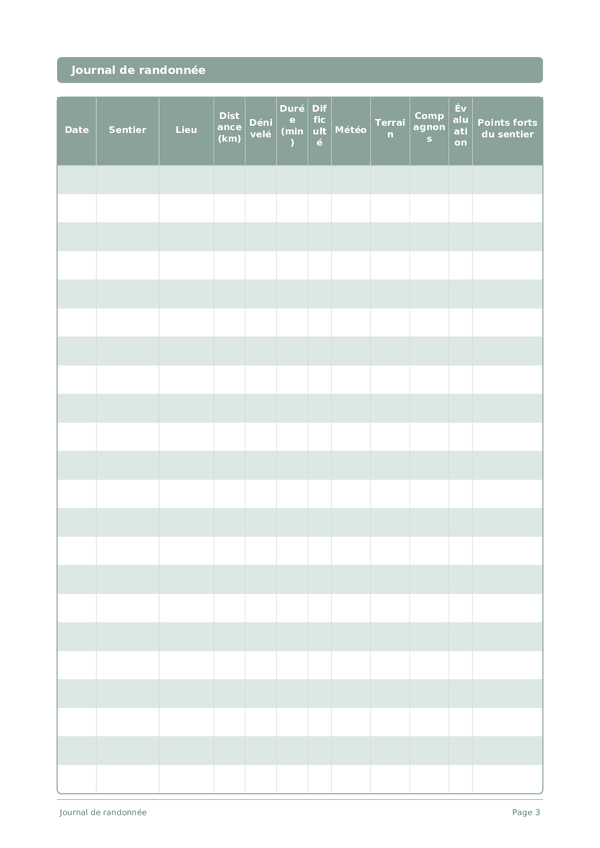
Journal de randonnée
Suivez chaque sentier, sommet et aventure en plein air
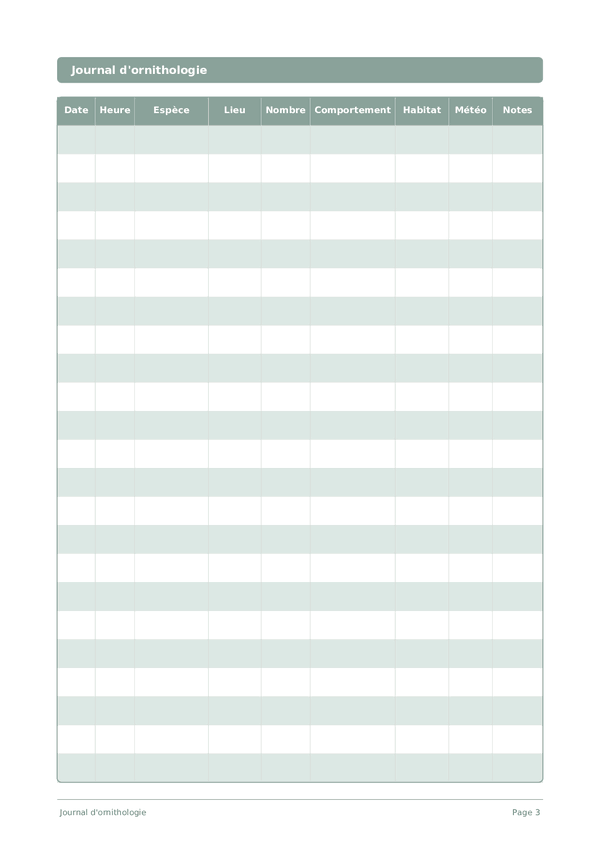
Journal d'ornithologie
Notez chaque observation d'oiseau avec l'espèce, l'habitat et le comportement
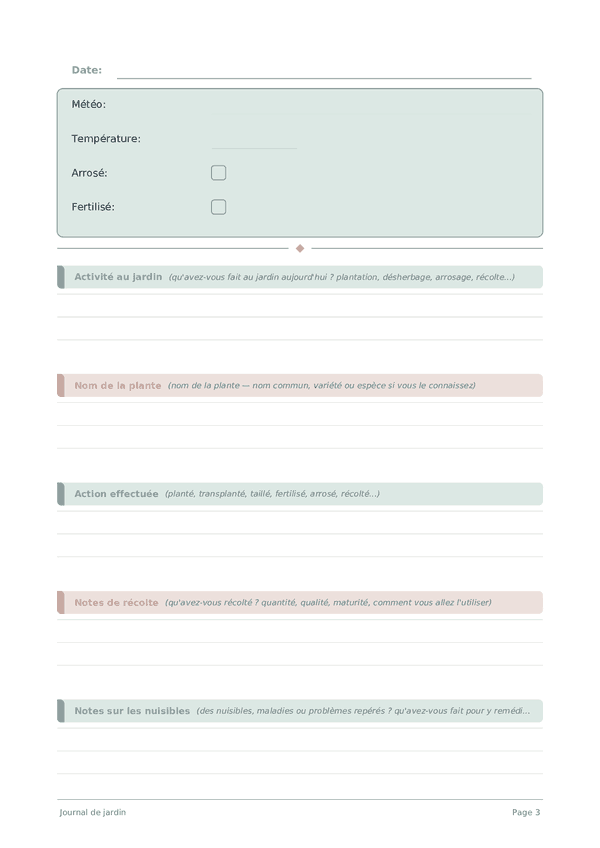
Journal de jardin
Planifiez, suivez et apprenez de chaque saison de culture
Journal météo
Observations météorologiques quotidiennes pour météorologues amateurs
Molette pour zoomer, glisser pour déplacer