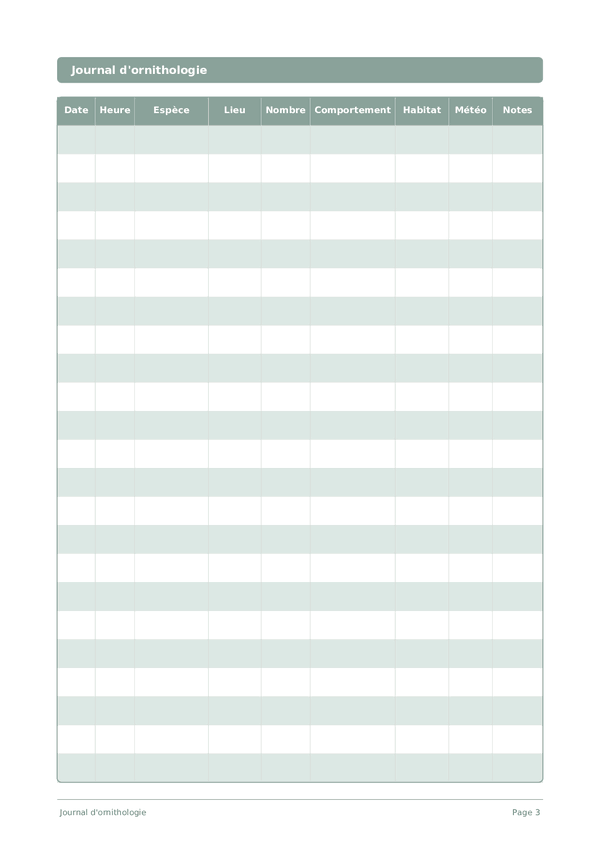
Printable Journal d'ornithologie
Notez chaque observation d'oiseau avec l'espèce, l'habitat et le comportement
A structured field log designed for birders of all levels. Capture species, location, count, behavior, habitat, and weather conditions for every sighting. Build a detailed life list, track seasonal migrations, and spot long-term patterns in bird activity across different habitats.
Personnaliser les champs
Activez ou désactivez les champs. Cliquez sur le crayon pour renommer, ou ajoutez vos propres champs.
Avantages
Comment utiliser
Qu'est-ce que ce journal ?
A birdwatching journal is a structured observation log for recording every bird you spot in the field. By documenting species, location, behavior, and habitat conditions, you build a personal birding database that tracks your growing knowledge and reveals patterns in bird activity across seasons and locations.
This journal is for birders at every level — from backyard bird feeders to dedicated listers pursuing life lists. It is equally valuable whether you are learning to identify your first ten species or tracking rare migrants at a known hotspot.
Citizen science research has shown that personal birding records contribute significantly to understanding bird populations and migration patterns. Beyond contributing to collective knowledge, the practice of careful observation and recording trains your eyes and ears to detect subtle differences — the skill that separates casual observers from skilled birders.
Exemple rempli
Voici à quoi ressemble une entrée typique une fois remplie :
| Date | Heure | Espèce | Lieu | Nombre | Comportement | Habitat | Météo | Notes |
|---|---|---|---|---|---|---|---|---|
| 2025-03-04 | 7:15 | Northern Cardinal | Riverside Park, feeder area | 2 | Male singing from top of oak; female foraging below feeder | Suburban park, mixed deciduous, near water | Overcast, 8C, calm | Bright red male very vocal — territorial song. Pair seems resident. |
| 2025-03-04 | 7:30 | Black-capped Chickadee | Riverside Park, willow grove | 4 | Active foraging flock moving through willows, hanging upside down on twigs | Willow grove near river bank | Overcast, 8C, calm | Mixed with Tufted Titmice. Very active and vocal — "chick-a-dee-dee-dee" calls. |
| 2025-03-04 | 8:05 | Great Blue Heron | Riverside Park, river shallows | 1 | Standing motionless in ankle-deep water, hunting. Struck once — missed. | River shallows, rocky bottom, overhanging willows | Overcast, mist clearing, 9C | Same individual as last Tuesday? Same spot. Patient hunter. Stood for 20 min without moving. |
| 2025-03-04 | 8:20 | Red-tailed Hawk | Above Riverside Park, soaring | 1 | Soaring in wide circles, gaining altitude, then heading east | Open sky above park and fields | Cloud breaking, thermals starting | Light morph adult. Beautiful contrast against grey sky. All songbirds went quiet. |
Comment remplir chaque champ
Chaque page est un tableau avec des colonnes. Remplissez une ligne par entrée. Voici à quoi sert chaque colonne :
Date
Inscrivez la date du jour. Cela ancre votre entrée dans le temps et aide lors de la relecture ultérieure.
Heure
Enregistrez l'heure de la mesure ou de l'événement. Un horaire constant rend les données comparables et révèle des tendances selon le moment de la journée.
Espèce
Nom de l'espèce de poisson pêché
Lieu
Où la photo a-t-elle été prise ?
Nombre
Comportement
Habitat
Météo
Ensoleillé, nuageux, pluie, vent — conditions actuelles
Notes
Ajoutez tout contexte ou réflexion supplémentaire. Cette colonne fourre-tout est pour tout ce qui ne rentre pas ailleurs mais pourrait être utile plus tard.
Conseils pour réussir
Quand et à quelle fréquence écrire
Log every birding outing immediately, whether it is a dedicated trip or a casual backyard observation. Fill in one row per species sighted per session. Weekly birders should review their log monthly to track species diversity trends. During migration seasons (spring and fall), daily logging is especially valuable. At the end of each year, review your complete log to calculate your annual species count and compare it to previous years.
Questions fréquentes
Quelles données noter pour chaque observation d'oiseau ?
Enregistre systématiquement : espèce, date, heure, lieu précis, nombre d'individus, habitat (forêt, prairie, zone humide…), comportement observé (vol, chant, alimentation, nidification) et conditions météo. Ce protocole, inspiré du standard eBird du Cornell Lab, transforme tes listes de coches en données scientifiques réutilisables. Ajoute une colonne « Nouveauté » pour marquer les premières observations.
Faut-il noter les oiseaux communs ou seulement les espèces rares ?
Note tout, y compris les espèces banales. L'RSPB et l'Audubon Society insistent sur la valeur des données de suivi des espèces communes, dont certaines déclinent dramatiquement sans qu'on s'en rende compte. De plus, observer attentivement un moineau te prépare à reconnaître une espèce rare quand elle passe. La régularité des notes sur le commun affûte ton regard pour l'exceptionnel.
Comment identifier un oiseau que je n'ai jamais vu ?
Décris d'abord tout ce que tu remarques sans chercher à identifier : taille (par rapport à des espèces connues), forme du bec et de la queue, couleurs et motifs, comportement, habitat, son. Utilise ensuite une application comme Merlin (Cornell Lab) ou un guide de terrain régional. En France, le site Faune-France et l'application NaturaList sont particulièrement utiles pour soumettre et confirmer des observations.
Qu'est-ce que le protocole eBird et pourquoi l'utiliser ?
eBird est une base de données collaborative du Cornell Lab of Ornithology qui centralise des millions d'observations d'oiseaux dans le monde. Soumettre tes listes contribue à la science citoyenne et te donne accès à des cartes de répartition, des tendances saisonnières et des alertes pour les raretés locales. Ton journal papier peut compléter eBird : note les détails comportementaux et sensoriels que l'application ne capture pas.
Comment suivre ma progression en ornitho ?
Tiens une liste de vie (life list) : toutes les espèces observées depuis tes débuts. Mais ajoute aussi des listes par lieu (jardin, réserve préférée, département) et par année. Relis tes premières entrées régulièrement : tu mesureras combien tu as progressé dans l'identification, la patience d'observation et la connaissance des comportements. Cette progression est plus motivante que le simple comptage d'espèces.
Quel matériel noter dans mon journal ?
Consigne les jumelles utilisées (grossissement, diamètre de l'objectif), la lunette si tu en as une, les conditions de lumière. Ces informations t'aident à comprendre pourquoi certaines observations sont incertaines (contre-jour, distance trop grande) et à améliorer ton équipement progressivement. Note aussi ce qui t'a manqué lors d'une sortie — c'est souvent plus instructif que ce que tu avais.
Comment profiter au maximum d'une sortie ornithologique ?
Prépare-toi en consultant eBird pour les espèces attendues dans le lieu et la saison. Pars tôt (les deux premières heures après le lever du soleil sont les plus actives), marche lentement, fais des pauses fréquentes. Dans ton journal, note l'heure de chaque observation : cela révèle les pics d'activité. L'Audubon Society recommande aussi de noter les « manqués » — les espèces entendues mais non vues, qui figurent dans les données mais pas dans la liste.
Mon journal d'ornitho peut-il servir à la conservation ?
Oui, directement. En France, les données collectées via Faune-France et le STOC (Suivi Temporel des Oiseaux Communs) alimentent les bilans de la LPO (Ligue pour la Protection des Oiseaux) et les politiques de conservation. Même un observateur du dimanche contribue si ses notes sont précises et régulières. Ton journal devient une archive locale : dans dix ans, tes données de 2025 auront une valeur scientifique que tu ne soupçonnes pas encore.
Vous aimerez aussi
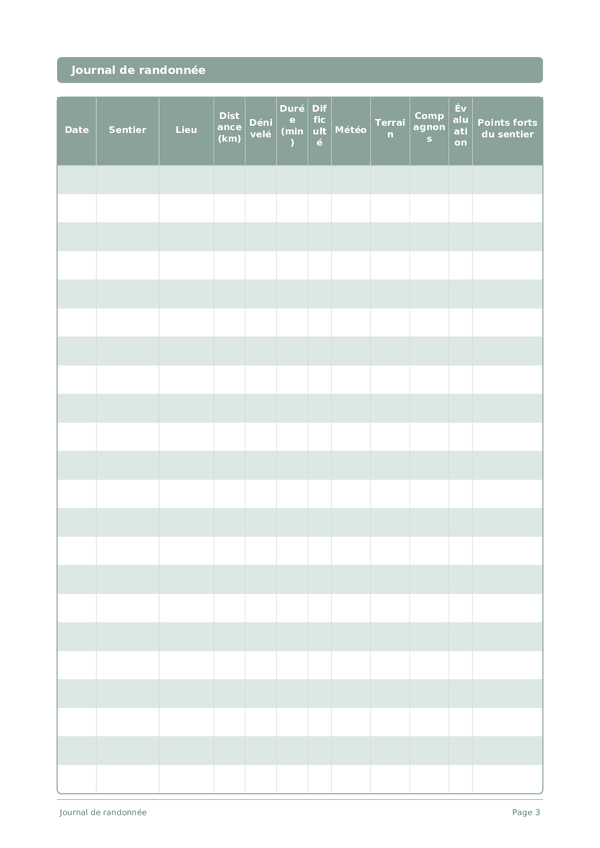
Journal de randonnée
Suivez chaque sentier, sommet et aventure en plein air
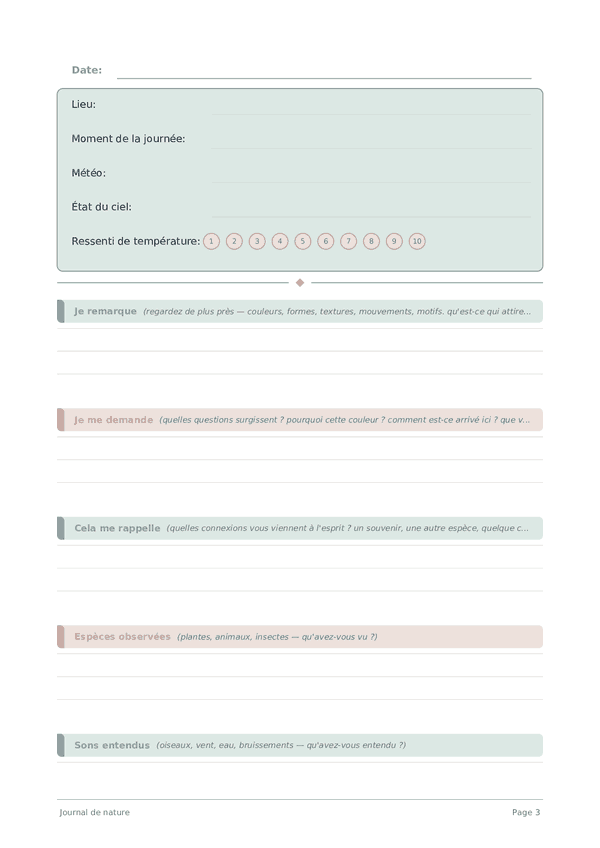
Journal de nature
Observez, émerveillez-vous et connectez-vous avec le monde naturel
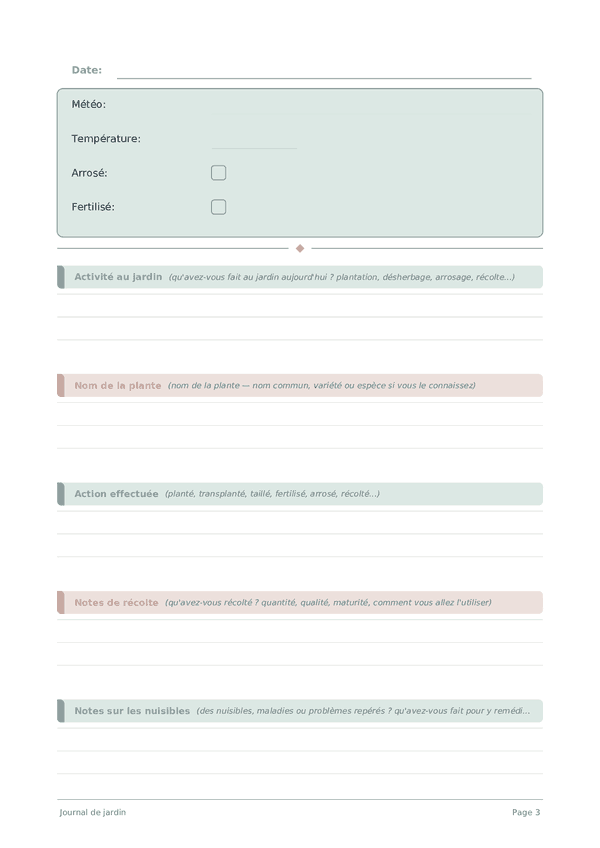
Journal de jardin
Planifiez, suivez et apprenez de chaque saison de culture
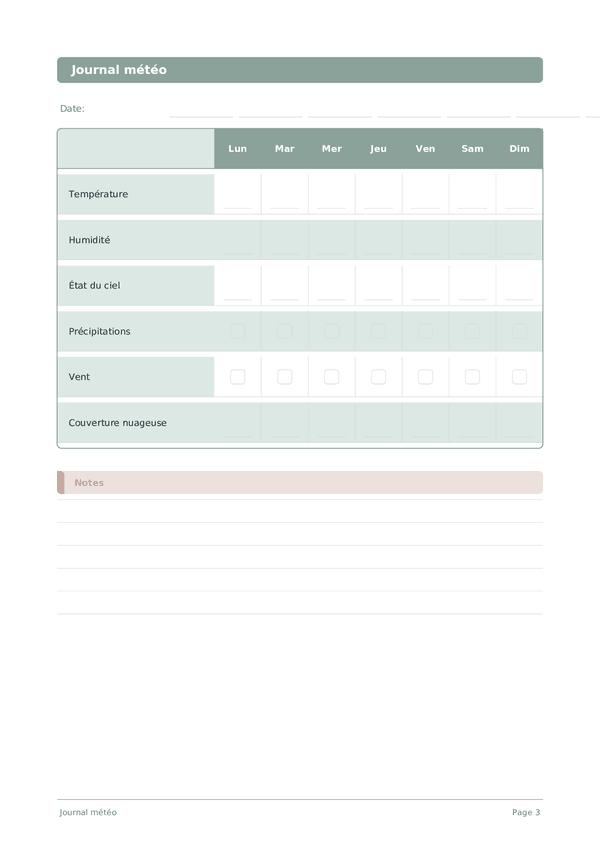
Journal météo
Observations météorologiques quotidiennes pour météorologues amateurs
Molette pour zoomer, glisser pour déplacer