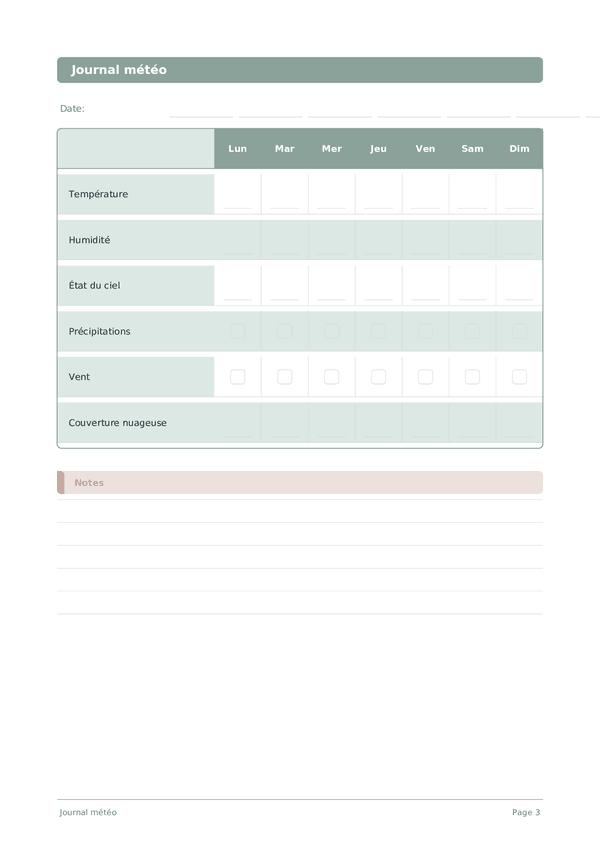
Printable Journal météo
Observations météorologiques quotidiennes pour météorologues amateurs
A structured daily log for anyone who wants to track local weather conditions with precision and consistency. Record temperature, humidity, sky condition, precipitation, wind, and cloud cover each day to build a meaningful personal climate record. Over weeks and months, patterns emerge — seasonal shifts, microclimatic quirks, and correlations with everyday life become visible.
Personnaliser les champs
Activez ou désactivez les champs. Cliquez sur le crayon pour renommer, ou ajoutez vos propres champs.
Avantages
Comment utiliser
Qu'est-ce que ce journal ?
A weather journal is a daily tracker for recording local weather conditions with precision. By logging temperature, humidity, sky conditions, and precipitation each day, you build a hyperlocal climate record that reveals seasonal patterns, microclimates, and long-term trends that official weather stations may miss.
This journal is for weather enthusiasts, gardeners, photographers, outdoor planners, and anyone fascinated by the ever-changing atmosphere. It is also valuable for documenting how weather affects your mood, energy, and activities — creating a personal weather-life correlation record.
Citizen weather observation has a long and valuable history in meteorology. Your daily records contribute to understanding local climate patterns that coarse-grained weather data cannot capture. Over years, this journal becomes a personal almanac — telling you exactly when your area's seasons shift, which weeks bring the best light for photography, and how your garden's microclimate differs from the nearest weather station.
Exemple rempli
Voici à quoi ressemble une entrée typique une fois remplie :
| Mon | Tue | Wed | Thu | Fri | Sat | Sun | |
|---|---|---|---|---|---|---|---|
| Température | 8 | 11 | 14 | 12 | 9 | 7 | 10 |
| Humidité | 72 | 65 | 58 | 70 | 78 | 82 | 68 |
| État du ciel | Overcast | Partly sunny | Clear | Cloudy | Rain | Fog AM, clear PM | Partly cloudy |
| Précipitations | ✓ | ✓ | |||||
| Vent | ✓ | ✓ | ✓ | ||||
| Couverture nuageuse | 9 | 5 | 1 | 7 | 10 | 6 | 4 |
Comment remplir chaque champ
Chaque page est une grille hebdomadaire. Les lignes sont vos éléments de suivi, les colonnes sont les jours de la semaine. Voici ce que signifie chaque élément :
Température
Enregistrez votre température basale. Les variations de température aident à suivre l'ovulation et la santé globale du cycle.
Humidité
État du ciel
À quoi ressemble le ciel en ce moment ? Décrivez les nuages, la clarté ou la météo
Précipitations
Vent
Couverture nuageuse
Conseils pour réussir
Quand et à quelle fréquence écrire
Record observations at the same time every day without exception \u2014 consistency is the foundation of meaningful weather data. Morning readings capture overnight changes; afternoon readings capture the day\u2019s peak conditions. A twice-daily habit takes under 2 minutes each time. Weekly, scan your entries for developing patterns. Monthly and seasonally, compare this period to the same period in previous years. After one full year, your data becomes a genuine reference for your local microclimate.
Questions fréquentes
Quelles mesures noter dans un journal météo quotidien ?
Pour chaque matin, consigne : température (min/max), précipitations (type et quantité en mm), couverture nuageuse sur une échelle de 1 à 8 oktas (0 = ciel dégagé, 8 = ciel couvert), direction et force du vent, pression atmosphérique si tu as un baromètre, et humidité ressentie. Ces relevés matinaux réguliers constituent une série temporelle précieuse pour observer les tendances locales.
Qu'est-ce que l'échelle des oktas et comment l'utiliser ?
L'okta est l'unité standard de mesure de la nébulosité. Divise mentalement le ciel en 8 parties égales et compte combien sont couvertes de nuages : 0 = ciel parfaitement dégagé, 4 = moitié couverte, 8 = entièrement couvert. Cette échelle est utilisée dans l'observation météorologique professionnelle et dans le réseau CoCoRaHS (Community Collaborative Rain, Hail and Snow Network). Elle te donne un vocabulaire commun avec les météorologues amateurs.
Comment contribuer à la météorologie citoyenne avec mon journal ?
Le réseau CoCoRaHS et le Cooperative Observer Program (COOP) aux États-Unis acceptent les données d'observateurs amateurs. En France, Météo-France propose un réseau similaire d'observateurs bénévoles. Tes relevés quotidiens, même simples, contribuent à combler les lacunes entre stations officielles. Pour participer, il te faut au minimum un pluviomètre gradué et un thermomètre min/max calibré.
Comment comparer les conditions locales avec les prévisions officielles ?
Note chaque jour la prévision de Météo-France et les conditions réelles observées. Sur plusieurs mois, tu identifies les biais de ton microclimat : un jardin en creux reçoit souvent 20 % de pluie de plus que la station de référence, un versant sud est régulièrement 3-4 °C plus chaud. Ces corrections te permettent de faire tes propres prévisions locales plus précises que les bulletins généraux.
Qu'est-ce qu'un microclimat et comment le documenter ?
Un microclimat est un ensemble de conditions météorologiques spécifiques à un lieu restreint, souvent différentes des conditions générales de la zone. Note les particularités de ton emplacement : givre tardif dans les fonds de vallée, gel plus précoce dans les zones ombragées, vent canalisé dans une rue. Ces observations, accumulées sur plusieurs années, te donnent une connaissance intime de ton environnement que nulle station météo distante ne peut fournir.
Comment suivre les événements météo extrêmes ?
Réserve une section dédiée aux événements remarquables : orages violents, canicules, gelées tardives, chutes de grêle, inondations locales. Note la date, la durée, l'intensité et les effets observés (arbres tombés, routes inondées, cultures endommagées). Ces archives personnelles prennent une valeur considérable avec le temps, notamment pour suivre l'évolution des extrêmes climatiques dans ta région.
Comment analyser mes données météo après plusieurs mois de notes ?
Commence par calculer des moyennes mensuelles : température, précipitations, nombre de jours de gel ou de pluie. Compare avec les normales climatiques de Météo-France pour ta région. Cherche des tendances inter-annuelles. Relie les anomalies météo aux observations de nature ou de jardin notées en parallèle : une floraison précoce en mars 2025 correspond-elle à un mois de mars exceptionnellement doux dans tes relevés ?
Quel matériel minimal faut-il pour tenir un journal météo sérieux ?
Le minimum utile : un thermomètre min/max (placé à l'ombre, à 1,5 m du sol), un pluviomètre gradué (à vider quotidiennement), une boussole pour la direction du vent. Un baromètre ajoute une dimension précieuse pour la prévision locale à court terme. Tous ces instruments sont abordables (moins de 50 €) et ne nécessitent aucune électronique. La régularité des relevés compte bien plus que la sophistication du matériel.
Vous aimerez aussi
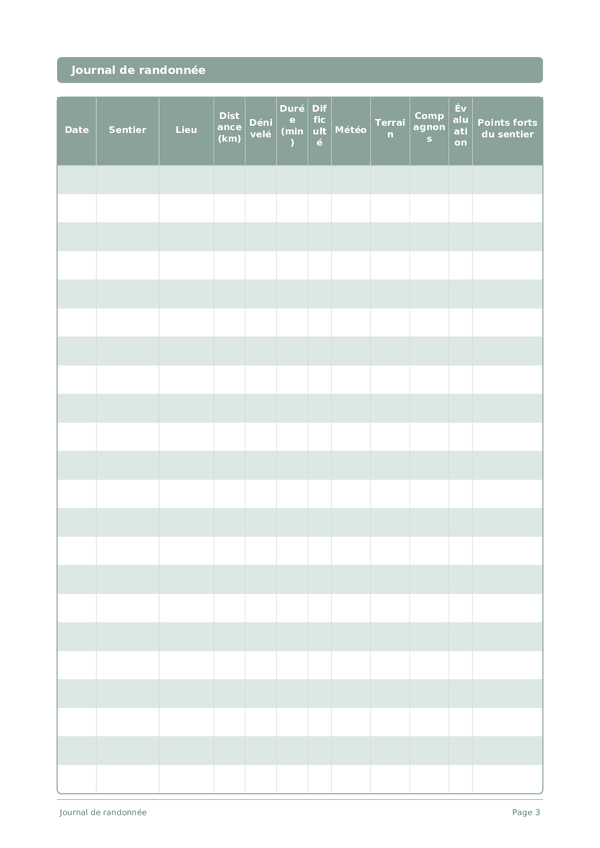
Journal de randonnée
Suivez chaque sentier, sommet et aventure en plein air
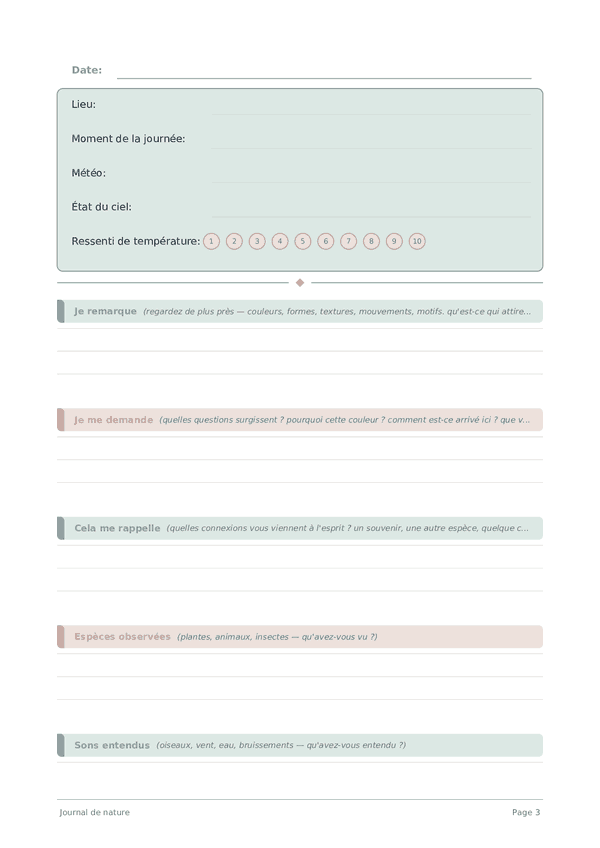
Journal de nature
Observez, émerveillez-vous et connectez-vous avec le monde naturel
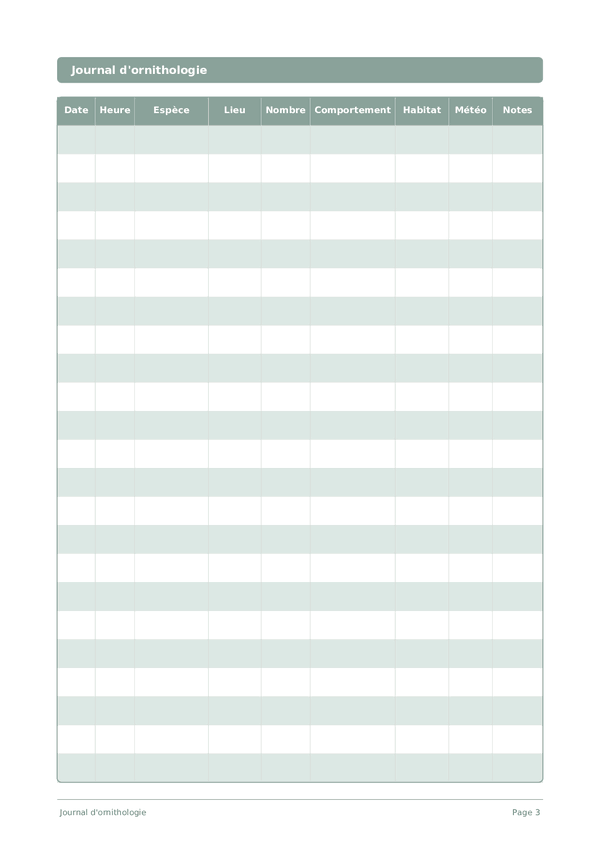
Journal d'ornithologie
Notez chaque observation d'oiseau avec l'espèce, l'habitat et le comportement
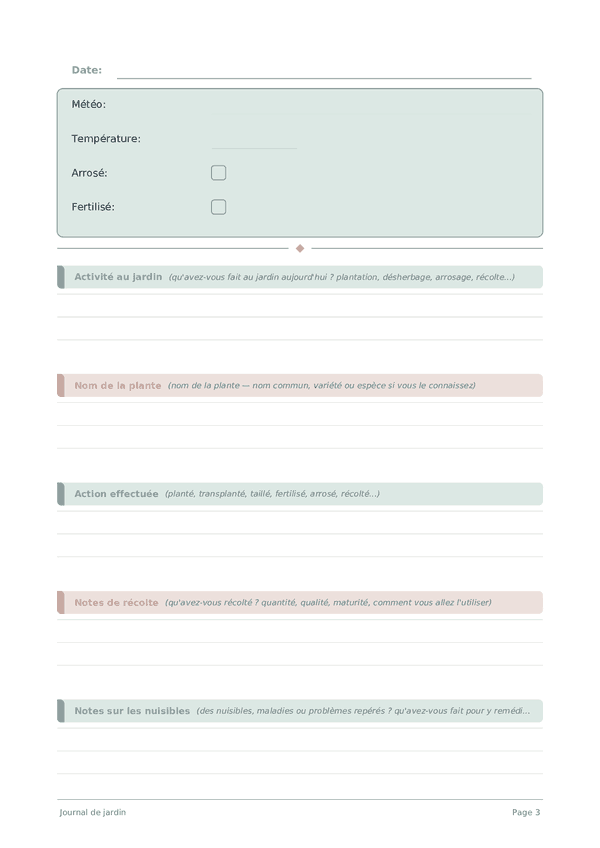
Journal de jardin
Planifiez, suivez et apprenez de chaque saison de culture
Molette pour zoomer, glisser pour déplacer