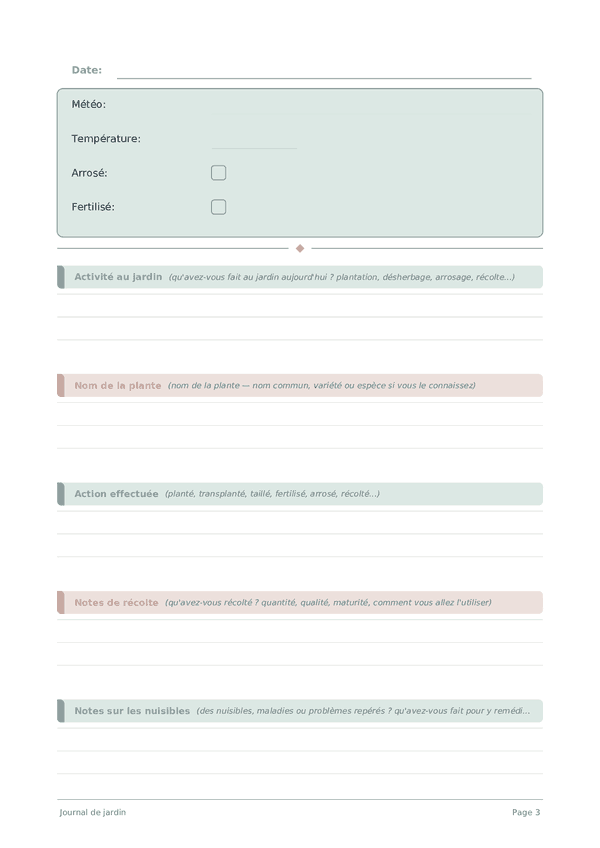
Printable Journal de jardin
Planifiez, suivez et apprenez de chaque saison de culture
A structured daily log for gardeners. Record weather, watering, fertilizing, plant activities, harvests, and pest observations — all in one place. Build a season-by-season knowledge base that helps you grow more successfully each year.
Personnaliser les champs
Activez ou désactivez les champs. Cliquez sur le crayon pour renommer, ou ajoutez vos propres champs.
Avantages
Comment utiliser
Qu'est-ce que ce journal ?
A garden journal is a daily log for tracking weather conditions, plant care activities, and observations in your garden. By recording what you planted, watered, harvested, and noticed, you build a seasonal record that becomes more valuable each year — revealing what works in your specific soil, climate, and microenvironment.
This journal is for gardeners of all types — from balcony container growers to homesteaders with acres. Whether you grow flowers, vegetables, herbs, or a mix of everything, consistent journaling transforms your garden from a series of annual experiments into a cumulative body of knowledge.
Master gardeners consistently cite their journals as their most valuable tool. The garden journal captures information that no book or website can provide: what grew well in your specific conditions, when your microclimate's last frost actually occurs, which pest strategies worked in your soil, and the exact timing that produced your best harvests. Over years, this data becomes irreplaceable.
Exemple rempli
Voici à quoi ressemble une entrée typique une fois remplie :
Comment remplir chaque champ
Le haut de chaque page comporte des champs à remplissage rapide (évaluations, cases à cocher, chiffres). En dessous se trouve une section lignée pour écrire. Voici ce que signifie chaque champ :
Météo
Ensoleillé, nuageux, pluie, vent — conditions actuelles
Température
Enregistrez votre température basale. Les variations de température aident à suivre l'ovulation et la santé globale du cycle.
Arrosé
Avez-vous arrosé votre jardin ou des plantes spécifiques aujourd'hui ?
Fertilisé
Avez-vous appliqué de l'engrais ou des amendements à vos plantes aujourd'hui ?
Activité au jardin
Qu'avez-vous fait au jardin aujourd'hui ? Plantation, désherbage, arrosage, récolte...
Nom de la plante
Nom de la plante — nom commun, variété ou espèce si vous le connaissez
Action effectuée
Planté, transplanté, taillé, fertilisé, arrosé, récolté...
Notes de récolte
Qu'avez-vous récolté ? Quantité, qualité, maturité, comment vous allez l'utiliser
Notes sur les nuisibles
Des nuisibles, maladies ou problèmes repérés ? Qu'avez-vous fait pour y remédier ?
Observations
Observations générales du jardin — progression de la croissance, effets de la météo, état du sol, faune
Conseils pour réussir
Quand et à quelle fréquence écrire
During the growing season, write a brief entry every day or every other day \u2014 even just noting weather, watering, and any visible changes. Weekly, do a deeper walkthrough and record plant health, new growth, and pest activity. At season\u2019s end, review the full log and write a summary of what worked, what failed, and what to change. In the off-season, revisit your journal monthly when planning next year\u2019s garden.
Questions fréquentes
Quelles informations essentielles noter dans un journal de jardin ?
Pour chaque entrée, consigne : météo et températures (min/max), arrosage (quantité et méthode), fertilisation (produit, dose, date), observations sur les plantes (croissance, floraison, problèmes), notes sur les ravageurs et maladies, et dates de récolte. La RHS (Royal Horticultural Society) recommande aussi de noter la zone de rusticité USDA de tes variétés pour anticiper les hivernages et les risques de gel.
Comment utiliser les zones de rusticité USDA dans mon jardin en France ?
La France métropolitaine s'étend des zones 6b (Alsace, montagne) à 10a (Côte d'Azur). Chaque plante porte une indication de zone minimale de rusticité. Note dans ton journal la zone de chaque variété et compare avec celle de ton jardin. Cela explique pourquoi certaines plantes ne passent pas l'hiver et t'aide à choisir des variétés adaptées. La carte interactive de Météo-France ou des sites spécialisés te permettent d'identifier ta zone précise.
Comment suivre l'arrosage et l'humidité du sol ?
Note la quantité d'eau apportée (litres ou minutes d'arrosage), la méthode (goutte-à-goutte, asperseur, arrosoir) et l'état du sol au toucher (sec, humide, détrempé). Combine avec les données de précipitation. Au fil du temps, tu identifies les besoins réels de chaque zone et de chaque culture, et tu évites l'erreur la plus courante : l'excès d'arrosage. Un bon suivi permet de réduire la consommation d'eau de 30 à 40 %.
Que noter sur les ravageurs et les maladies ?
Décris le symptôme précis (taches jaunes, feuilles percées, dépérissement), la plante atteinte, la date et l'étendue de l'attaque. Note les traitements appliqués et leur efficacité. Ces données te permettent d'anticiper les problèmes récurrents (certains ravageurs ont des cycles prévisibles) et de comparer les méthodes — parfois un simple jet d'eau ou de la bouillie bordelaise suffit là où un traitement chimique semblait nécessaire.
Comment planifier les rotations de cultures grâce au journal ?
Note chaque année quelles cultures ont occupé chaque parcelle. La rotation consiste à ne pas cultiver deux années de suite des plantes de la même famille au même endroit (ex. : tomates/poivrons/aubergines sont toutes des Solanacées). Ton journal te montre précisément l'historique de chaque carré et t'évite les erreurs de mémoire. La RHS recommande un cycle minimum de 3-4 ans pour les cultures sensibles aux maladies du sol.
Pourquoi noter les dates précises de semis et de récolte ?
Ces dates sont ton guide de planification pour les années suivantes. En comparant les dates de semis et les premières récoltes, tu calcules les durées de culture réelles dans tes conditions (sol, exposition, microlimat). Tu peux ainsi optimiser les successions de cultures et maximiser la production sur une petite surface. Sans ces notes, tu retombes chaque année dans les mêmes tâtonnements.
Comment noter les expériences et les essais variétaux ?
Crée une section dédiée aux comparaisons : variété A vs variété B, compost maison vs engrais du commerce, paillage vs sol nu. Note les conditions de chaque essai et les résultats mesurables (rendement, résistance aux maladies, saveur). Même des observations informelles accumulées sur plusieurs années valent une expérimentation rigoureuse. Ton jardin devient un laboratoire vivant dont tu es le scientifique.
Comment utiliser mon journal de jardin en hiver ?
L'hiver est le moment idéal pour relire et analyser. Dresse le bilan de la saison : succès, échecs, surprises. Fais la liste des graines à commander, des aménagements à réaliser, des variétés à tester. Consulte tes notes sur les ravageurs pour prévoir les traitements préventifs de printemps. Ce travail de réflexion hivernal, loin de l'urgence du jardin en saison, est souvent ce qui fait la différence entre une année passable et une année excellente.
Vous aimerez aussi
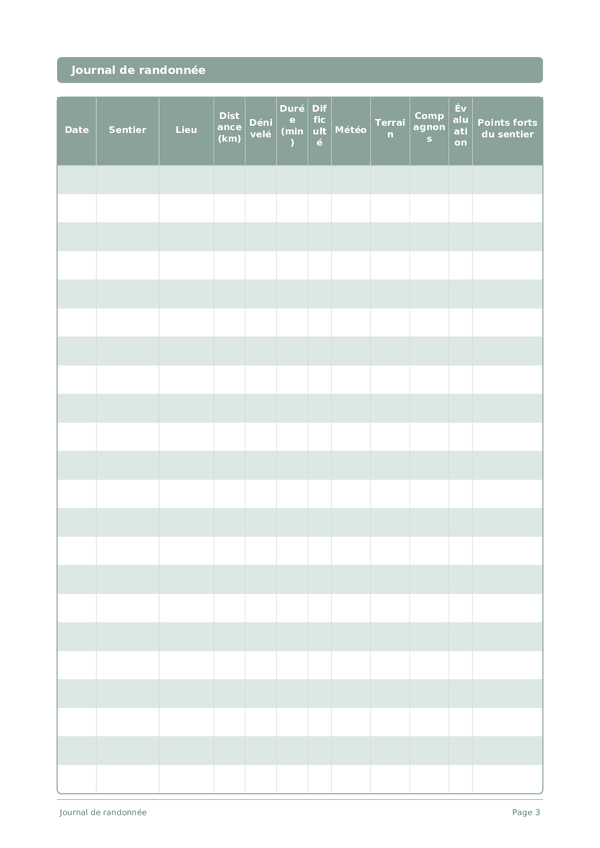
Journal de randonnée
Suivez chaque sentier, sommet et aventure en plein air
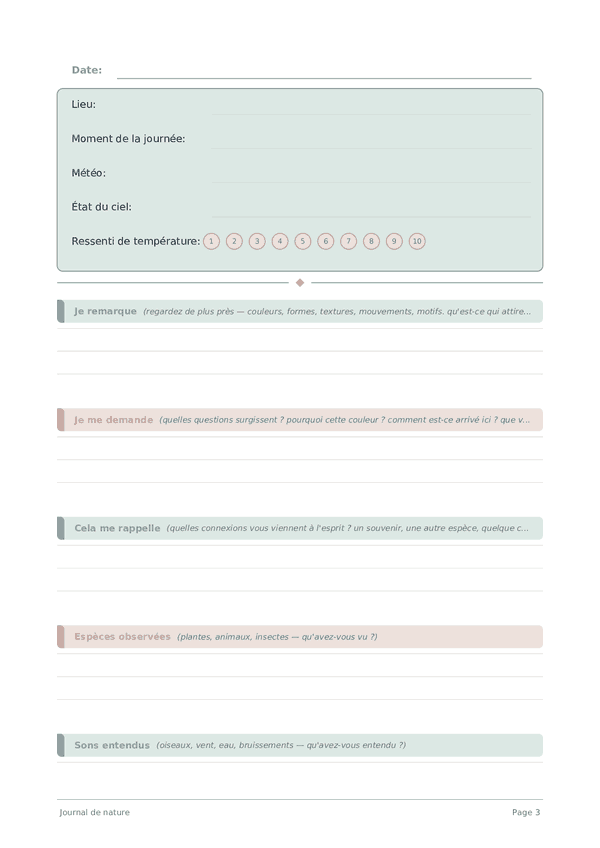
Journal de nature
Observez, émerveillez-vous et connectez-vous avec le monde naturel
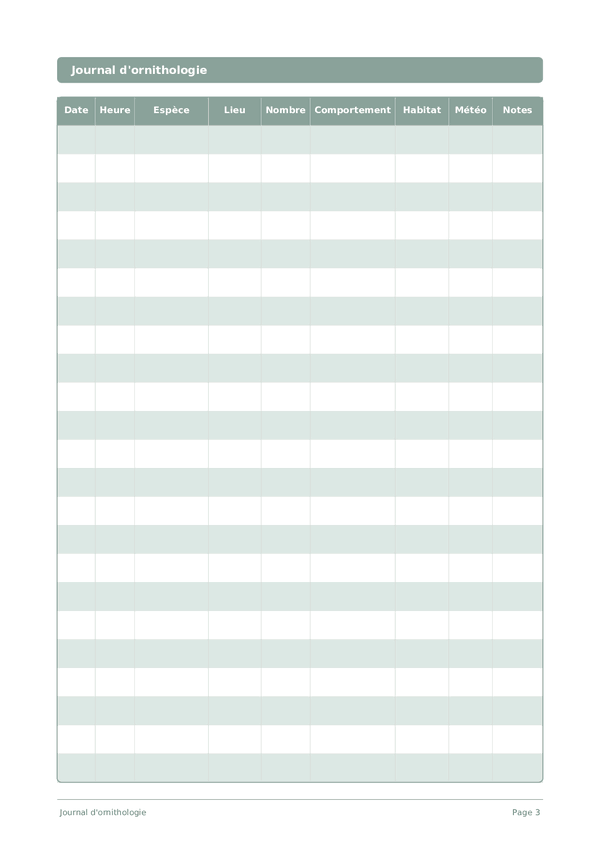
Journal d'ornithologie
Notez chaque observation d'oiseau avec l'espèce, l'habitat et le comportement
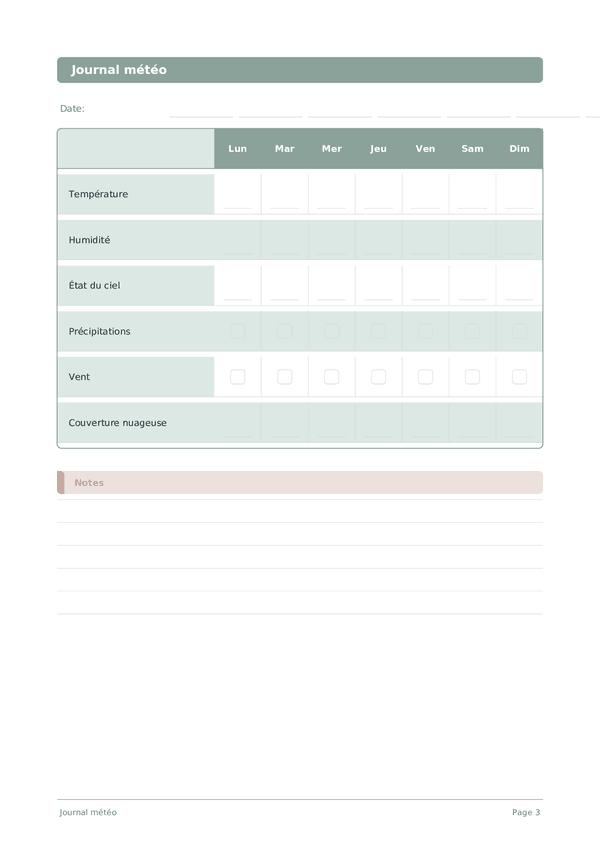
Journal météo
Observations météorologiques quotidiennes pour météorologues amateurs
Molette pour zoomer, glisser pour déplacer