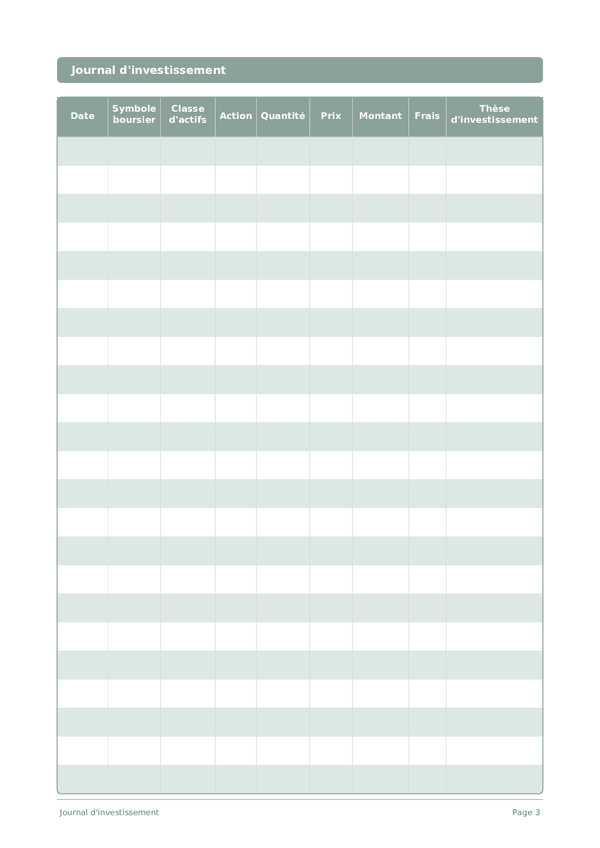
Printable Journal d'investissement
Suivez vos transactions, analysez vos décisions et faites croître votre portefeuille
A structured investment journal for recording every trade — ticker, asset class, price, quantity, and your reasoning behind each decision. Reviewing past entries reveals patterns in your strategy, helps you avoid repeating mistakes, and builds the discipline that separates consistent investors from impulsive ones.
Personnaliser les champs
Activez ou désactivez les champs. Cliquez sur le crayon pour renommer, ou ajoutez vos propres champs.
Avantages
Comment utiliser
Qu'est-ce que ce journal ?
An investment journal is a disciplined record-keeping tool for anyone who actively manages their investment portfolio. By logging every transaction — the ticker, asset class, action taken, quantity, price, total amount, fees, and your investment thesis — you create an invaluable archive of your decision-making process. This journal serves both as a practical ledger and as a learning tool that helps you become a better investor over time.
The most common mistake investors make is acting on emotion rather than analysis. A journal combats this by requiring you to articulate your investment thesis before or immediately after each trade. When you must write down why you are buying or selling, you naturally become more thoughtful and deliberate. Reviewing past entries reveals whether your reasoning was sound, which strategies generated returns, and where emotional decisions led to losses.
Whether you invest in individual stocks, ETFs, bonds, cryptocurrency, or real estate, this journal adapts to any asset class. It is especially valuable during volatile markets, where the temptation to panic-sell or chase gains is strongest. Having a written record of your original thesis provides the anchor of rationality that keeps you on your long-term plan.
Exemple rempli
Voici à quoi ressemble une entrée typique une fois remplie :
| Date | Symbole boursier | Classe d'actifs | Action | Quantité | Prix | Montant | Frais | Thèse d'investissement |
|---|---|---|---|---|---|---|---|---|
| 2026-03-01 | VTI | ETF (US Total Market) | Buy | 15 | 268.5 | 4027.5 | 0 | Monthly DCA into broad market index. Long-term core holding. |
| 2026-03-01 | AAPL | Stock (Tech) | Buy | 10 | 192.3 | 1923 | 0 | Strong Services revenue growth, AI integration, attractive P/E after pullback. |
| 2026-03-02 | BND | ETF (Bonds) | Buy | 20 | 72.8 | 1456 | 0 | Rebalancing to 20% bonds allocation. Rate cuts expected in H2 2026. |
| 2026-03-03 | TSLA | Stock (Tech) | Sell | 5 | 245 | 1225 | 0 | Taking partial profits after 35% run-up. Valuation looks stretched. |
| 2026-03-03 | BTC | Crypto | Buy | 0.05 | 82000 | 4100 | 12.3 | Small allocation (2% of portfolio). Halving cycle thesis, long-term hold. |
Comment remplir chaque champ
Chaque page est un tableau avec des colonnes. Remplissez une ligne par entrée. Voici à quoi sert chaque colonne :
Date
Inscrivez la date du jour. Cela ancre votre entrée dans le temps et aide lors de la relecture ultérieure.
Symbole boursier
Classe d'actifs
Action
Quantité
Prix
Combien avez-vous payé ? Prix de la bouteille dans votre devise locale
Montant
Enregistrez le montant de cette entrée. Soyez précis — les arrondis créent des inexactitudes qui s'accumulent avec le temps.
Frais
Thèse d'investissement
Conseils pour réussir
Quand et à quelle fréquence écrire
Make an entry every time you execute a trade — capture the reasoning, position size, and conviction level in the moment, not after the outcome. For open positions, do a weekly check-in: has the thesis changed? Are you still within your risk parameters? Monthly, review all closed positions and calculate your win rate, average gain vs. average loss, and return by asset class. Quarterly, read back through your thesis entries and grade yourself on discipline.
Questions fréquentes
Pourquoi noter une thèse d'investissement à chaque transaction ?
Écrire votre raisonnement au moment de l'achat réduit le biais rétrospectif et facilite la relecture ultérieure. La SEC (en France : l'AMF) recommande de documenter les décisions et d'éviter les transactions émotionnelles. Kahneman, *Thinking, Fast and Slow* (2011), montre que les décisions consignées par écrit résistent mieux à l'auto-justification a posteriori. La colonne thèse d'investissement de ce carnet rend cette habitude opérationnelle à chaque ligne.
Comment utiliser la colonne classe d'actifs pour surveiller la diversification ?
Étiquetez chaque transaction par classe — actions, ETF, obligations, crypto — puis additionnez le montant par classe chaque mois pour observer la dérive d'allocation. La SEC/AMF considère la diversification comme la discipline centrale de gestion du risque. Combiner les colonnes classe d'actifs et amount transforme un journal de transactions en rapport d'allocation sans logiciel externe.
En quoi ce carnet papier diffère-t-il d'un relevé de courtier ?
Le relevé de courtier indique ce que vous avez fait ; ce carnet enregistre pourquoi. Les neuf colonnes — dont thèse d'investissement, fees et classe d'actifs — préservent l'intention à côté de l'exécution. La SEC/AMF recommande de tenir des archives personnelles indépendantes des relevés courtier, notamment pour la justification fiscale et l'analyse des décisions, surtout si vous gérez plusieurs comptes.
Pourquoi consigner les frais à chaque entrée ?
Les frais s'accumulent et érodent les rendements plus que la plupart des investisseurs ne l'estiment. La SEC a montré qu'une commission annuelle de 1 % peut réduire la valeur d'un portefeuille de dizaines de milliers d'euros sur des décennies. La colonne fees impose une prise de conscience à chaque transaction plutôt qu'une seule fois par an sur un relevé.
Tenir un journal d'investissement améliore-t-il vraiment les résultats ?
La documentation soutient le cycle de pratique délibérée — enregistrer, relire, affiner. Le CFPB (en France : l'ACPR et la Banque de France) approuve les registres écrits pour toute activité financière. Si aucun carnet ne garantit des rendements, rédiger la colonne thèse d'investissement et relire ses entrées mensuellement contrecarre les biais de surconfiance et d'aversion aux pertes décrits par Kahneman.
Ce carnet convient-il aux investisseurs en ETF et fonds indiciels ?
Oui. La colonne classe d'actifs accueille indifféremment ETF, fonds indiciels, obligations ou actions individuelles. Même les investisseurs passifs bénéficient de consigner leurs apports et leur raisonnement — la SEC/AMF recommande une vérification périodique de l'allocation. Pour les investisseurs à faible fréquence, la page de 12 lignes couvre environ un an d'apports mensuels, facilitant la révision à la saison fiscale.
Quelles erreurs courantes ce carnet aide-t-il à éviter ?
Deux erreurs majeures : chasser la performance passée et oublier pourquoi on a acheté. La SEC/AMF avertit que changer de stratégie selon les rendements récents détruit la performance à long terme. Remplir le champ thèse d'investissement impose une phrase de justification ; le relire mensuellement expose les erreurs récurrentes — surconcentration, vente panique, achat de récits plutôt que de fondamentaux.
À quelle fréquence revoir ses entrées de carnet ?
La revue mensuelle est la bonne cadence pour la plupart des investisseurs — assez fréquente pour détecter une dérive, assez rare pour éviter le surtrading. La SEC/AMF suggère de vérifier l'allocation à intervalles définis plutôt que de réagir aux mouvements de marché. Avec 12 lignes par page, une page correspond approximativement à un cycle de revue ; parcourez ensemble les entrées thèse d'investissement et les totaux classe d'actifs.
Vous aimerez aussi
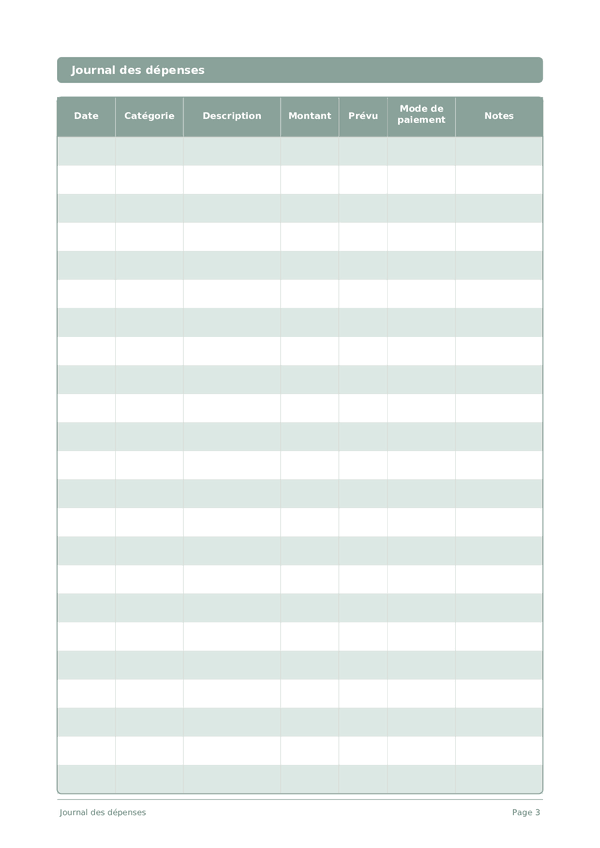
Journal des dépenses
Suivez chaque euro pour prendre le contrôle de vos finances
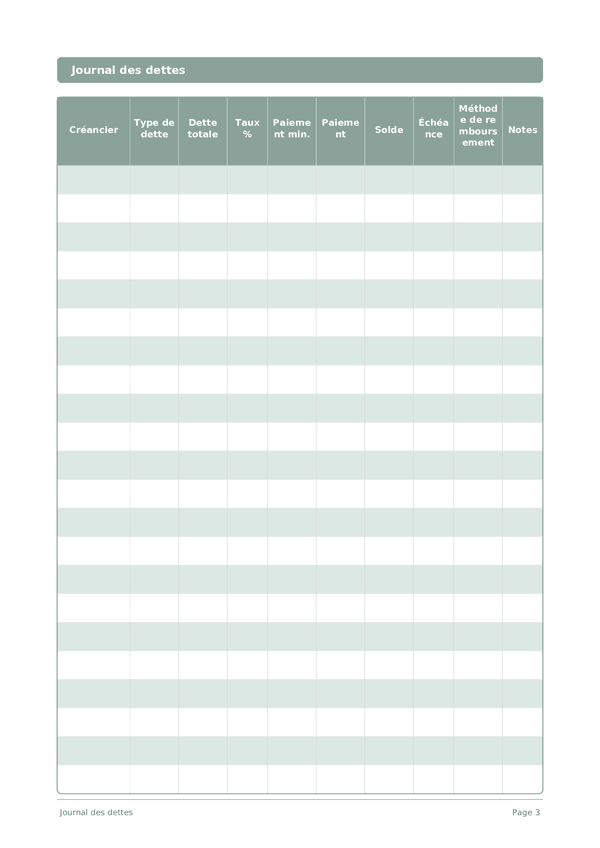
Journal des dettes
Suivez et éliminez vos dettes avec une stratégie de remboursement claire
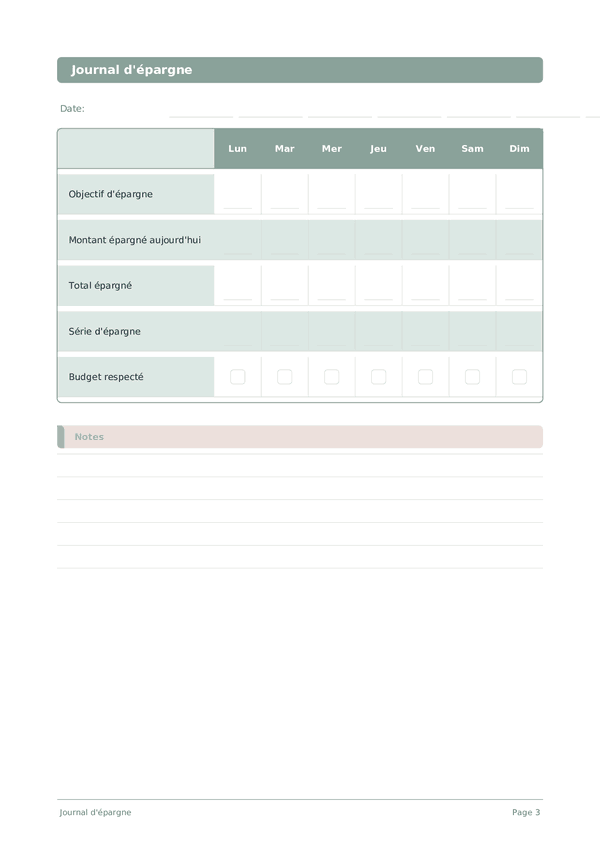
Journal d'épargne
Suivez vos habitudes d'épargne quotidiennes et progressez vers vos objectifs financiers
Journal de carrière
Suivez vos réalisations et accélérez votre croissance professionnelle chaque jour
Molette pour zoomer, glisser pour déplacer