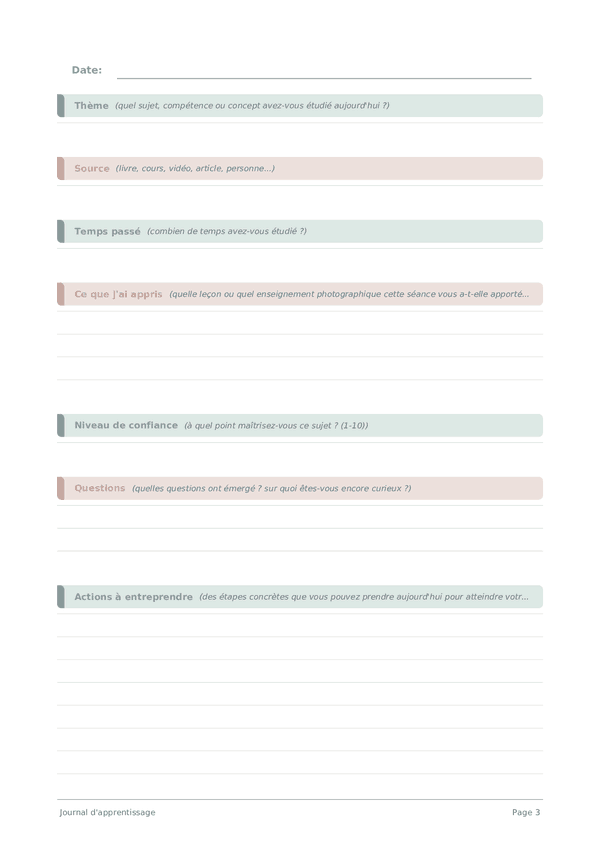
Printable Journal d'apprentissage
Apprenez en profondeur avec la technique Feynman
Apply the Feynman technique to every study session. Explain what you learned in plain words, surface knowledge gaps, spark new questions, and turn insights into concrete action — all in one daily entry.
Personnaliser les champs
Activez ou désactivez les champs. Cliquez sur le crayon pour renommer, ou ajoutez vos propres champs.
Avantages
Comment utiliser
Qu'est-ce que ce journal ?
A learning journal built on the Feynman technique is one of the most effective tools for deep understanding. The core idea is simple: if you cannot explain something in plain language, you do not truly understand it. Each entry challenges you to articulate what you learned, identify gaps, and plan concrete next steps — turning passive consumption into active mastery.
Every session begins by noting the topic, source, and time invested. Then you write what you learned as if explaining it to someone with no background in the subject. This act of simplification exposes fuzzy thinking and forgotten details far faster than re-reading notes ever could.
Finally, you record your confidence level, lingering questions, and specific action steps. Over weeks, your journal becomes a personal knowledge base that charts not just what you studied, but how deeply you understood it — and where you still need to dig deeper.
Exemple rempli
Voici à quoi ressemble une entrée typique une fois remplie :
Comment remplir chaque champ
Chaque jour, vous trouverez plusieurs sections étiquetées avec des lignes pour écrire. Voici à quoi sert chaque section :
Thème
Quel sujet, compétence ou concept avez-vous étudié aujourd'hui ?
Source
Livre, cours, vidéo, article, personne...
Temps passé
Combien de temps avez-vous étudié ?
Ce que j'ai appris
Écrivez une chose nouvelle que vous avez apprise aujourd'hui. Cela peut être un fait, une compétence, une prise de conscience sur vous-même ou une leçon de vie. L'apprentissage quotidien se compose en sagesse.
Niveau de confiance
À quel point maîtrisez-vous ce sujet ? (1-10)
Questions
Quelles questions ont émergé ? Sur quoi êtes-vous encore curieux ?
Actions à entreprendre
Décomposez votre objectif en actions concrètes. Que ferez-vous exactement, quand et comment ? Plus c'est précis, mieux c'est.
Conseils pour réussir
Quand et à quelle fréquence écrire
Write an entry after every study session or significant learning event — the same day, ideally within an hour, when recall is strongest. If you are in a course or structured program, daily entries keep pace with new material. For self-directed learners, three to four entries per week maintain momentum without burnout. Weekly, review your entries and rewrite key concepts from memory as spaced repetition. Monthly, identify which topics need revisiting based on your self-rated understanding scores.
Questions fréquentes
Qu'est-ce que la technique Feynman et comment ce journal l'applique-t-il ?
La technique Feynman : choisis un sujet, explique-le en langage simple comme si tu enseignais à un enfant, trouve les lacunes, affine. La structure de ce journal reflète cela — champ sujet, ce que j ai appris dans tes propres mots, niveau de confiance pour trouver les lacunes, champ questions pour ce que tu n'as pas pu expliquer, étapes d action pour la suite. Chaque entrée quotidienne force la boucle expliquer-trouver-affiner sur une seule séance d'apprentissage.
Pourquoi expliquer ce que j'ai appris « comme à un enfant » ?
Générer une explication dans tes propres mots est de la pratique de récupération — le mécanisme d'apprentissage le plus puissant en sciences cognitives. Roediger et Karpicke (2006, Psychological Science, 17(3), 249-255) ont montré que la récupération produit une rétention à long terme dramatiquement meilleure que la relecture. Simplifier pour un non-expert expose les mots que tu récites par cœur par rapport aux idées que tu comprends vraiment. Le champ de quatre lignes ce que j'ai appris est l'espace de travail pour cela.
Comment utiliser le champ niveau de confiance pour trouver les lacunes ?
Note ta confiance sur le sujet du jour immédiatement après avoir écrit l'explication. Une faible confiance sur un sujet que tu viens d'« apprendre » est un avertissement d'illusion de fluidité — reconnaître du matériel n'est pas la même chose que le rappeler ou l'appliquer (Bjork & Bjork, 2011, Psychology and the Real World, Worth Publishers). Utilise ces faibles notes pour signaler des sujets à réviser de façon espacée dans le champ étapes d'action.
Que mettre dans la section questions ?
Tout ce à quoi tu n'as pas pu répondre dans ta propre explication, plus ce sur quoi le matériel t'a rendu curieux. Les trois lignes t'obligent à nommer ton ignorance spécifiquement — « pourquoi X provoque-t-il Y ? » plutôt que « je ne comprends pas ça ». La théorie de la charge cognitive de Sweller (Educational Psychology Review, plusieurs articles) montre que les questions articulées réduisent la charge non pertinente sur les futures séances d'étude car tu arrives avec des cibles précises.
Comment le champ étapes d'action fait-il le lien entre apprentissage et pratique ?
Deux lignes pour ce que tu feras — révision avec répétition espacée, construire un petit projet, trouver un exemple résolu, enseigner le sujet. Sans cette étape, l'apprentissage reste passif. Le cadre de pratique délibérée d'Ericsson et al. (1993, Psychological Review, 100(3), 363-406) exige une application ciblée, pas seulement une exposition. Les meilleures étapes d'action sont petites et limitées dans le temps : « refaire le problème 4.2 demain sans notes ».
À quelle fréquence réviser les anciennes entrées d'apprentissage ?
Utilise des intervalles espacés — 1 jour, 3 jours, 1 semaine, 2 semaines, 1 mois. Cepeda et al. (2006, Psychological Bulletin, 132(3), 354-380) ont constaté que des intervalles croissants optimisent la rétention à long terme. Les champs date et sujet du journal le rendent consultable pour la révision. Relis d'abord ta propre explication ; si tu peux l'étendre ou la corriger sans notes, le sujet se consolide. Sinon, retourne au matériel source.
En quoi est-ce différent d'Anki ou d'une appli de cartes mémoire ?
Anki et les applis SRS optimisent le rappel factuel par répétition espacée. Ce journal construit la compréhension par l'explication et la réflexion — une fonction complémentaire, pas redondante. Utilise les deux : les entrées du journal révèlent ce que tu comprends ou non ; les cartes mémoire exercent les faits. Le champ questions devient souvent la source de tes meilleures cartes Anki.
Ce journal fonctionnera-t-il pour l'apprentissage technique, linguistique ou en sciences humaines ?
Oui — la technique Feynman est neutre par rapport au domaine. Les ingénieurs l'utilisent sur les algorithmes et les preuves ; les apprenants de langues sur les règles de grammaire ; les étudiants en histoire sur les chaînes causales. Oakley (2014, A Mind for Numbers, Tarcher) applique explicitement une explication similaire en langage simple aux matières STEM. Le champ source capture le type de matériel pour que les schémas interdisciplinaires deviennent visibles avec le temps.
Vous aimerez aussi
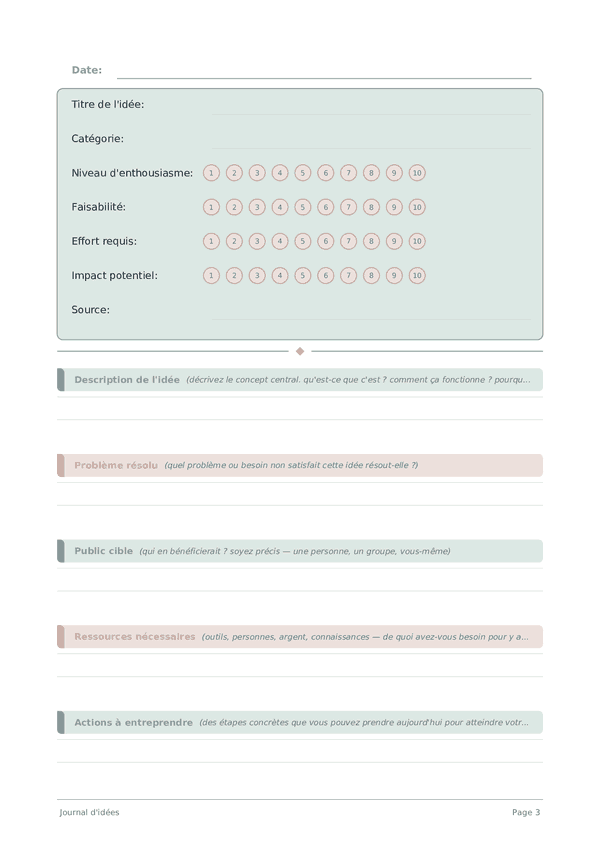
Journal d'idées
Capturez, évaluez et développez vos meilleures idées
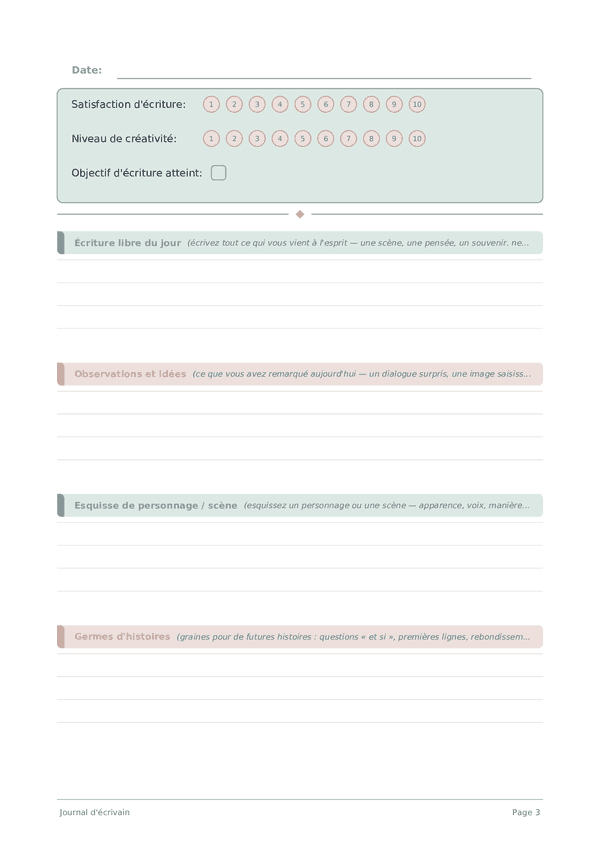
Journal d'écrivain
Pratique quotidienne d'écriture créative et développement du style
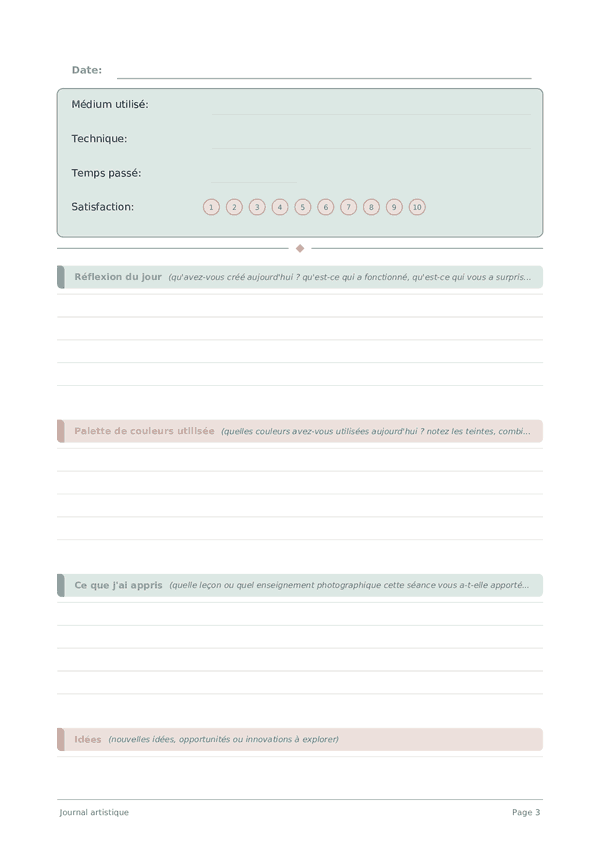
Journal artistique
Documentez votre processus créatif et votre évolution artistique
Journal de croquis
Pages à grille de points ouvertes pour le croquis, le dessin et l'exploration visuelle

Molette pour zoomer, glisser pour déplacer