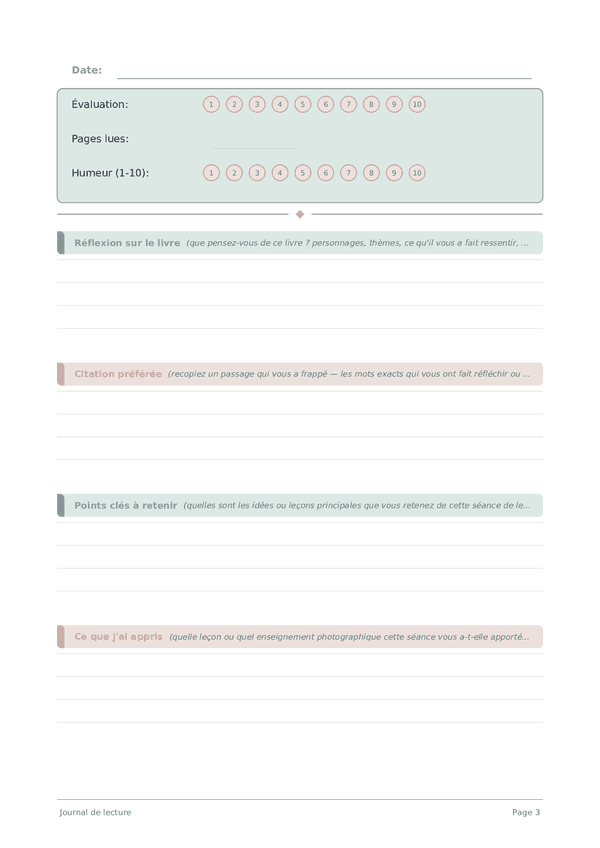
Printable Journal de lecture
Réfléchissez à chaque livre que vous lisez
A guided reading journal that combines quick tracking with thoughtful reflection. Rate each book, record your progress, and capture the quotes, insights, and takeaways that matter most. Transform passive reading into an active practice of learning and self-discovery.
Personnaliser les champs
Activez ou désactivez les champs. Cliquez sur le crayon pour renommer, ou ajoutez vos propres champs.
Avantages
Comment utiliser
Qu'est-ce que ce journal ?
A Reading Journal is a hybrid companion for thoughtful readers who want to get more from every book. The top section tracks your rating, pages read, and current mood. The bottom section prompts you to reflect on what you read, capture key takeaways, save your favorite quote, note what you learned, and record whether you would recommend the book. It transforms passive reading into active learning.
Studies in cognitive science consistently show that writing about what you read dramatically improves retention and understanding. Without reflection, most of a book's insights fade within weeks. This journal creates a simple habit: after each reading session, spend a few minutes processing the material in your own words. Over time, you build a personal library of distilled wisdom that you can revisit anytime.
Keep this journal next to wherever you read. After each session, fill in the tracker — it takes seconds. Then write your reflection while the material is fresh: what stood out, what challenged your thinking, what you want to remember. The favorite quote section is especially valuable — curating the lines that resonate with you creates a personal anthology that reveals your evolving interests and values.
Exemple rempli
Voici à quoi ressemble une entrée typique une fois remplie :
Comment remplir chaque champ
Le haut de chaque page comporte des champs à remplissage rapide (évaluations, cases à cocher, chiffres). En dessous se trouve une section lignée pour écrire. Voici ce que signifie chaque champ :
Évaluation
Note globale de l'expérience
Pages lues
Combien de pages avez-vous lues aujourd'hui ? Même quelques pages comptent — la régularité est essentielle
Humeur (1-10)
Évaluez votre état émotionnel général de la journée. 1 signifie très bas ou déprimé, 10 signifie exceptionnellement heureux et positif. Ne réfléchissez pas trop — fiez-vous à votre instinct.
Réflexion sur le livre
Que pensez-vous de ce livre ? Personnages, thèmes, ce qu'il vous a fait ressentir, ce qui vous est resté
Citation préférée
Recopiez un passage qui vous a frappé — les mots exacts qui vous ont fait réfléchir ou ressentir quelque chose
Points clés à retenir
Quelles sont les idées ou leçons principales que vous retenez de cette séance de lecture ?
Ce que j'ai appris
Écrivez une chose nouvelle que vous avez apprise aujourd'hui. Cela peut être un fait, une compétence, une prise de conscience sur vous-même ou une leçon de vie. L'apprentissage quotidien se compose en sagesse.
Recommanderiez-vous
Recommanderiez-vous ce livre ? À qui et pourquoi ?
Conseils pour réussir
Quand et à quelle fréquence écrire
Make a short entry every time you finish a reading session — even two lines are enough to capture what resonated. Write a full reflection within a day of finishing a book while details are still vivid. Once a month, scan your entries to notice trends: are you gravitating toward certain authors, themes, or moods? A quarterly review of your reading list helps you set intentional goals for the next period rather than drifting between random picks.
Questions fréquentes
Que suit le Journal de lecture par entrée ?
Un tracker (note 0 à 10, pages lues jusqu'à 9999, humeur 0 à 10) plus 8 lignes pour réflexion sur le livre avec des questions pour citation favorite, points clés, ce que j ai appris et recommanderais je. Le format hybride convient à la fois à la réflexion sur un livre complet à la fin et à la consignation par séance pendant les lectures longues. La structure transforme la lecture d'une activité passive en une pratique d'apprentissage actif.
Pourquoi consigner les pages lues — finir le livre n'est-il pas ce qui compte ?
Pages lues maintient l'habitude quotidienne et expose les schémas. Certains lecteurs surestiment constamment leur rythme ; d'autres découvrent qu'ils lisent plus qu'ils ne le pensaient. Willingham (2017, The Reading Mind, Jossey-Bass) souligne que le prédicteur le plus fort de la compréhension de la lecture est l'engagement soutenu — qui se construit avec une lecture quotidienne régulière plutôt que des sessions de lecture intensive occasionnelles. Même 10 pages consignées quotidiennement dépasse le volume réel de la plupart des lecteurs occasionnels.
Comment écrire une section points clés utile ?
Deux ou trois idées spécifiques du livre exprimées dans tes propres mots, pas ceux de l'auteur. Wolf (2018, Reader, Come Home, HarperOne) décrit comment la lecture en profondeur exige que le cerveau construise plutôt que reçoive passivement — ta propre formulation est la construction. Les points vagues (« livre important ») s'estompent ; les spécifiques (« les intérêts composés jouent contre toi dans les dettes autant qu'ils jouent pour toi dans l'épargne ») survivent.
Tenir un journal de lecture améliore-t-il vraiment la rétention ?
Oui — pour la même raison que l'effet de test fonctionne dans l'apprentissage académique. Roediger et Karpicke (2006, Psychological Science, 17(3), 249-255) ont montré que la récupération et l'articulation produisent une mémoire à long terme bien plus forte que la relecture. Les questions de réflexion forcent la récupération ; le champ citation favorite exige une sélection. Les lecteurs qui tiennent un journal retiennent en gros 2 à 3 fois plus d'un livre six mois plus tard par rapport à ceux qui finissent simplement et passent à autre chose.
En quoi est-ce différent de Goodreads ou d'une appli de lecture ?
Goodreads consigne que tu as lu un livre et ta note ; ce journal capture ce que tu en as tiré. L'espace de 8 lignes de réflexion est là où la lecture devient apprentissage. Les applis optimisent pour le partage social et les algorithmes de recommandation ; ce journal optimise pour la compréhension personnelle. Utilise les deux si tu veux — Goodreads pour le suivi et la découverte, le journal pour les livres qui valent la peine d'être bien mémorisés.
Si je lis de la fiction — les points clés et « ce que j'ai appris » s'appliquent-ils ?
Oui. La fiction enseigne différemment — sur le caractère, le langage, la vérité émotionnelle, la structure narrative — mais elle enseigne. Maryanne Wolf (2018, Reader, Come Home, HarperOne) décrit comment la lecture littéraire en profondeur développe l'empathie et la réflexion de façon mesurable. Points clés peut capturer une observation sur le métier, une image récurrente, ou ce qui a changé dans ta pensée. Recommanderais je devient plus nuancé pour la fiction : à qui, et pour quoi ?
Faut-il écrire par livre ou par séance de lecture ?
Par séance pour les livres longs ou complexes ; par livre pour les lectures plus courtes ou légères. La consignation multi-séances capture les impressions évolutives — ta vision d'un personnage ou d'un argument change souvent à mesure que le livre se déroule. Le champ pages lues supporte les deux approches. La recherche sur la lecture et l'instruction montre constamment que l'engagement distribué et la réflexion produisent une compréhension plus profonde que les réactions en une seule séance.
À quelle fréquence réviser les anciennes entrées de lecture ?
Trimestriellement pour la révision des schémas ; en fin d'année pour le tableau d'ensemble. L'effet d'espacement (Cepeda et al., 2006, Psychological Bulletin, 132(3), 354-380) fait de la relecture distribuée le meilleur outil pour l'intégration à long terme. La révision de fin d'année avec attention aux notes et aux citations favorites révèle aussi les évolutions de goût et les préoccupations actuelles — le journal devient un registre involontaire du développement intellectuel sur des années.
Vous aimerez aussi
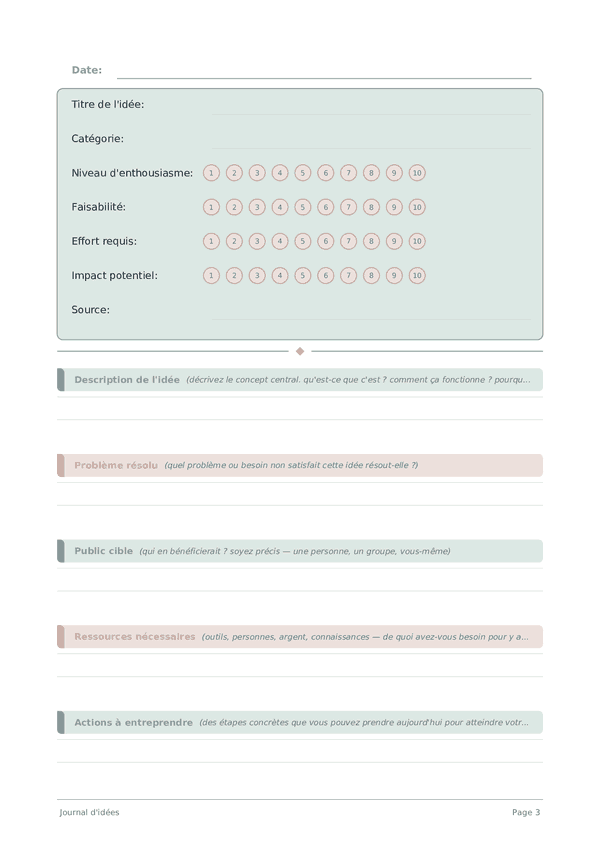
Journal d'idées
Capturez, évaluez et développez vos meilleures idées
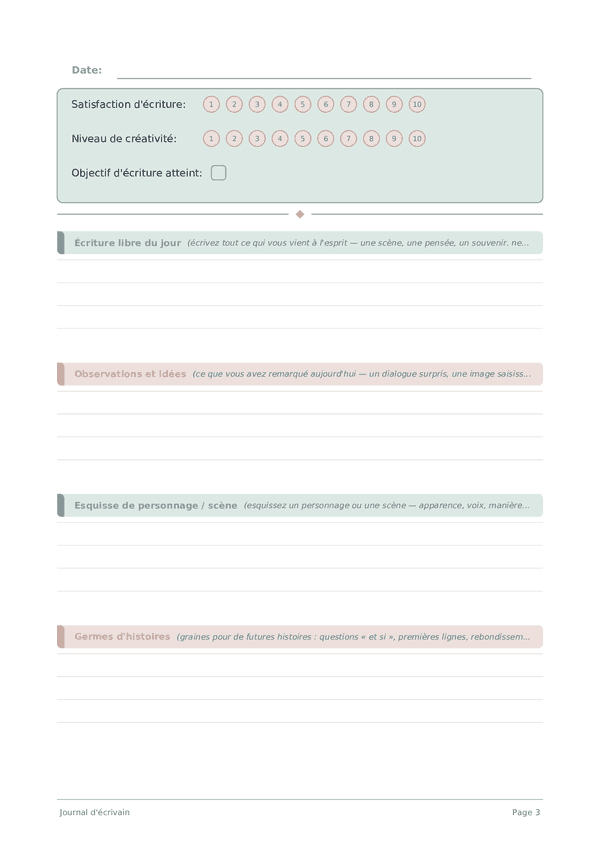
Journal d'écrivain
Pratique quotidienne d'écriture créative et développement du style
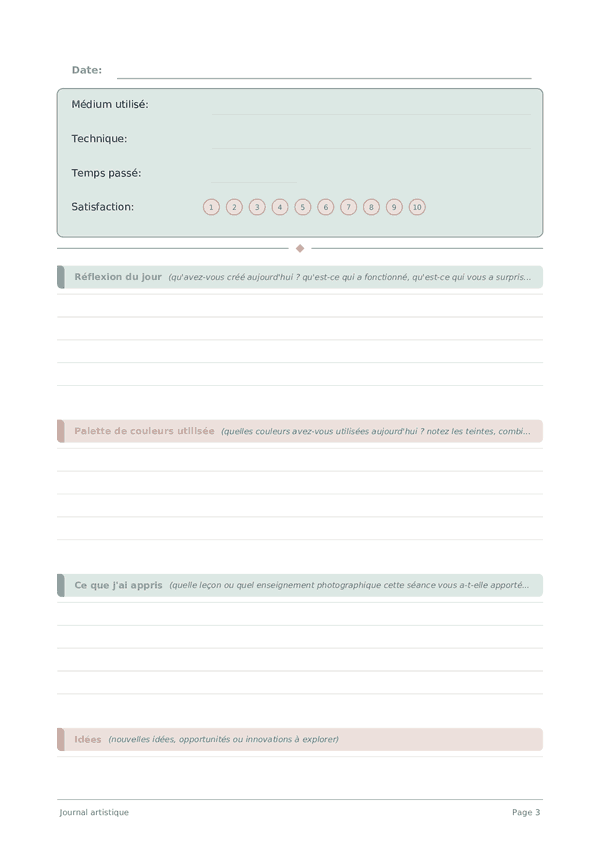
Journal artistique
Documentez votre processus créatif et votre évolution artistique
Journal de croquis
Pages à grille de points ouvertes pour le croquis, le dessin et l'exploration visuelle
Molette pour zoomer, glisser pour déplacer