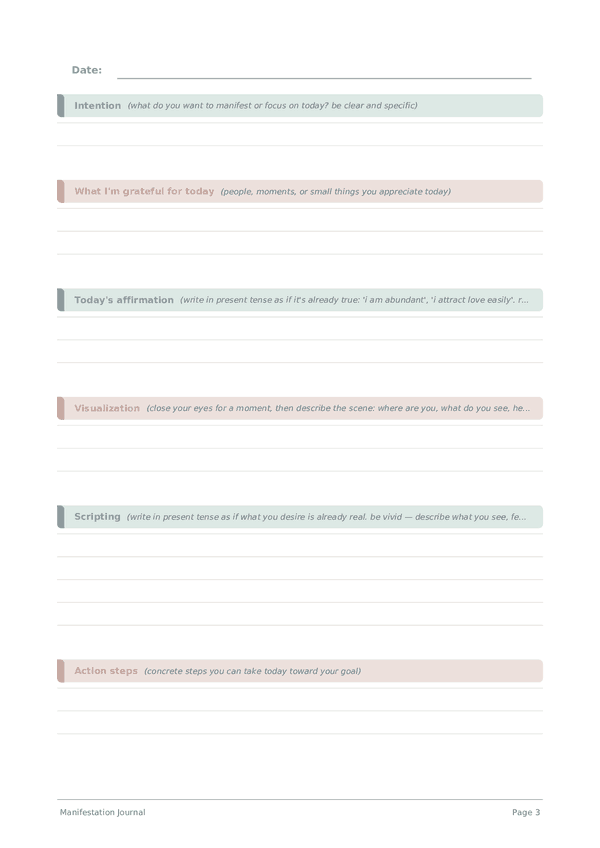
Printable Manifestation Journal
Align your thoughts, beliefs, and actions with your deepest desires
A powerful daily practice that combines intention setting, gratitude, affirmations, visualization, scripting, and action planning to help you consciously create the life you desire. Ground your dreams in feeling and then move them into reality — write as if your ideal life is already here.
Customize fields
Toggle fields on or off. Click the pencil to rename, or add your own fields.
Benefits
How to Use
What is this journal?
A manifestation journal is a daily intentional writing practice that combines gratitude, visualization, and aligned action to help you move toward your deepest goals. Each entry guides you through clarifying your intentions, feeling gratitude for what you have, and scripting the life you are creating.
This journal is for dreamers who want to become doers — anyone who believes that clarity of vision paired with consistent action can shape their reality. Whether you are manifesting career growth, better relationships, financial freedom, or personal transformation, this practice keeps your goals vivid and your actions aligned.
While manifestation draws from the law of attraction tradition, the practice is grounded in goal-setting psychology. Research from NYU shows that mental contrasting — vividly imagining a desired future while honestly acknowledging current obstacles — increases goal attainment by up to 20% compared to positive visualization alone.
Filled example
Here's what a typical entry looks like when filled in:
How to fill in each field
Each day you'll find several labeled sections with lines for writing. Here's what each section is for:
Intention
What do you want to manifest or focus on today? Be clear and specific
What I'm grateful for today
List 1–3 things you're grateful for today. They can be big or tiny — a good meal, a kind word, sunshine. Gratitude journaling is one of the most scientifically supported well-being practices.
Today's affirmation
Write a positive statement about yourself in the present tense, as if it's already true. For example: 'I am capable and resilient.' Repeating affirmations rewires your thinking patterns over time.
Visualization
Picture your success vividly — describe it as if it's real
Scripting
Write in present tense as if what you desire is already real. Be vivid — describe what you see, feel, and experience
Action steps
Break your goal into concrete next actions. What exactly will you do, when, and how? The more specific, the better.
What I'm letting go of
Write down something you're ready to release — a worry, resentment, or expectation. Naming what you're letting go of is the first step toward freedom from it.
Tips for success
When and how often to write
Write every morning to set your intention for the day, ideally within 15 minutes of waking. Spend 5 minutes writing your desires and visualizations, then 5 minutes on the action steps for today. In the evening, take 2-3 minutes to note any signs of progress or alignment you noticed. The morning-evening cycle creates a feedback loop that keeps your subconscious focused. Review weekly to notice which desires are gaining momentum and which need clearer definition.
Frequently Asked Questions
Is 'manifestation' the same as Law of Attraction?
This journal uses manifestation-adjacent techniques but the active mechanisms are mainstream psychology: implementation intentions (Gollwitzer, 1999, American Psychologist, 54(7)), goal visualization process work (Pham and Taylor, 1999, Personality and Social Psychology Bulletin, 25(2)), and self-affirmation (Cohen and Sherman, 2014, Annual Review of Psychology, 65). Law of Attraction as a metaphysical claim is not supported by research; the practical techniques have evidence.
What's the difference between 'visualization' and 'scripting'?
Visualization is sensory — picturing the situation. Scripting writes it as narrative. Pham and Taylor (1999, Personality and Social Psychology Bulletin, 25(2)) showed process visualization (steps taken) improved goal achievement, while outcome-only visualization sometimes reduced effort. Both fields in the journal work best when describing the doing, not just the having — what you say, how you act, who's there.
Why does the journal pair 'visualization' with 'action steps'?
Because visualization alone correlates with reduced effort. Oettingen's mental contrasting and WOOP research (Oettingen, 2014, 'Rethinking Positive Thinking', Penguin) found that pairing imagined outcomes with explicit obstacles and action plans produced better outcomes than visualization alone. Action steps grounds the practice in behavior, the only thing that actually moves a goal.
How do affirmations function in manifestation practice?
As cognitive priming and self-concept work. Cohen and Sherman (2014, Annual Review of Psychology, 65) and Steele's self-affirmation theory show value-affirmations reduce defensiveness and support goal pursuit. Wood et al. (2009, Psychological Science, 20(7)) warn against affirmations the writer doesn't believe. Three lines is space for credible affirmations tied to identity and values, not magical thinking.
What is 'what I'm letting go of' protecting against?
Attachment to outcome can reduce flexibility. Hayes' Acceptance and Commitment Therapy (Hayes, Strosahl, Wilson) frames psychological flexibility as committing to direction while releasing rigid attachment to specific outcomes. Two lines for naming what you're releasing — control, timing, specific form — supports the action-then-allow stance that produces better adjustment than white-knuckled grip.
Will writing what I want actually bring it?
Writing won't cause external events but shapes your behavior toward them. Locke and Latham (2002, American Psychologist, 57(9)) on goal setting and Gollwitzer (1999, American Psychologist, 54(7)) on implementation intentions established that articulating goals plus action plans increases goal-directed behavior. The journal works through your actions, not metaphysics — be honest about that mechanism.
How is this different from a goal journal?
A goal journal optimizes execution; the manifestation format adds emotion, identity, and meaning work via scripting, visualization, and affirmations. For someone whose blockers are motivational rather than tactical — feeling unworthy of the goal, disconnected from why it matters — this format engages those layers. Both journals can complement each other if used in parallel.
Is this evidence-based or pseudoscience?
Mixed. The component techniques — intention-setting, gratitude, structured visualization, affirmations grounded in values, action planning — have peer-reviewed support cited above. Claims that thoughts directly cause outcomes via universal forces are not supported by evidence. Use the journal for the validated mechanisms; treat metaphysical framing as cultural language, not prediction.
You Might Also Like
Scroll to zoom, drag to move