Printable Self-Discovery Journal
Daily self-discovery and personal growth journal
Explore your inner world through guided daily prompts. Uncover your values, strengths, and fears while developing deeper self-awareness and purpose.
Customize fields
Toggle fields on or off. Click the pencil to rename, or add your own fields.
Benefits
How to Use
What is this journal?
A self-discovery journal is a guided exploration of who you are beneath the surface — your values, strengths, fears, beliefs, and purpose. While most journals capture what happens to you, this journal is about uncovering what drives you, what limits you, and what you are truly capable of becoming.
Self-discovery journaling draws from positive psychology, existential therapy, and personal development traditions. Each day, you engage with prompts that challenge you to examine fundamental questions about your life — not in an abstract philosophical way, but through concrete, personal reflection tied to your daily experience.
This journal walks you through eight structured sections covering life purpose, core values, personal strengths, fears, limiting beliefs, daily learnings, reflections, and gratitude. Over weeks and months, your entries create a detailed self-portrait that evolves as you grow, helping you make decisions that align with who you truly are.
Filled example
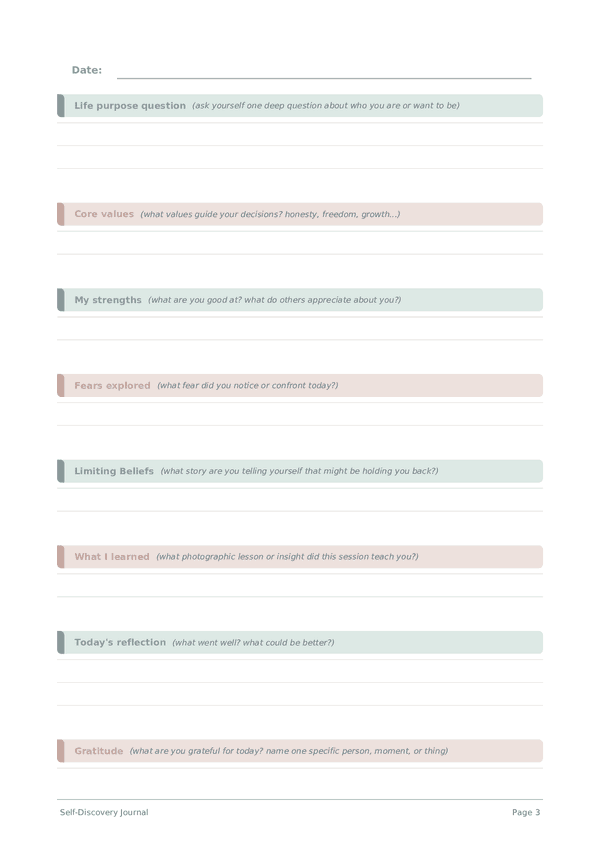
Here's what a typical entry looks like when filled in:
How to fill in each field
Each day you'll find several labeled sections with lines for writing. Here's what each section is for:
Life purpose question
Ask yourself one deep question about who you are or want to be
Core values
What values guide your decisions? Honesty, freedom, growth...
My strengths
What are you good at? What do others appreciate about you?
Fears explored
What fear did you notice or confront today?
Limiting Beliefs
What story are you telling yourself that might be holding you back?
What I learned
Write one new thing you learned today. It can be a fact, a skill, an insight about yourself, or a life lesson. Daily learning compounds into wisdom.
Today's reflection
Look back at your day honestly. What went well? What could be better? This isn't about judgment — it's about learning and growing.
Gratitude
What are you grateful for today? Name one specific person, moment, or thing
Tips for success
When and how often to write
Write once daily, either morning or evening. Morning is ideal for the 'life purpose question' and 'core values' sections (they set intention). Evening is better for 'what I learned' and 'reflection' (they capture experience). If you can only write once, evening gives more material. Once a month, re-read all entries to map your evolving self-understanding.
Frequently Asked Questions
What is 'life purpose question' supposed to surface?
It's a daily prompt to sit with a single existential question rather than answer everything at once. Frankl's logotherapy ('Man's Search for Meaning', 1946) and recent purpose research (Hill and Turiano, 2014, Psychological Science, 25(7)) treat purpose as built through repeated engagement with meaning. Three lines invite a partial, honest answer. Purpose is iterative, not a one-time discovery.
How do I identify 'core values' if I don't know them?
Work from concrete moments. Schwartz's basic human values theory (Schwartz, 1992, Advances in Experimental Social Psychology, 25) and ACT-based values work (Hayes, Strosahl, Wilson) recommend pulling values from times you felt most alive or most resentful. Two lines give space for one or two values plus the situation that revealed them, not abstract labels picked from a list.
What's the difference between 'fears explored' and avoidance?
Avoidance is silence; exploration is naming. Hayes' Acceptance and Commitment Therapy treats willingness to contact difficult content as central to psychological flexibility. The 'fears explored' section asks for the fear itself and what it's protecting. Two lines force compression. Write the fear and one underlying value at risk, not a long catastrophe story.
How do I work with 'limiting beliefs' usefully?
Use the cognitive restructuring framework from Beck ('Cognitive Therapy and the Emotional Disorders', 1976). Write the belief verbatim ('I'm not good enough'), then ask what evidence supports and contradicts it. Two lines force selection: pick one belief, one piece of disconfirming evidence. Repeating this daily across different beliefs weakens their grip more than long single sessions.
Is this journal therapeutic?
It's supportive, not clinical. Existential, values, and limiting-belief work overlap with ACT, schema therapy, and existential therapy, but a structured paper journal is not psychotherapy. If exploration surfaces material that distresses you persistently, particularly trauma memories or lasting shame, consult a licensed mental health professional. The journal works well alongside therapy as a between-session reflection space.
How is 'strengths' different from my positive qualities or accomplishments?
Strengths are character traits you bring across contexts. The VIA Classification (Peterson and Seligman, 2004, 'Character Strengths and Virtues', Oxford) catalogs 24 strengths supported by Niemiec's positive psychology research. Two lines are for naming one or two strengths you noticed in action today, not a list of past wins. Daily strengths-spotting builds identity-level confidence.
Will daily self-discovery questions burn out?
If treated as an exam, yes. Trapnel and Campbell (1999, JPSP, 76(2)) distinguished reflection, meaning open exploration, from rumination, the repetitive distressed loop. The journal's eight short sections (most just 2-3 lines) deliberately keep depth bounded. If a day's answer is brief or 'I'm not sure today', that's valid; depth across weeks beats depth in a single session.
What's the right frequency for this journal?
Daily completion is ambitious for eight sections; three to five times weekly is more sustainable for most people. Adherence research across journaling interventions (Smyth, 1998, Journal of Consulting and Clinical Psychology, 66(1)) shows benefits scale with engagement quality, not strict daily frequency. Set a pace you can hold across months. The existential work this targets unfolds slowly.
You Might Also Like
Scroll to zoom, drag to move