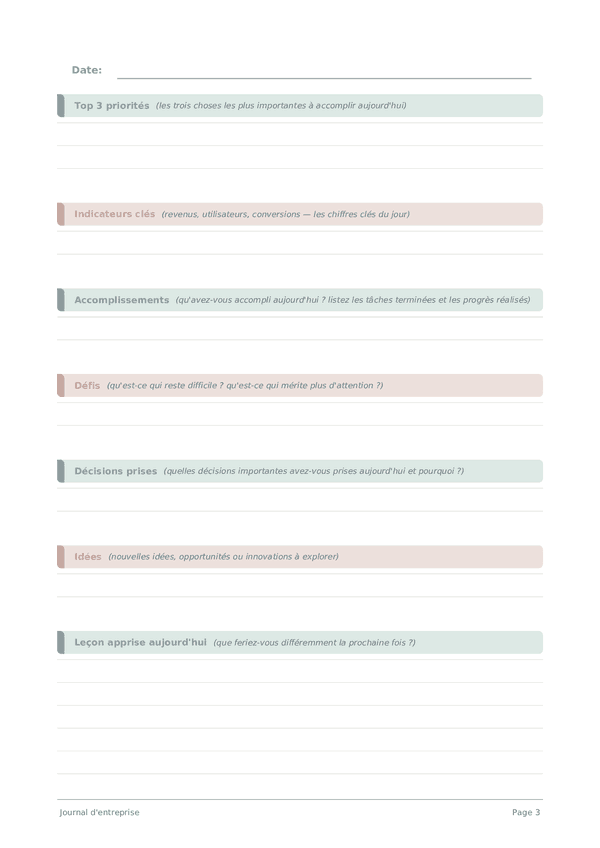
Printable Journal d'entreprise
Planification et suivi de progrès quotidien pour votre entreprise
Keep your business on track with daily goal-setting, metric tracking, and strategic reflection. Capture decisions, ideas, and lessons to accelerate growth.
Personnaliser les champs
Activez ou désactivez les champs. Cliquez sur le crayon pour renommer, ou ajoutez vos propres champs.
Qu'est-ce que ce journal ?
A Business Journal is a daily reflection framework for business owners and managers who want to run their operations with intention rather than reaction. Each entry captures your top priorities, key metrics, accomplishments, challenges, decisions made, new ideas, and lessons learned. It transforms scattered thoughts into a structured record that drives better decision-making day after day.
In the chaos of running a business, it is easy to lose sight of what actually moves the needle. A daily business journal forces you to pause, assess, and plan deliberately. Over time, the accumulated entries reveal patterns — which strategies consistently produce results, which challenges recur, and which decisions paid off or backfired.
Fill in your priorities and metrics each morning before diving into work. At the end of the day, spend ten minutes recording what you accomplished, the decisions you made, and the most important lesson you are taking forward. This evening review is where the real value lives: it turns experience into insight.
Exemple rempli
Voici à quoi ressemble une entrée typique une fois remplie :
Comment remplir chaque champ
Chaque jour, vous trouverez plusieurs sections étiquetées avec des lignes pour écrire. Voici à quoi sert chaque section :
Top 3 priorités
Les trois choses les plus importantes à accomplir aujourd'hui
Indicateurs clés
Revenus, utilisateurs, conversions — les chiffres clés du jour
Accomplissements
Qu'avez-vous accompli aujourd'hui ? Listez les tâches terminées et les progrès réalisés
Défis
Qu'est-ce qui reste difficile ? Qu'est-ce qui mérite plus d'attention ?
Décisions prises
Quelles décisions importantes avez-vous prises aujourd'hui et pourquoi ?
Idées
Capturez vos idées avant qu'elles ne disparaissent. Aucune idée n'est trop petite ou trop bête. Certaines des meilleures percées commencent comme des pensées brutes et à moitié formées.
Leçon apprise aujourd'hui
Retenez un enseignement de l'expérience d'aujourd'hui. Avec le temps, ces leçons deviennent une bibliothèque de sagesse personnelle.
Conseils pour réussir
Quand et à quelle fréquence écrire
Write every business day for 15 minutes, ideally at the end of the day when you can reflect on what actually happened. Cover your key metric, decisions made, customer insights, and one priority for tomorrow. Skip weekends unless a significant event occurs. Weekly, dedicate 30 minutes to reviewing the week: what moved the needle, what was wasted effort, and what patterns are emerging. Monthly, reread the full month and extract the three biggest lessons to carry forward.
Questions fréquentes
Comment choisir ce qu'écrire dans la section top 3 priorités ?
Trois lignes imposent une sélection impitoyable — uniquement ce qui fait avancer le chiffre d'affaires, le risque ou la stratégie. Covey, *Les 7 habitudes*, distingue l'important de l'urgent ; top 3 priorités est pour l'important. La HBR (Di Stefano et al., 2014) montre que la définition quotidienne explicite des priorités améliore les performances par rapport au travail réactif.
Quels chiffres appartiennent à la section indicateurs clés ?
Les deux ou trois chiffres qui prédisent réellement la santé de votre entreprise — chiffre d'affaires, position de trésorerie, taux de conversion clé ou pipeline. La U.S. SBA recommande aux propriétaires de suivre un petit ensemble d'indicateurs avancés quotidiennement plutôt que de chasser les tableaux de bord. Deux lignes forcent la sélection ; les mêmes métriques répétées chaque jour révèlent des tendances invisibles dans les rapports mensuels.
Pourquoi journaliser décisions prises séparément des accomplishments ?
Décisions et résultats sont des unités de travail différentes. Kahneman, *Thinking, Fast and Slow* (2011), montre que la qualité d'une décision s'évalue le mieux au regard des informations disponibles au moment, pas du résultat final. Enregistrer décisions prises par écrit le jour même crée le seul jeu de données honnête pour évaluer ultérieurement si votre processus décisionnel — et pas seulement la chance — s'améliore.
En quoi diffère-t-il d'une application CEO ou de productivité ?
Les logiciels optimisent la capture ; le papier optimise la réflexion. Thaler & Sunstein, *Nudge* (2008), décrivent la friction écrite comme un avantage comportemental. Les sept sections — priorités, métriques, accomplissements, défis, décisions, idées, leçon apprise aujourd'hui — imposent les mêmes questions de revue quotidiennement, tandis que les applications vous tentent de faire défiler plutôt que de penser. Beaucoup de fondateurs utilisent les deux.
Que capturer dans la section leçon apprise aujourd'hui ?
Une phrase qui nomme un insight spécifique cause-effet d'aujourd'hui, pas une platitude. La HBR (Di Stefano et al., 2014) démontre qu'articuler l'apprentissage, pas seulement l'expérimenter, génère des gains de performance. Deux lignes suffisent ; si vous ne pouvez nommer aucune leçon, écrivez « aucune aujourd'hui » plutôt que d'inventer — les blancs honnêtes révèlent eux aussi des patterns instructifs.
Comment utiliser la section ideas sans qu'elle devienne un dépotoir ?
Capturez, puis triez chaque semaine. La SBA recommande la capture d'idées associée à une revue régulière par rapport à la stratégie en cours. Deux lignes par jour donnent environ 10 idées par semaine ; le vendredi, marquez chacune : Poursuivre, Mettre en attente, ou Abandonner. Sans tri hebdomadaire, la section se dégrade en bruit — le carnet fonctionne comme un entonnoir, pas un coffre-fort.
Le journal d'entreprise quotidien est-il réellement corrélé à de meilleures performances ?
La réflexion structurée est empiriquement liée à des gains de performance. La HBR (Di Stefano et al., 2014) a constaté que 15 minutes de réflexion en fin de journée amélioraient les performances de plus de 20 % par rapport à la poursuite du travail. Les sept sections opérationnalisent cette réflexion de façon fiable plutôt que de dépendre de l'humeur ou de la mémoire.
Quel est le bon moment de la journée pour remplir le journal d'entreprise ?
La fin de journée pour les sections de revue, le matin pour top 3 priorités si vous préférez. La HBR soutient spécifiquement la réflexion en fin de journée. Clôturer la journée avec accomplishments, challenges, décisions prises, ideas et leçon apprise aujourd'hui consolide l'apprentissage pendant que les détails sont frais ; définir top 3 priorités peut se faire ce soir-là ou en premier le lendemain matin.
Vous aimerez aussi
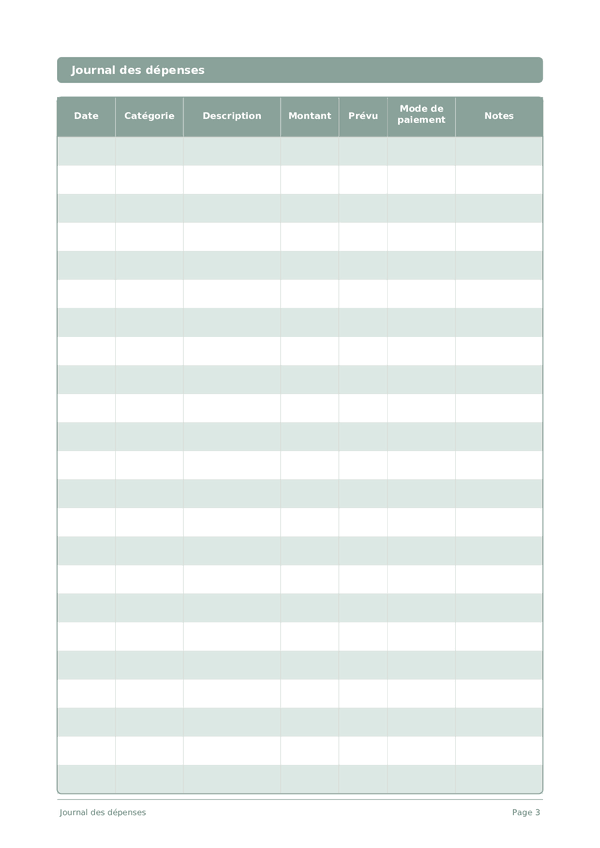
Journal des dépenses
Suivez chaque euro pour prendre le contrôle de vos finances
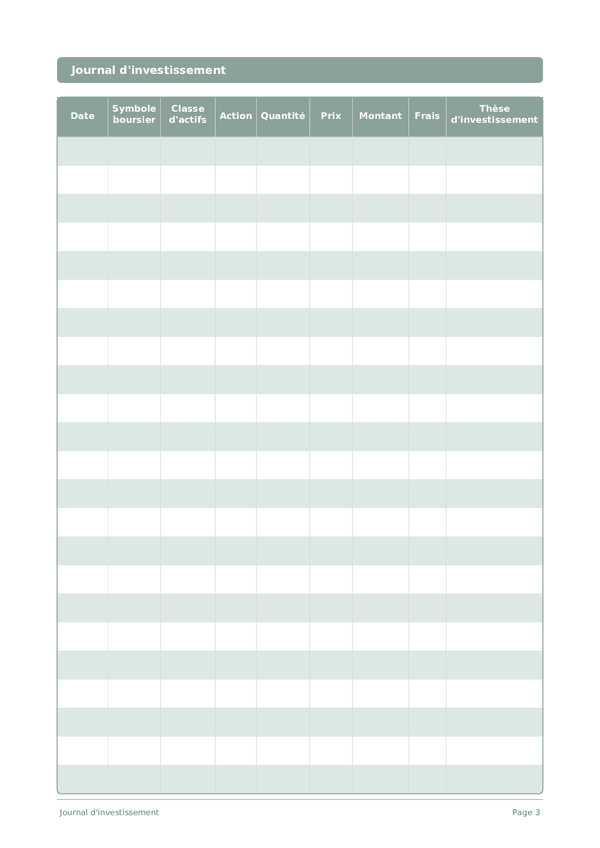
Journal d'investissement
Suivez vos transactions, analysez vos décisions et faites croître votre portefeuille
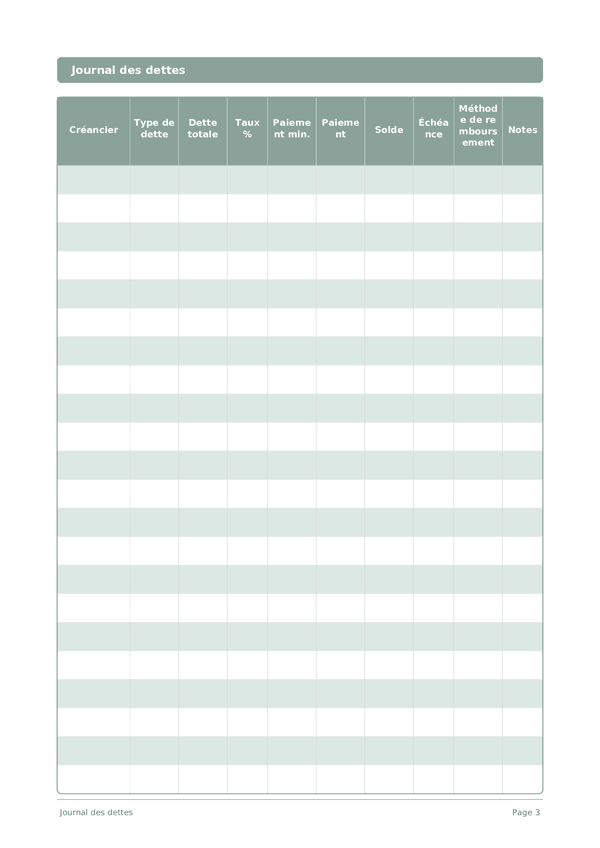
Journal des dettes
Suivez et éliminez vos dettes avec une stratégie de remboursement claire
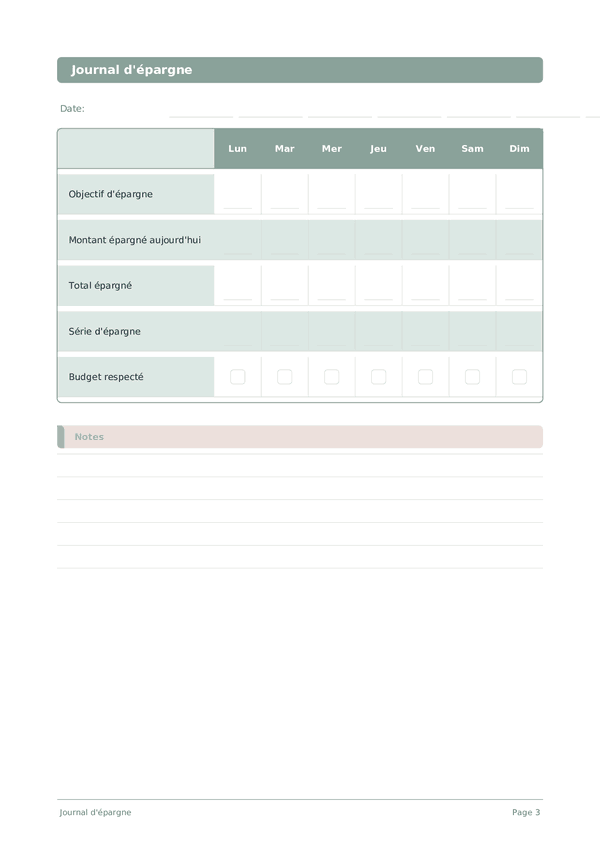
Journal d'épargne
Suivez vos habitudes d'épargne quotidiennes et progressez vers vos objectifs financiers
Molette pour zoomer, glisser pour déplacer