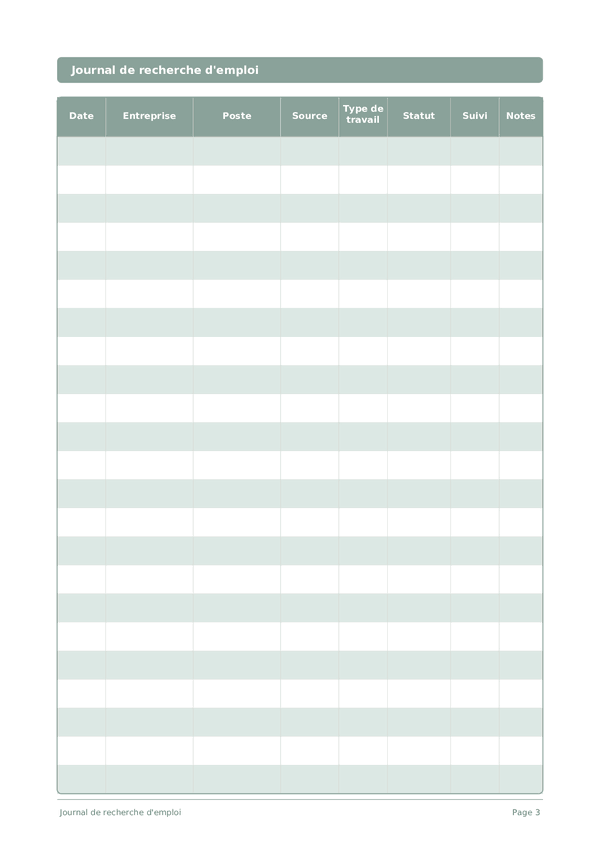
Printable Journal de recherche d'emploi
Suivez chaque candidature, entretien et relance dans un seul carnet organisé
Job searching is a numbers game — and staying organized is the competitive advantage most candidates overlook. This structured table-log journal gives you a clear view of every application at a glance: where you applied, the role, source, current status, and when to follow up. Stop juggling browser tabs and sticky notes. One row per application, complete visibility over your entire search.
Personnaliser les champs
Activez ou désactivez les champs. Cliquez sur le crayon pour renommer, ou ajoutez vos propres champs.
Avantages
Comment utiliser
Qu'est-ce que ce journal ?
A Job Search Journal is a structured log that keeps every application, contact, and follow-up organized in one place. Each row captures the date, company name, position, source, work type, application status, follow-up date, and notes. Instead of relying on memory or scattered spreadsheets, you get a single, scannable record of your entire job hunt.
Job searching is essentially a project management challenge. The most successful candidates treat it that way — tracking dozens of applications, remembering which recruiter said what, and following up at the right time. This journal gives you that system in a clean, printable format that you can review at a glance every morning.
Fill in a new row each time you apply or make a meaningful contact. Update the status column as you progress through stages — Applied, Phone Screen, Interview, Offer, Rejected. Use the notes column for details you will want to recall later, such as the interviewer's name or a specific question they asked. Review your log weekly to identify which strategies are generating the most callbacks.
Exemple rempli
Voici à quoi ressemble une entrée typique une fois remplie :
| Date | Entreprise | Poste | Source | Type de travail | Statut | Suivi | Notes |
|---|---|---|---|---|---|---|---|
| 2025-01-06 | Acme Corp | Product Manager | Remote | Interview | 2025-01-13 | 2nd round with VP of Product on Jan 10 | |
| 2025-01-07 | BrightPath Inc | Senior PM | Referral | Hybrid | Applied | 2025-01-14 | Referred by Sarah K., sent portfolio link |
| 2025-01-07 | NovaLabs | Product Lead | Company site | On-site | Phone Screen | 2025-01-10 | HR call scheduled for Jan 9 at 2 PM |
| 2025-01-08 | Greenfield Tech | Associate PM | Indeed | Remote | Applied | 2025-01-15 | Tailored resume to SaaS focus |
| 2025-01-08 | Summit Digital | Product Manager | Recruiter | Hybrid | Rejected | Position filled internally |
Comment remplir chaque champ
Chaque page est un tableau avec des colonnes. Remplissez une ligne par entrée. Voici à quoi sert chaque colonne :
Date
Inscrivez la date du jour. Cela ancre votre entrée dans le temps et aide lors de la relecture ultérieure.
Entreprise
Nom de l'entreprise ou de l'organisation
Poste
Intitulé du poste pour lequel vous avez postulé
Source
Livre, cours, vidéo, article, personne...
Type de travail
Télétravail, hybride, sur site, temps partiel, contrat...
Statut
Candidature envoyée, Entretien téléphonique, Entretien, Offre, Refus, Désistement...
Suivi
Quand envoyer un courriel de relance
Notes
Ajoutez tout contexte ou réflexion supplémentaire. Cette colonne fourre-tout est pour tout ce qui ne rentre pas ailleurs mais pourrait être utile plus tard.
Conseils pour réussir
Quand et à quelle fréquence écrire
Update your job search log daily during active searches — add new applications, update statuses, and check follow-up dates. Even on days you do not apply, spend 5 minutes reviewing your pipeline and moving stale applications to no response. Weekly, calculate your application-to-interview ratio to see if your resume and targeting strategy are working. If you are sending 20+ applications with zero callbacks, it is time to revise your approach rather than increase volume.
Questions fréquentes
Quelles valeurs utiliser dans la colonne status ?
Standardise un vocabulaire court — Candidaté, Entretien téléphonique, Entretien, Offre, Refusé, Retiré, Sans réponse. Cette cohérence te permet de trier et compter les résultats par source dans le temps. Avec 15 lignes par page, parcourir la colonne status montre la forme de ton pipeline d'un coup d'œil.
Comment utiliser la colonne source pour améliorer ta recherche d'emploi ?
Note exactement l'origine de chaque candidature — recommandation, LinkedIn, site entreprise, recruteur, jobboard. Après 20-30 candidatures, compte les entretiens par source. Les recommandations produisent systématiquement de meilleurs taux de recrutement que les candidatures à froid. Les données dans ta colonne source te disent où investir ta prochaine heure de recherche.
Quand fixer le suivi après avoir candidaté ?
Cinq à sept jours ouvrés après l'envoi est un délai raisonnable en l'absence d'autre signal. Une relance polie unique est appropriée si tu n'as pas eu de retour. Fixe suivi au moment où tu enregistres la candidature pour que ce ne soit jamais « un jour » ; la colonne de date rend la revue hebdomadaire actionnable.
En quoi ce carnet diffère-t-il d'une feuille de calcul ou d'un suivi en ligne ?
Le papier impose un engagement d'une façon qu'un onglet qu'on peut fermer n'offre pas. Thaler & Sunstein, *Nudge* (2008), décrivent la friction physique comme un avantage comportemental. Les huit colonnes imposent aussi les mêmes champs à chaque fois — date, entreprise, poste, source, type de travail, statut, suivi, notes — pour que la revue hebdomadaire compare des éléments comparables.
Que noter dans la colonne notes ?
Noms des intervieweurs, salaire évoqué, délais de l'exercice pratique, et tout signal spécifique — positif ou signal d'alarme. Enregistre les détails d'entretien immédiatement après chaque conversation. La colonne notes étroite impose la concision ; si tu as besoin de plus, marque une étoile et continue au verso de la page.
Combien de candidatures par semaine est-ce réaliste ?
La qualité bat le volume pour la plupart des postes. Un rythme courant est de 5 à 10 candidatures bien ciblées par semaine avec des lettres de motivation substantielles. La page de 15 lignes couvre environ deux semaines à ce rythme — assez court pour être relu sans perdre l'élan.
Quand retirer une candidature du suivi actif ?
Après quatre semaines sans réponse, traite la candidature comme clôturée sauf si un suivi t'indique le contraire. La plupart des recruteurs répondent dans les trois à quatre semaines. Note le statut « Sans réponse » et déplace ton attention vers les conversations actives plutôt que de chasser le silence — ton temps est la ressource limitante.
Pourquoi la colonne type de travail est-elle importante pour l'analyse ?
Les candidatures télétravail, hybride et présentiel se convertissent à des taux différents et sont rémunérées différemment. Consigner type de travail te permet de comparer les taux d'entretien selon les modes et d'éviter de gaspiller des efforts dans des marchés inadaptés — par exemple postuler à des postes en présentiel quand tu as besoin de télétravail.
Vous aimerez aussi
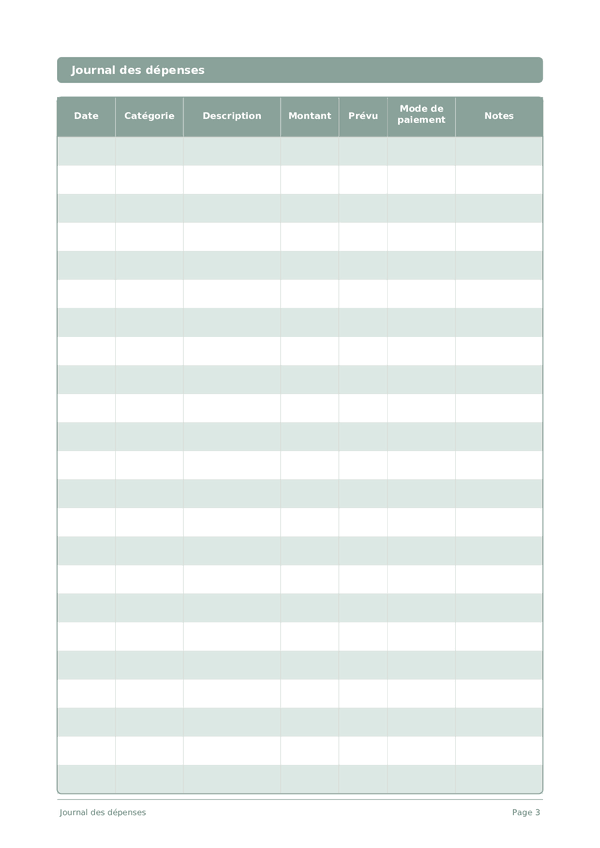
Journal des dépenses
Suivez chaque euro pour prendre le contrôle de vos finances
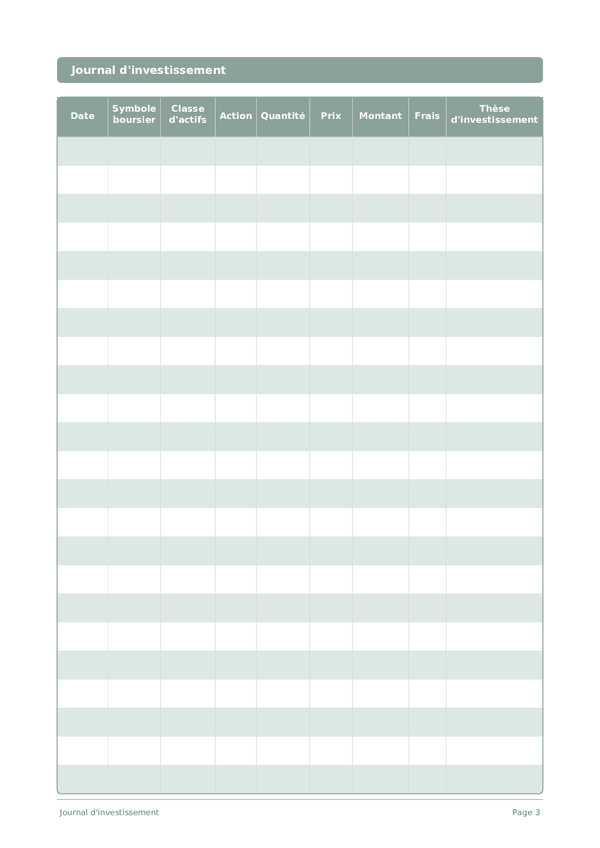
Journal d'investissement
Suivez vos transactions, analysez vos décisions et faites croître votre portefeuille
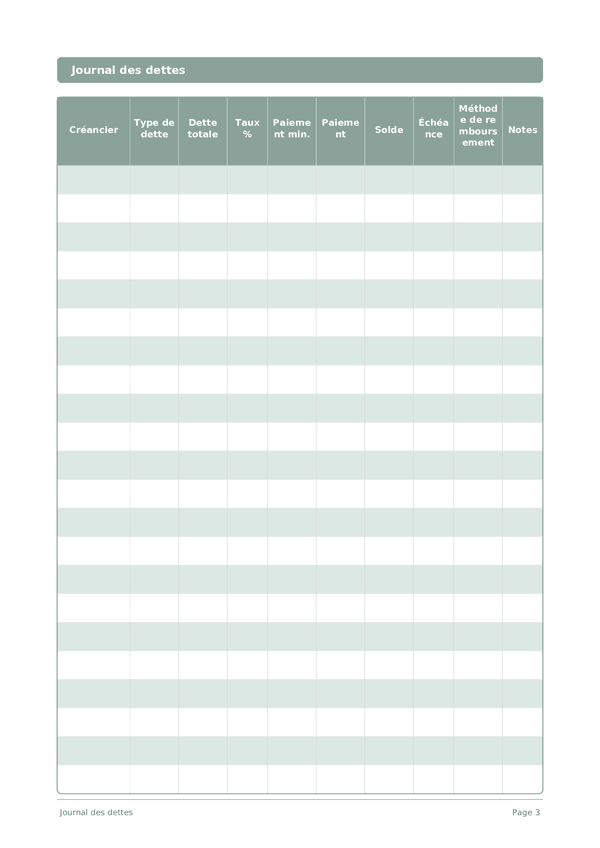
Journal des dettes
Suivez et éliminez vos dettes avec une stratégie de remboursement claire
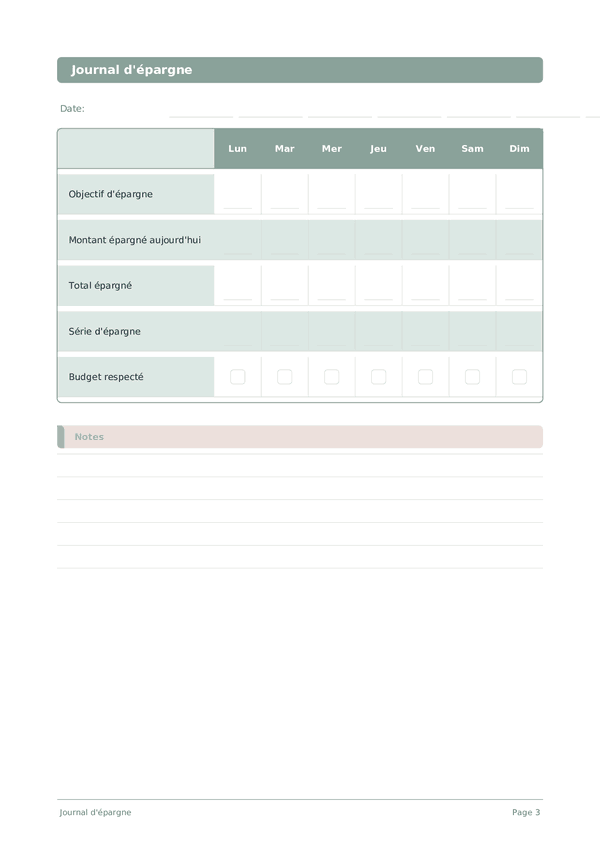
Journal d'épargne
Suivez vos habitudes d'épargne quotidiennes et progressez vers vos objectifs financiers
Molette pour zoomer, glisser pour déplacer